Digilah

Categories
AI Res

The Human Brain VS Artificial Intelligence

Written by Sharnaya Panag on Digilah (Student Tech Research)

I am Sharnaya Panag, a graduate of O. P. Jindal Global University with a Journalism and Communication degree. I am fascinated by the hold machine and IoT has on our species, knowing that what has become of us, cannot be undone. My greatest interest is understanding and writing about our Psyche and the future we will create for ourselves.

Can mankind’s unquenchable thirst to make life easier lead to our own downfall?

It was around 5 million years ago that for the first time, the planet witnessed the breakthrough of sentient life. Nature created a species so astute, one that would never act on behalf of the will of the planet, but the will of itself.

Since Man’s inception, there has been one thing that has remained constant throughout our history. If the past has shown us one thing it is that humanity will go to great lengths to create a life of increasing comfort.

We have a very deep connection with our past, as our ancestors left behind a trail of evidence to help us decode our history. The more we read, the more it helps us to communicate with the past. 

One can take a look through manifold scriptures, some pieces of literature or even just a page out of a diary, and for a moment the reader gets to delve into the mind of somebody who lived ages before they did.

This highlights the significance of reportage, why is it so important for us to report? Not just for the present, to spread awareness, but also to leave proper documentation for the future to analyse, just as we have been doing with documents of the past, trying to connect the dots of history.

Over the course of our time, man has remained invested in breaking through to new technological advances to make everyday life easier. 

Machine was created to cut down on physical labour and for the first time, the world saw the mass production of goods in rapid time.

Fast forward to 2023, and we are now sitting in a world entirely supported by machine. The time of self-sufficiency is over. In our society, our lives wholly revolve around them for the sake of our comfort. 

Phones, laptops, cars, aeroplanes, trains, ATMs, air conditioners, and heaters, are just a few appliances we use on a daily basis, without which the lives of many would crumble.

However, the invention that completely altered the course of our evolution would be the invention of the internet. 30 years ago, on the 30th of April, 1993, the World Wide Web was made accessible to the public.

It crept its way to every nook and cranny it could and now trillion gigabytes of data are in the hands of each and every human being that can afford to access it. The overall pace picked up by humanity seemed to be quicker than ever before.

This, of course, was also not enough. Mankind is always willing to test its limits. Hence came the next chapter, the creation of an artificial body, an entity in itself. The creation of machine to decrease physical labour felt inadequate. 

Man wanted life to be effortless, we consider ourselves so superior, that we refuse to even think for ourselves, therefore the creation of Artificial Intelligence. The most popular example of this would be Chat GPT, launched on the 30th of November, 2022, an AI created to help people structure their thoughts and opinions into words not written by themselves.

Artificial Intelligence is a body that has been created to think for us. To research data, store it, assimilate it, paraphrase it, and structure it in detail in the form required by the user. Chat GPT uses web scraping as a tool using automated methods to scan websites, retrieve data and synthesize it to provide the user with a well-grounded assimilation of it. 

It also has a plug-in feature which allows it to interconnect with third-party websites. Chat GPT uses the Bing API which permits two or more computer programs to communicate and uses it to navigate through the web to gather data. It can cite every source so that the user has access to every website it went through.

Students are now using Chat GPT to write their assignments, and even people working in multinational corporations use it to assimilate data and statistics. The need has become so severe that people are now using it to write mail since formatting an e-mail has become such a task.

We are dealing with an entity beyond our understanding. A trillion gigabytes of data, endless information at the fingertips of this AI. The majesty of the human brain is undeniable, but can the brain possibly compete with an AI whose brain we can potentially attribute to the entire internet?

There is nothing stopping companies from permanently resorting to using AI to achieve profitability. The wheel is already set in motion, just in the month of July of 2022, the founder and CEO of e-commerce firm Dukaan, Suumit Shah took to X(formerly called Twitter) to announce that 90% of the customer crew of his company has been replaced by an AI chatbot.

He added that the response time has dropped from a whopping two hours to just three minutes and the cost related to customer care was brought down by 85%.

Being sentient beings, our species has evolved beyond belief. We have the privilege to read or write anything we desire in detail, and we can preserve our beliefs for future generations. The world today is obsessed with taking the easy way out because of how fast-paced society has become.

In the past writers, and documentarians from all over the globe went to great lengths to collect, assimilate, and structure data. People spent years trying to extract the information necessary, going through extensive bodies of work, scriptures, research papers, articles, books, speeches, and various other documents. 

They did this all to keep the populace aware of world events, to provide them with entertainment or even just writing for fun.

At the centre of it all remains effort, and creativity. However, now there is an entity that can produce material in a matter of seconds, in turn reducing the effort we put in to educate ourselves, leading to the inevitable culmination of creativity.

Without creativity, our credibility to commit to the task will be put to the test. Our skills may fall short in the face of Artificial Intelligence. Looking at journalism and writing as an example, will man be able to make the effort and hold on to creativity?


The problem is that if our mind isn’t put to work, and is given constant chances to escape effort, it will lead to the impotency of the human brain. If the students of today use interfaces as a loophole to avoid the task at hand, the pattern will spread and over the course of time, it is bound to become a habit. 

In the near future, resorting to Artificial Intelligence will become the norm, just as relying on machinery, technology, and the internet became the social norm.

The facts are displayed in front of us very clearly. Humanity must be able to spot the pattern otherwise all we can do is sit back and watch our own downfall. Companies will always vouch for their profitability and benefit. It will be difficult to hold on to reality as we know it. 

There will be no jobs left for man if we accept and allow AI to become a part of our lives and the social norm. The progress of Artificial intelligence must be put to a stop or at least slowed for the preservation of the future of upcoming generations.

Resources

https://botpress.com/blog/does-chatgpt-save-data#:~:text=So%2C%20where%20does%20ChatGPT%20get,stores%20it%20in%20its%20database.

https://cointelegraph.com/news/chatgpt-can-now-access-the-internet-with-new-openai-plugins#:~:text=Join%20us%20on%20social%20networks,introduced%20by%20its%20creator,%20OpenAI

https://www.ncbi.nlm.nih.gov/books/NBK231624/#:~:text=In%20evolutionary%20terms%2C%20if%20objective,off%20from%20the%20lesser%20apes.

https://www.ndtv.com/india-news/dukaan-ceo-replaces-90-of-customer-support-staff-with-ai-chatbot-internet-angry-4197641#pfrom-instagram

https://cointelegraph.com/news/chatgpt-can-now-access-the-internet-with-new-openai-plugins#:~:text=Join%20us%20on%20social%20networks,introduced%20by%20its%20creator,%20OpenAI.

Images

https://feeds.abplive.com/onecms/images/uploaded-images/2023/05/18/48a0f3031002ea28e4913062116ef0381684423930331324_original.jpg?impolicy=abp_cdn&imwidth=650

https://cepr.org/sites/default/files/styles/16_9_small/public/voxeu-cover-image/Hartmann_Maschinenhalle_1868_%252801%2529.jpg?itok=dxF3XNKc

https://images.inc.com/uploaded_files/image/1920×1080/getty_910319072_387225.jpg

https://miro.medium.com/v2/resize:fit:1168/0*bb87estJQdKJTiqf.jpeg

Most asked questions

When was the World Wide Web made accessible to the public?

How AI chatbots are profiting companies and businesses?

How AI will lead to the decline of human aptitude?

Most searched queries

Bing API

ChatGPT

Artificial Intelligence

Gigabytes

Hello readers! Hope you liked what you read today. Click the like button at the bottom of this page and share insights with your colleagues and friends!


For more such amazing articles and research on technology follow Digilah industry leaders and students researchers .


Categories
HR Tech

How technology affects the work environment today?

Written by Shweta Rautela on Digilah (Tech Thought Leadership)

In the prevailing scenario, Technology has perpetually converted the way people across industries do their work.

From the past two decades digital evolution has improved working conditions immensely. It has augmented productivity and made working from anywhere accessible.

I am going to shed light to some of the upsides and downsides I have witnessed with the emerging technology trends.

⏩ Team Collaboration made easier:

Thanks to the virtual communication tools, it allows us to work more closely even as we work remotely. Team collaborations have been simplified. People don’t have to be present physically at the same place.

Video conferencing, meeting remotely and working on the same stuff at once with cloud based file sharing has made our life easier.

Automated follow-ups and customer service using AI messaging has outperformed the heavy lifting.

⏩ No longer need to stay at the Workplace:

Major impact of digital evolution in the workplace is the workplace itself. Majority of workplaces still ask you to work on-site, there are plenty of positions open to work remotely all over the country.

Advancements in global job hunts have given wings to our fulfillments and outlived the restrictions to our capabilities. We can freelance from anywhere. Organizations can hire potential candidates half a world away.

⏩ Efficiency and Incessant Speed:

Technology is the real boost. Employees have become systematically structured than ever before. What used to be a cumbersome tiring process is now done in seconds. Messages can be sent instantly to colleagues and clients across the world. Payments, billings and proposals can be taken care off immediately.

🚫 Some of the downsides include anxiety due to increased working hours. If you work from home it may feel like you are never out of the office. Flashing, pinging constantly draw Employees back to their jobs.

The learning curve to implement new methodologies separating employees by screens leads to miscommunication. Being glued to systems disrupts people and automated voicemails sometimes can make clients upset.

In a nutshell, technology in the office environment has encouraged productive habits. Organizations with advanced approaches may consider the gains in efficiency from technology as a reason to slow down as opposed to rushing the process. 

I hope employees one day will get notified to take a break instead of handling more work related demands.


Most searched question

What role does technology play in today’s workforce?

What are the 10 advantages of technology?

What are the effects of technology on employees?

Most searched queries  

Impact of technology on organizations

Beneficial and ill effects of technology in work

Negative impact of technology in the workplace


Hello readers! Hope you liked what you read today. Click the like button at the bottom of this page and share insights with your colleagues and friends!

For more such amazing content follow Digilah

Categories
AI Tech Web 3.0 Tech

Web3.0:The Real decentralized Internet 

Written by Femi Omoshona on Digilah (Tech Thought Leadership)

Decentralized technology is the present and the early we start investing our time, energy and resources trying to understand what future DApp looks like the better for us. 

Blockchain, AI, AR and IOT are amazing technologies we should be wrapping our brain around in this 21st century.

In this article, I lay out how the web has evolved, where it’s going next, and how Africa as a continent can position itself for the future.

Think about how the internet affects your life on a daily basis since it was discovered in early 1990. Internet, a system architecture that has revolutionized communications and methods of commerce by allowing various computer networks around the world to interconnect. Sometimes referred to as a network of networks, the Internet emerged in the United States in the 1970s but did not become visible to the general public until the early 1990s.

By 2020, approximately 4.5 billion people, or more than half of the world’s population, were estimated to have access to the Internet.

The Evolution of the Web

The evolution of the web can be classified into three separate stages: Web 1.0, Web 2.0, and Web 3.0.

Web 1.0  are static web sites and personal sites, the term used for the earliest version of the Internet as it emerged from its origins with Defense Advanced Research Projects Agency (DARPA) and became, for the first time, a global network representing the future of digital communications. Web 1.0  offered little information and was accessible to users across the world; these pages had little or no functionality, flexibility, or user-generated content.

Web 2.0 is called the “read/write” web, which seems to indicate an updated version of the current World Wide Web, which is known as Web 1.0. It’s more accurate to think of Web 2.0 as a shift in thinking and focus on web design. Instead of static HTML pages with little or no interaction between users, Web 2.0 represents a shift to interactive functionality and compatibility through some of the following features: User-generated content, Transparency in data and integrations.

Web 3.0 (…Loading)

Web 3.0 is the next stage of the web evolution that would make the internet more intelligent or process information with near-human-like intelligence through the power of AI systems that could run smart programs to assist users.

Tim Berners-Lee had said that the Semantic Web is meant to “automatically” interface with systems, people and home devices. As such, content creation and decision-making processes will involve both humans and machines. This would enable the intelligent creation and distribution of highly-tailored content straight to every internet consumer.

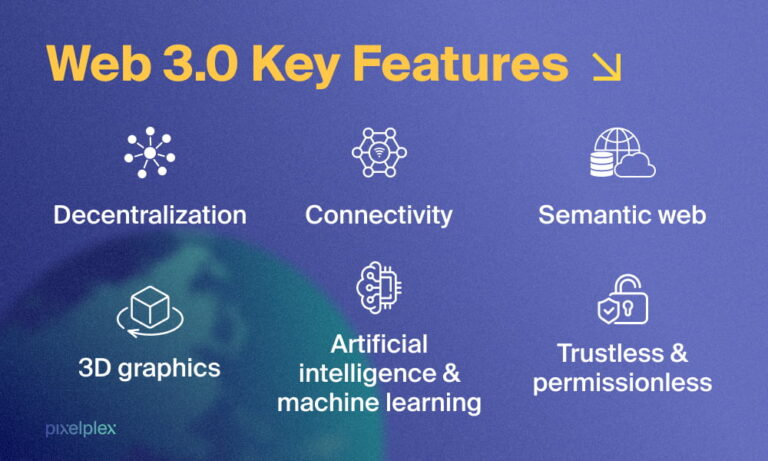
Key Features of Web 3.0

To really understand the next stage of the internet, we need to take a look at the four key features of Web 3.0:

Semantic Web

Semantic(s) is the study of the relationship between words. Therefore, the Semantic Web, according to Berners-Lee, enables computers to analyze loads of data from the Web, which includes content, transactions and links between persons.

Artificial Intelligence

Web 3.0 machines can read and decipher the meaning and emotions conveyed by a set of data, it brings forth intelligent machines. Although Web 2.0 presents similar capabilities, it is still predominantly human-based, which opens up room for corrupt behaviors such as biased product reviews, rigged ratings, etc.

For instance, online review platforms like Trustpilot provide a way for consumers to review any product or service. Unfortunately, a company can simply gather a large group of people and pay them to create positive reviews for its undeserving products. Therefore, the internet needs AI to learn how to distinguish the genuine from the fake in order to provide reliable data.

Web3.0 future for Africa

Across the world, the new Web3 economy is giving birth to myriad opportunities and the implications for the African continent are massive. Code 247 Foundation is on a mission to raised the next generation of Africa talent who will leverage the latest blockchain technologies to provide real value to billions of unbanked, underbanked and underserved individuals across Africa and other emerging markets, and we’re excited to see various blockchain protocols, startups, investors, grant funders and governments interested in doing the same.

Web3 can open up an intra-African exchange economy, it can be used for purchases and transportation between African nations. It will assist Africans to generate more economic value in a wider market.

In Africa, the evolution of blockchain technology has interested many governments across the Africa countries  to explore blockchain-based solutions, creating Central Bank Digital Currencies (CBDCs) that are likely to develop a more informed approach to the Web3 economy along with policy frameworks in line with the needs of everyday users.

Web 3 can be used to solve some of the challenges in Africa, issues of land ownership:

It is no secret the messy land management in most African countries has made it harder for citizens to acquire genuine land. This has meant that most communities are left poor due to lack of access to manage and develop their lands. Other challenges include faulk drugs, financial transactions and management of traffic etc.

Conclusion

We believe in Africa 100%. Africa can be great, will be great and must be great. Blockchain and Web3 technologies will be revolutionary in Africa. There are a lot of problems with currency and corruption in Africa.

Most searched question

What Is Web 3.0 the evolution of the internet?

When did Web 3.0 start?

Why Web 3.0 is the future?

Most searched  queries

Web 3.0 blockchain

Web 3.0 technologies

Web 3.0 metaverse


📣 Hello readers: Do you like what you read today? Click the 💟 “Like” button at the bottom of this page and share insights with your colleagues and friends and do follow Digilah for more amazing articles.