Digilah

Categories
Mar Tech AI Tech

Transforming Marketing using Generative AI

Written by Shivani Koul on Digilah (Tech Thought Leadership).

As marketers, we fundamentally learn about the 4 Ps of Marketing: Product, Price, Place, and Promotion. Later, three more Ps were added: People, Process, and Physical evidence. Whatever we do revolves around the customer.

AI will disrupt all the Ps in many ways going forward, and many times there is an argument: will that take jobs? My assumption is that it will take non-productive jobs and give space to marketers to work on something newer, something smarter.

This is the role of technology! To assist humans in making the best possible product, but never forgetting that “human touch”. Marketing is all about creativity, empathy, and understanding human behavior. Successful marketing needs originality and a creative spark only humans can possess.

Having said that, a 2020 Deloitte global survey of early AI adopters showed that three of the top five AI objectives were marketing-oriented: enhancing existing products and services, creating new products and services, and enhancing relationships with customers.

The main job of any marketer is understanding the need of the customer, matching it with the offerings like product and services, and persuading the customer to buy the product and service. 

This looks simply, a 3-step process, but there are a lot of critical steps & information involved in-between where marketers must analyze a lot of data and tweak the marketing strategy accordingly.

Let’s discuss it here with some real-time examples and see how marketers are using AI to support them.

1. Content Marketing –

Currently, AI can help in customizing the marketing content like product information, email writing, blogs, marketing messages, and copywriting. All this can be done using open AI tools available and should work on simple prompts.

With machine learning, this data can be used further for creating sales pitch, cross-selling pitch, customer engagement, last-minute deal or offer by considering different variables like demographics of the target consumer, behavior, demographic, along with deep analysis of the impact of communication. Example AI tools.

2. Data Analytics –

Slicing and dicing of data was done earlier as well, but AI has taken it to the next level where one can get predictive analysis and prompts/suggestions to enhance the content/marketing campaign. 

Customer data like preferences, engagement, status as in which ladder of purchase funnel the customer and CRM, and that gives space to marketers for redefining the market strategy. Example CRM tools.

3. Search Engine Optimization –

This has been a game-changer with real-time examples like Google, Netflix, and other search engines. This will help segmentation of customers and suggest target advertising. This has also helped marketers to leverage cross-functional platforms.

So, if you search for some product on Amazon and open any social media like Instagram or Facebook, you will see recommendations of the same or similar products on that platform as well. By doing this, marketers can enhance the recall value of products or services.

4. Placement of advertisement –

This has been very important: where to post an advertisement for the best ROI. AI has made it easy to target or place advertisements based on consumer data like purchase history, preference, and context of purchase. 

Example Google/YouTube advertisement.

5. E-commerce and Digital Marketing –

AI has been widely used by e-commerce websites and digital marketing to reach out to the right customers, understand their needs and buying patterns, and automate marketing workflows and course correction of marketing efforts which otherwise would have taken a lot of resources. Example any AI-enabled fitness app.

AI can be a game-changer in many ways, but Human decision-making is typically reserved for the most consequential questions, such as whether to continue a campaign or to approve expensive TV ads.

Training your algorithm enough that it should give expected results, training algorithms with correct prompts, and above all, safety and security of data.

Data privacy is going to be of utmost importance for AI. Clear and transparent policies need to be drafted against data security and privacy.

I believe AI is like a child which needs to be trained to become a responsible assistant; hence humans have a greater role as to how they are raising this child to serve mankind. 

As marketers continue to embrace AI technologies, they must strike a balance between innovation and ethical considerations, leveraging AI’s capabilities to enhance customer experiences while upholding trust and transparency.

References:

https://hbr.org/2021/07/how-to-design-an-ai-marketing-strategy

Most asked questions

What are the 4 P’s of marketing?

4 P’s of Marketing: Product, Price, Place, and Promotion. Later, three more P’s were added: People, Process, and Physical evidence. 

What is the key to successful marketing?

Successful marketing needs originality and a creative spark.

How is machine learning serving the marketing industry?

With machine learning, data is used for creating sales pitches, cross-selling pitches, customer engagements, last-minute deals, or offers along with deep analysis of the impact of communication.

Most searched queries

Machine learning

CRM (Customer Relationship Management)

SEO (Search Engine Optimization)

ROI (Return on Investment)

Hello readers! Hope you liked what you read today. Click the like button at the bottom of this page and share insights with your colleagues and friends!

For more such amazing thought leadership articles on technology follow Digilah people.

Categories
Digi Tech

How Email Marketing Can Empower Your Business

Written by Sheenah Lozada  on Digilah (Tech Thought Leadership)

Let’s go back to memory lane. Imagine the day when there was no email. Most of the marketers rely heavy on traditional mail for advertising. These are in the forms of flyers, catalogues, promotional letters sent via snail mail and delivered by your favorite postman.

When I was growing up and now, my mom an avid fan of Readers Digest, and we always looked forward in the mail on a monthly basis for it to arrive. She has cooking book subscriptions as well that we are eager to receive and try out some of the recipes. 

The agony of waiting……… 

Thankfully today, it is very convenient in just few clicks you can subscribe to your favorite brands, cookbook, etc.  No more waiting… 

Email has tremendously transformed how many businesses can reach through their customers immediately and establish a rapport where they have the option to choose the content they want to receive.

Let’s dive in to know the History for Email Marketing 

1971 Ray Tomlinson sent the first email message which either said “Test 123” or the top row keys, “QWERTYUIOP”

1972 Larry Roberts created an email management database that let users list, select, forward and respond to email messages.

1978Gary Thuerk, a marketing manager at Digital Equipment Corporation, sent the first email blast to 400 Arpanet advertising machines. This generated $13 million in sales.

1982 Electronic mail message becomes the “EMAIL”.

1988Spam was introduced.  Inspired by those who are angry receiving email blast the word spam is added to the Oxford English dictionally. 

1989Lotus Notes 1.0, was launched as the first widely use email software service.

1991 – The internet was born. Everyone was using it. 

Late 1990s – Email service was introduced. Microsoft released Internet Mail (now Outlook) and Hotmail launched in 1998. The same time HTML was introduced to add characters to emails using custom fonts, colors, graphics and formatting.

2003 CAN-SPAM was introduced in the U.S, it was signed by President George W. Bush. This prompts businesses to reduce sending unsolicited emails and include sender details and unsubscribe link in every message.

2009 – The introduction of Responsive Emails which enables readers to use their desktop, smartphones, or tablet to access and read emails.

TodayEmail marketing is an integral part of the any digital marketing strategies that marketers are using to nurture their customer communication in the most cost effective way.

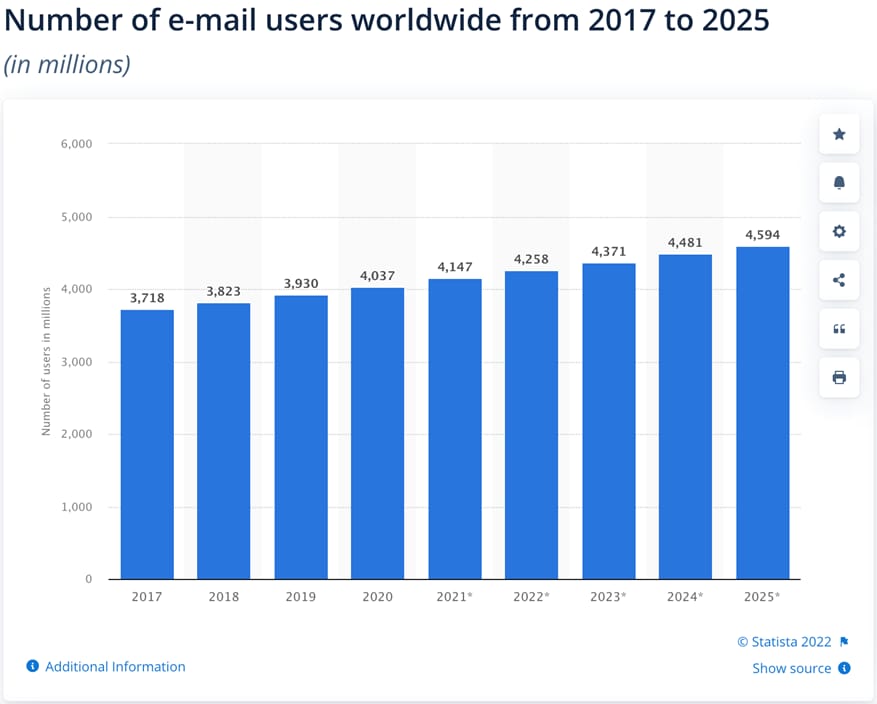
Source: https://www.statista.com/statistics/255080/number-of-e-mail-users-worldwide/

Despite the growth and prominence of mobile messengers and chat apps, email global users amounted to 4 billion and is set to grow to 4.6 billion users in 2025.

The global emails received and sent worldwide was approximately 306 billion in 2020. It is projected to increase to over 376 billion emails on 2025. This data shows that the trend towards mobile also is true for email.

As we know that the consumers interaction is multi-event and multichannel

These are some of the marketing strategies that you can invest with.

  • Inbound marketing
  • Content marketing
  • Email marketing
  • Search Engine Optimization(SEO)
  • Social Media
  • Paid Advertising
  • Mobile Marketing

One thing for sure is that email for marketing isn’t going anywhere. It will continue to be a staple part of any marketing strategy for all types of businesses.

COMMON SEARCHES:

Email marketing tools

Email marketing meaning 

Email marketing example 

Email marketing service

Email marketing examples 

Types of email marketing

Email marketing ideas

Email marketing benefits

WHAT PEOPLE GENERALLY ASK

What is email marketing and example?

How do businesses marketing?

What is an email marketing strategy?

What is email marketing and its benefits?

Categories
Mar Tech

WALLED GARDENS AND AD-FRAUD

Written by Aditya Satheesh for Digilah (Tech Thought Leadership)

Low data prices has increased Internet users in India (mobile first Internet market) while propelling the growth/reach of social media giants as well as video content watch time over the last 5 years; but digital media still isn’t the preferred vehicle of marketing for most clients and only accounts for 25-30% of the industry spends, although it is growing YOY.

The adoption of digital media has been hindered by the fragmented digital ecosystem, doubts over ad fraud and effectiveness of the medium, questions over viewability of ads, traditional mindset of brand managers and their lack of understanding of the digital ecosystem. Even until recently, I have been asked to run campaigns targeting the brands HQ or been provided with custom audience lists of senior executives in the company, to be targeted with the brand campaign so as to satisfy and address the question a lot of brand managers ask – I am not able to see my ad; as they compare it to traditional media where ads are shown in an appointment-viewing manner.

The ever-changing pandemic situation has definitely forced a digital pivot, with print and outdoor media taking a hit. Brand managers are forced to consider digital due to its targeting capabilities ensuring low spillage and cost efficiencies. And like learning the ABCs of the alphabets, all brands jump on the bandwagon of Facebook and Google with over 80% budget going to these 2 platforms. The platform scale/reach, along with cost efficiencies as well as brand credibility is definitely unbeatable in the space and hence becomes a no brainer for brands. But as the adoption of the duopoly increases, the strength and power of the walled gardens grow and so do their prices.

As marketers spend more on these platforms, they understand less about their customers as walled garden campaigns and interactions can’t be tied back to the brand’s CRM database. Brands receive a consolidated view of how their campaigns performed rather than an individualized view. There’s no way to verify impression/reach data or understand affinity target selections that work, you simply have to take it on faith. Yet marketers continue to spend more and get less.

A more equitable value exchange needs to be more about standardizing taxonomy and identifiers across all of these platforms to see and understand the customer journey. Today, even having unified unique reach in a digital campaign is next to impossible due to the fragmented ecosystem as well as walled gardens.

With the increased spends on digital, reports indicate that ad fraud rates gone up by 40% in these COVID times. Today ad verification in India is in its nascent stages and only around 10-15% invest on third party verification tools.  The path for safer and more secure digital advertising effectiveness lies in third party ad verification, which ensures that brands are investing in quality media. Third party verification would ensure 4 things mainly

  • Brand Safety/Brand suitability – identify inflammatory/negative content and protect brand image/reputation
  • Ad Fraud – identifying Invalid Traffic to help evaluate efficacy of platform and calculate brands return on media investment
  • Viewability – helps measure effectiveness of ad delivery
  • In Geo – ensure ads served within intended demographics

Advertisers need to understand these underlying challenges as the adoption of digital increases at a rapid pace. Investing in third party verification tools will not only improve trust and transparency in the ecosystem, while also holding publishers accountable and thus help decreasing fraudulent traffic and increasing overall return on investment.