“Our future success is directly proportional to our ability to understand, adopt and integrate new technology into our work”- Sukant Ratnakar
Workplace technology is growing exponentially. From the industrial age to current day, technology has changed manifolds. Not only has it helped in increasing productivity, it has also made “Work from anywhere” super easy and a reality.
Due to modern interpersonal communication technology, employees communicate more clearly and that’s leading to better results.
The onset of the global pandemic reshuffled the world of work. Businesses digitized themselves and shifted to working remotely overnight, all thanks to technology. With flexible workforces and mass adoption of remote and hybrid work models, many untapped talents are now shining bright. With talent not being restricted by geographical boundaries, both employers and employees are participating in the “Gig Economy.” Moving on an exponential growth trajectory, the gig economy workforce is projected to increase 3X from 7.7 million in 2021 to 23.5 million in 2030.
With every pros, comes the cons and the same is true for technology.
From separating employees by screens creating miscommunications, to the world of automated voicemails that can make customers upset, many believe that “Old is Gold.”
At the same time, with greater flexibility due to Work from Home or freelancing in the gig economy, people are often working overtime, over the weekend and even while sick. This has disbalanced the “Work life balance” and has mentally affected many people. From burnout, insomnia to depression, all have risen with more stress.
According to Technology and Innovation Report 2021, every spurt of progress has been associated with sharper inequality between countries. New technologies can have severe downsides if they outpace a society’s ability to adapt. To benefit from frontier technologies, countries need to promote their use, adoption, and adaptation, while addressing their potential adverse effects.
Moreover, International cooperation should:
Build stronger national capacities in STI,
Smooth technology transfer,
Increase women’s participation,
Improve foresight and technological assessment and promote inclusivity.
Moreover, Policymakers should direct technological change towards meeting societal needs and reducing inequalities; developing countries should adopt frontier technologies while continuing to diversify their production bases by mastering existing technologies; social protection systems should be strengthened to provide safety nets to workers who may lose their livelihoods.
Everything is a boon and a brain, it depends on us how to take it. To make technology a boon, effective communication, connectivity, being flexible but not insensible is the key! We must master the art of balancing our work and our life, otherwise we might not enjoy the super delicacy that the technology provides!
Most searched question
What role does technology play in today’s workforce?
What are the 10 advantages of technology?
What are the effects of technology on employees?
Most searched queries
Impact of technology on organizations
Beneficial and ill effects of technology in work
Negative impact of technology in the workplace
Hello readers! Hope you liked what you read today. Click the like button at the bottom of this page and share insights with your colleagues and friends!
Co-create learning that has strategic impact, scalable reach and sustainable deployment
Ongoing waves of next generation technology…
As a learning strategist, I have been an early adopter throughout several waves of “next generation technology”. In various forms, technology has always been and continues to be a very powerful enabler of learning. This happens only when it is used as an integrated part of a learning strategy targeted to achieve pre-defined and measurable positive impact on performance (of the people and organisation).
Recurring patterns
I found the patterns and the simple rules within this complex world of people, performance and purpose, while working and learning globally with a diverse range of organisations from corporates, NGOs, governments, educational institutions to start-ups.
As technology evolves, some things remain the same… The range of ways, in which humans react to any new technology, remain the same. How we learn, how our brains work and the psychology of learning, remains the same.
The paradox…
What has truly expanded is that we have more and more diverse, innovative, and impactful ways of how organisations could be enabling learning. In addition, the pace, complexity and volume of what needs to be learned and unlearned has increased.
Yet many organisations are still on the old island taking lecture-based classroom “training” &/or existing course content, which was not impactful in the first place and turning it into AI powered digital courses, virtual classrooms &/or even virtual reality experiences.
Formally support formal and informal learning
Let’s go back to the basics. As a lifelong observer of people, I believe we have a natural capacity to learn, an innate wisdom as well as a need for connection and shared purpose.
Therefore learning works (i.e. has an impact on capabilities, behaviours and results) when we formally support both formal and informal learning. Learning works when we respect our fellow human beings. Learning works when we innovate with integrity leveraging the best in human psychology and the latest in technology. As we digitise, we need to humanise.
Enabling the 3 ways we learn naturally
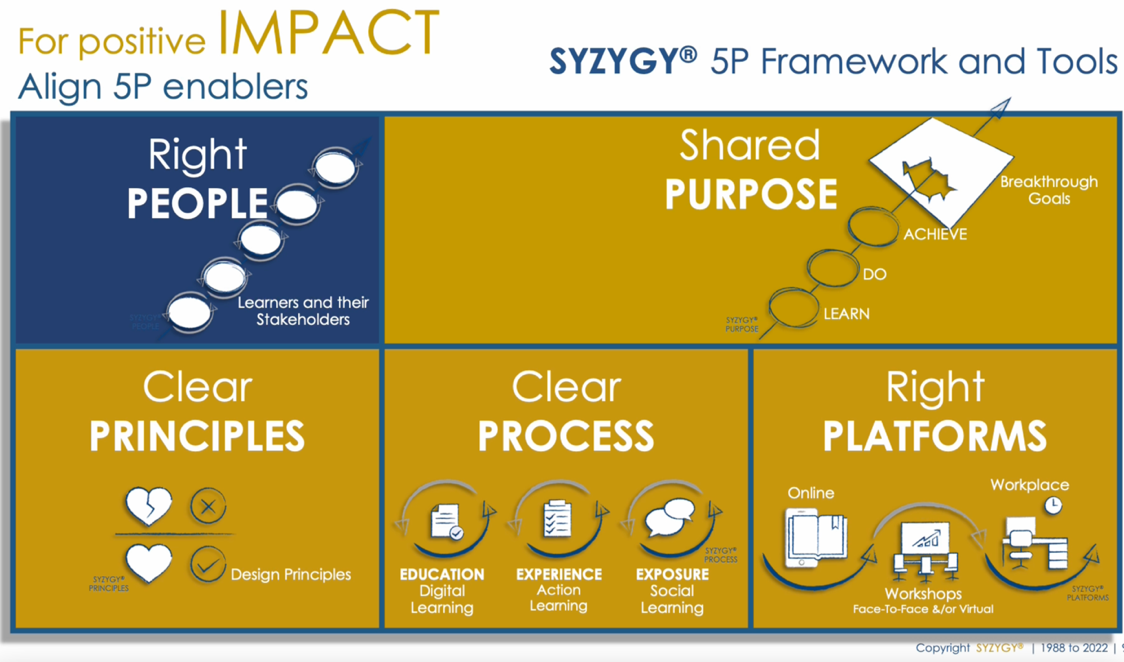
There are 3 ways we learn naturally. In addition to this being based on research, take a moment to reflect on your own natural habits every day. These include leveraging a combination of:
Digital Learning = Education via content available 24×7
Action Learning = Experiences to apply the learning while working
Social Learning = Exposure to learn from/with others
Organisations can therefore formally support learning as a daily habit by enabling a clear PROCESS which combines the 3 ways we learn.
Life is our classroom
Furthermore, every minute of the day we are presented with learning opportunities. The millions of dollars invested in low-impact, high-cost learning solutions is a crime and defies basic common sense.
It costs very little for any organisation to enable ongoing learning as a daily habit. It costs very little for the teams doing the real work, for example, to use their iphone cameras &/or basic PowerPoint to capture and share their tacit knowledge (Digital Learning).
You do NOT need to do contrived role plays and irrelevant activities in a classroom when it costs very little to consciously apply what has been learned in the workplace (Action Learning).
In conjunction with the above, it costs and takes very little to reflect on and discuss with each other, experts, practitioners, coaches &/or mentors what has been achieved and what can be improved (Social Learning).
Observing and learning with high performing teams and organisations, I found 5Ps are always in place and aligned. When we get the right PEOPLE together and support them to co-create a shared PURPOSE. Thereafter, we put in place clear PROCESSES and the right PLATFORMS (online and offline) using clear guiding PRINCIPLES. This creates a safe space that enables people to learn, adapt and improve as a daily habit.
We found this applies irrespective of whether you are working with and upskilling underprivileged youth in the rural areas, private bankers in the big cities, operators in a factory, leaders in a board room or the frontliners of a popular restaurant brand.
Technology amplifies, aggregates, increases accessibility and more…
What we are highlighting is that high performing organisations and teams create safe spaces to learn, adapt and improve every day. They fail fast and learn faster. Many call these agile teams and draw from the practices part of the agile approach, innovation and human centred design. I draw on these and practices from development and cognitive psychology.
Whatever our source, how we learn and evolve as a human race from prehistoric times to today and in future, there is nothing that is completely new. (Wall art and papyrus scrolls was the ancient form of technology (= makes things easier) and their form of digital learning available 24×7).
What continues to evolve is that technology takes what we do, accelerates and amplifies our efforts in ways that are even more scalable and sustainable. For example, a great speaker can create and instantly broadcast a relevant and meaningful message company-wide to thousands of people in a few minutes using a live video.
Technology allows us to aggregate, integrate and increase accessibility by bringing all the learning resources via an integrated or single front-end platform – from content, people to experiences.
Technology allows us to use AI such as sourcing very widely and then in seconds recommending relevant learning resources based on the Learner’s profile, needs and interests.
Technology is allowing us to distribute, consume, exchange and track learning and its impact on results using web2 such as learning experience platforms and now web3 technology such as the blockchain, NFTs and virtual reality spaces.
Yet as we leverage technology as an enabler of learning, the entire strategy must be designed for impact. We must not lead with technology. The technology as an enabler comes last in the design process. We can also reverse engineer and then iterate the original design as we learn more about new ways technology can be used.
We must design the end-to-end experience focusing on the human elements, human experience and impact.
Digital learning using learning technology as a standalone, without the human element in the real-life context, will not impact performance. It will not impact a change in our behaviours and results.
In addition to this – why learning technology is deployed and what capabilities it develops must consider human or soft skills. Soft skills have never been more important. Human intelligence combined with artificial intelligence is still the best combination. For this and many other reasons, developing our empathy, resilience, problem solving and communication skill sets and mindset, as examples, remain as critical future skills as the hard technical skills of any role. If we innovate with integrity leveraging the best in human psychology and the latest in technology – as we digitise in business, society and learning, we will remain human-centred.
Most searched queries
What is digitalization
Digitization vs digitalization
Benefits of digitalization
Most searched question
What is digital humanization?
What does it mean to humanize technology?
What is digitalization in healthcare?
Hello readers! Hope you liked what you read today. Click the like button at the bottom of this page and share insights with your colleagues and friends!
In the prevailing scenario, Technology has perpetually converted the way people across industries do their work.
From the past two decades digital evolution has improved working conditions immensely. It has augmented productivity and made working from anywhere accessible.
I am going to shed light to some of the upsides and downsides I have witnessed with the emerging technology trends.
Team Collaboration made easier:
Thanks to the virtual communication tools, it allows us to work more closely even as we work remotely. Team collaborations have been simplified. People don’t have to be present physically at the same place.
Video conferencing, meeting remotely and working on the same stuff at once with cloud based file sharing has made our life easier.
Automated follow-ups and customer service using AI messaging has outperformed the heavy lifting.
No longer need to stay at the Workplace:
Major impact of digital evolution in the workplace is the workplace itself. Majority of workplaces still ask you to work on-site, there are plenty of positions open to work remotely all over the country.
Advancements in global job hunts have given wings to our fulfillments and outlived the restrictions to our capabilities. We can freelance from anywhere. Organizations can hire potential candidates half a world away.
Efficiency and Incessant Speed:
Technology is the real boost. Employees have become systematically structured than ever before. What used to be a cumbersome tiring process is now done in seconds. Messages can be sent instantly to colleagues and clients across the world. Payments, billings and proposals can be taken care off immediately.
Some of the downsides include anxiety due to increased working hours. If you work from home it may feel like you are never out of the office. Flashing, pinging constantly draw Employees back to their jobs.
The learning curve to implement new methodologies separating employees by screens leads to miscommunication. Being glued to systems disrupts people and automated voicemails sometimes can make clients upset.
In a nutshell, technology in the office environment has encouraged productive habits. Organizations with advanced approaches may consider the gains in efficiency from technology as a reason to slow down as opposed to rushing the process.
I hope employees one day will get notified to take a break instead of handling more work related demands.
Most searched question
What role does technology play in today’s workforce?
What are the 10 advantages of technology?
What are the effects of technology on employees?
Most searched queries
Impact of technology on organizations
Beneficial and ill effects of technology in work
Negative impact of technology in the workplace
Hello readers! Hope you liked what you read today. Click the like button at the bottom of this page and share insights with your colleagues and friends!
As we venture into an era where the old ways of industries and new ways of technology converge rapidly to disrupt what we are used to, leaders are often thrust into situations where their people want both.
Digital transformation, sustainability, and climate change overwhelm leaders who have to deal with disruptions to businesses from new entrants; demand for corporate responsibility, in addition to their usual functions with shortening boom and bust business cycles. The average lifespan of a company has decreased from 67 years in the 1920s to just 15 years today. Blockbuster, a popular movie rental business in the United States of America (USA) lasted only 25 years from 1985 to 2010.
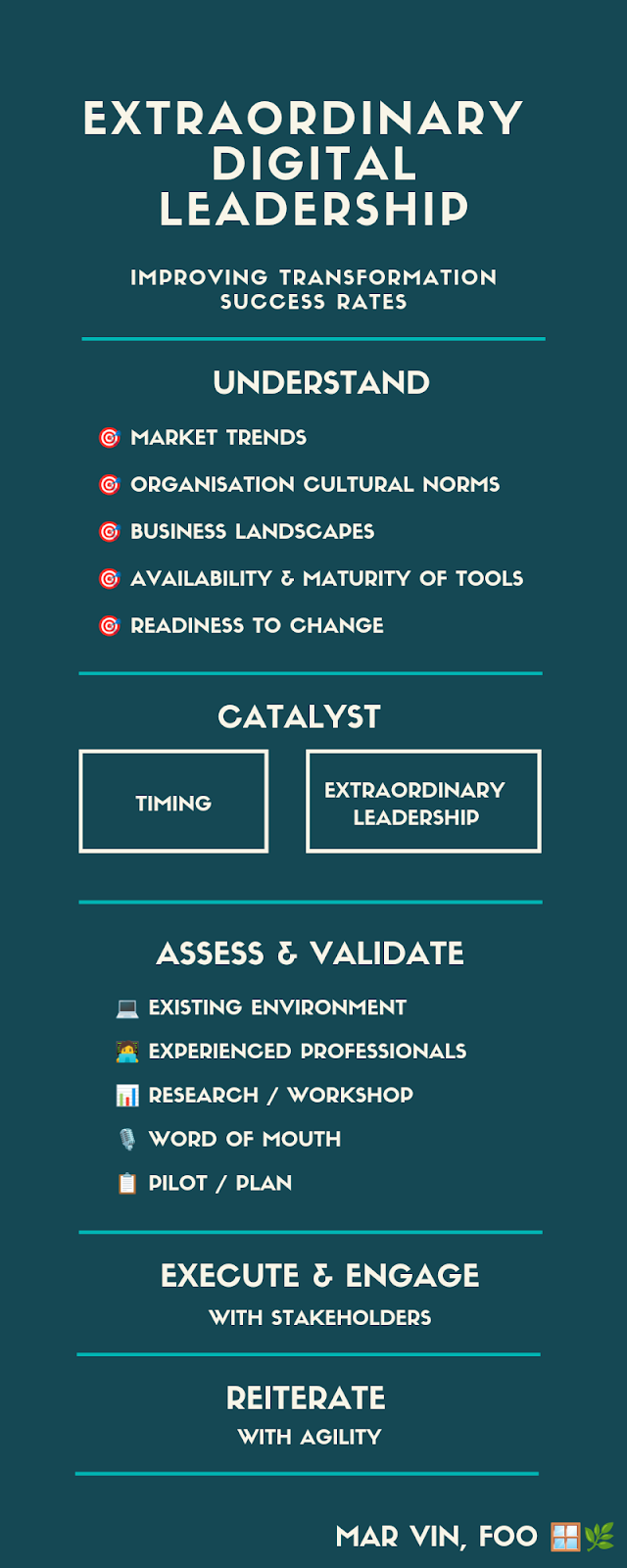
The ability to adapt is so crucial and leaders are overwhelmed to undertake the digital transformation of various departments beyond corporate Information Technology (IT) and into their business operations to survive. In this article, I’m going to share the factors contributing to transformational success, extraordinary leadership that takes immense courage to defy organisation cultural norms and business landscapes, and new technology tools that can bridge the automation, sustainability and security divide from reducing carbon footprint; escalating costs; to manpower and digital talent crunch. For the leaders who are championing workload modernisation for their sprawling legacy footprint, fret not because this will be covered towards the end of the article.
Factors for transformational success
Success isn’t always a mutually exclusive situation but rather a mutually inclusive decision that requires a knack for understanding the market trends, the organisation or society’s cultural conditions, the availability and maturity of the tools, and the readiness to change.
In Singapore, Parking.sg is a successful mobile application eliminating car parking coupons that need to be printed, perforated, inventoried, distributed, utilised and inspected. Not many are aware that there was a similar attempt to eliminate parking coupons using mobile phones when short messaging systems, SMS, were all the rage in the early 2000s before the advent of smartphones a decade later.
The maturity of mobile phones in its smartness was limited in the early 2000s with costly SMSes. A coupon-less SMS mobile solution would have been ahead of its time with limited success because the ease of use was lacking in comparison to the graphical user interfaces in today’s mobile phones.
Timing plays an important role because the effectiveness of a solution depends on it.
Today’s leaders are challenged especially in an era where it takes courage to break away from the norm, and when previous attempts at technological innovations or transformations did not succeed, making it tough to start a new attempt.
Our comforts of today come from extraordinary leadership
Steven was a former Economic Development Board (EDB) scholar who brought multiplex cinemas within a single location concept or cineplex into Singapore. It wasn’t a bed of roses to begin with because people were used to the single large seating cinemas that screens one show at a time before the 1990s.
The incumbent cinema operators in Singapore have an illustrious heritage in movie production and dominated the local scene with their traditional single-screen cinemas. They are backed by conglomerates and were keenly watching on what was deemed a risky move by a government agency to revolutionise the cinema scene in Singapore. Compared to the movie tycoons, Steven was a newbie in the business they had been in for decades.
Steven was determined to bring the successful cineplex experience from Australia to elevate local residents’ enjoyment as well as inviting innovative companies into Singapore for the benefit of the economy, which is the charter of EDB.
Conditions were challenging because he had to navigate the different agencies to secure a site to build Singapore’s first cineplex. During the 1980s and early 1990s of Singapore, prime land was reserved for private bidders and Orchard Road was the only shopping and entertainment destination. Being prudent, the relevant government agencies were only able to provide a location that was far from ideal, out in the suburbs where spending power of the residents were limited.
The odds were stacked against Steven and the cineplex company which he intended to bring into Singapore. However, they were silently confident in replicating the successful model into Singapore because of the intricate details from seat arrangement, acoustic, and the peripheral offerings from movie memorabilia and collectibles like membership cards, lighting, carpeting, plush corridors and luxurious walkways that delivered exceptional and thematic entertainment experiences.
Fast-forward till today, cineplexes are a norm and the local scene was rejuvenated with both the new and incumbent operators building cineplexes into shopping malls across the country with neighbouring countries following suit. It’s a transformational success and we have extraordinary leadership to thank for.
Maturity of technological tools and strategies for transformation
Disparate islands of systems spanning across decades and sprawling across organisational landscape, coupled with traditional computing workloads that once revolutionised manual paper processes are fast becoming stumbling blocks in the next digital transformation journey of many organisations.
Chief Information Officers (CIOs) and their teams are now overwhelmed with not just corporate IT functions but are increasingly required to offer recommendations into cybersecurity, business operations, operational technology, facilities management and Internet-of-Things (IoT).
This is made even more challenging with global inflationary concerns and the Great Resignation which reduced the pool of talents amidst the increased demand for digital talents required to transform the businesses.
The flurry of new technological start–ups make it difficult to choose the best-of-breed solution. The increasing difficulty to integrate or migrate from traditional computing workloads to newer operating models like cloud or as-a-service are present with increased risks too.
Automation and sustainable strategies from digital physical lockers for staff to self-service collection of their issued equipment; preemptive maintenance made possible with notifications; unified service desk and disparate systems for efficiency;
omni-channel platforms coupled with data and artificial intelligence to drive improved engagement experiences across mobile, web, SMS, social media and email; intelligent document processing with proven models; sustainable logistics and packaging to reduce carbon footprint are priorities to be determined by leaders in delivering the most impact in the shortest possible time.
Security strategies from conventional detection of known threats to unique detection-less methods rendering unknown attackers without a destination to target; data diodes to segregate and limit communication to one-way; file sanitization to mitigate security risks from users; automated vulnerability assessment and penetration testing (VAPT); and code scanning of binary files are a curated way to improve security postures while reducing costs.
We like the hype and excitement of new products but deep down we know maturity counts. We want a seasoned pair of hands to support transformational journeys to minimise risks and maximise the success rates.
Computing workload modernisation
For many organisations, there is really a big sprawling footprint of ageing infrastructure platforms which require a thorough review. It’s like buying a house 30 years ago and looking at the amount of items (systems) cluttering across the rooms and walkways that were bought over the years.
Some of these items are valuable because they contain important memories (data) and we like to give them a fresh lease of life with better cabinets (server rooms); offloading them to offsite storage hubs (datacentres); or digitising them and sharing with relatives over the Internet (cloud). Most of our enduring institutions or organisations are at least a few decades old and they can be cluttered. Even those who are organised will find it necessary to renovate their houses to keep up with times. The same goes for our IT systems, which are giving CIOs and their teams a hard time to revamp without having to tell their colleagues to live without a roof (downtime).
When it comes to keeping up with times, some organisations may want a rapid migration to cloud; some may be worried that the existing platforms they are on are reaching end-of-life and end-of-service. Others could already be exploring containerisation and facing challenges. Modernisation is making the right decisions with a thorough understanding and mapping of one’s environment. How much we know is half the battle won.
The next half is getting professional help. Enterprise architecture consulting offers the best insights for IT infrastructure modernisation by harmonising the existing sprawl with leading solutions that are innovative yet matured in adoption to deal with the distributed computing demands across on-premise, cloud, hybrid and edge.
Actionable digital leadership
In summary, market trends, organisation cultural norms, availability and maturity of tools, and readiness for change are factors for transformational success. Also, timing is important in rolling out successful campaigns. In addition, extraordinary leadership is crucial in delivering impact. Next, transformation success rates can be improved with careful deliberation supported by experienced professionals, backed by research, and word-of-mouth with a pilot trial or proof-of-concept to begin with. Today, social media, collaboration tools and information are readily available at our fingertips, hence it is important to execute and engage stakeholders to garner feedback for faster iterations to reach our objectives.
At Kyndryl, where I’m a partner to clients, colleagues and vendors in the region and globally, we have 30 years of experience in transforming traditional workloads including mainframes for some of the most enduring institutions.
I’m glad to share that Kyndryl developed a decision-making tree to aid our clients in a non-obligatory discovery workshop for private enterprises and public agencies. In a nutshell, it’s our way of saying hello and building goodwill in our community by offering complimentary advisory services for long-term partnerships.
#marvinTechAdvocate
I am Mar Vin, Foo.
Thank you for leading the conversation of change.
Most searched question
What makes digital leadership different?
What is the difference between leadership and digital leadership?
What technologies are involved in digital transformation?
Most searched queries
Digital transformation strategy
Technology used for digital transformation Digital leadership skills Role of technology in digital transformation
Remote learning and training became the norm during the covid pandemic. With most of us locked in our homes, we were forced to look for new ways to acquire knowledge, to connect with people and, for many, develop new skills and capabilities. Those at the top of organisations, including senior leaders who are Members of our Community, had to navigate the challenges of leading their businesses remotely. How do you keep in touch with your executive team, your Board, your people and the outside world? How do you seek inspiration and advice, from colleagues, mentors and peers, in a lock down?
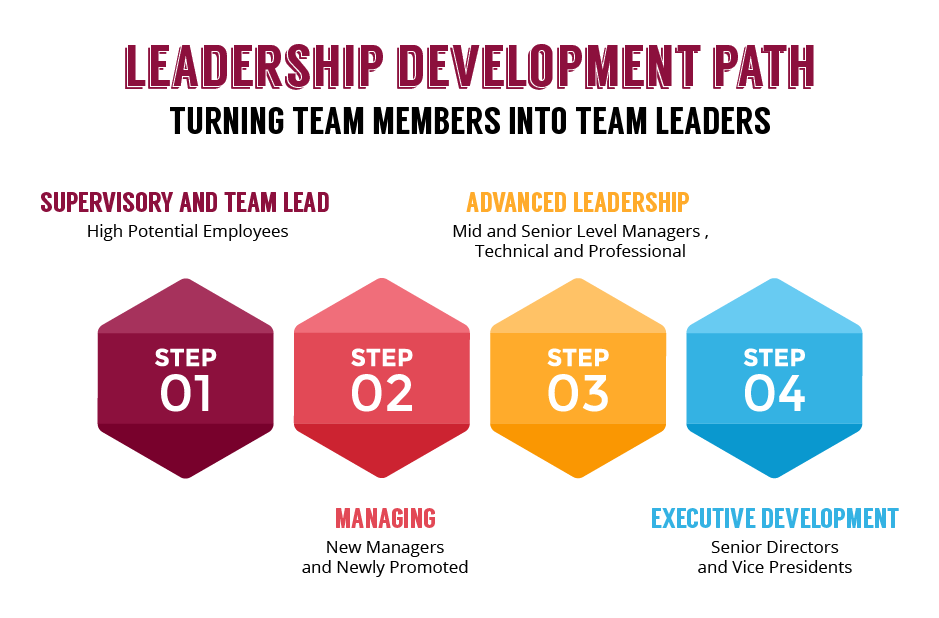
Online learning and training is nothing new. Companies have offered employees access to e-learning as a flexible and often cost effective way of upskilling teams for some time. The challenge of leadership development is more complex. For executives, it’s often less about learning a new skill, but instead understanding the business landscape outside of your immediate organisation and industry. It is no longer enough to have deep sector expertise, leaders need insight from a range of sources and across different geographies in today’s fast-paced environment.
Executive development using technology to let the outside in
According to our research, senior executives including CEOs, CFOs and HRDs consistently rate development opportunities like mentoring and peer learning as most effective to their roles and responsibilities. When lockdown hit back in March 2020, Criticaleye had to quickly adapt many of the learning experiences we offer our Members, so technology played a major role in keeping leaders current and connected.
In fact, when it comes to executive development, virtual meetings and connections with other leaders around the globe has become one of the major opportunities to emerge from the crisis. Our mentors are now able to combine face-to-face interactions with virtual conversations, creating a constant and consistent touchpoint for their mentee. Equally, and although we resumed our calendar of physical events last year when restrictions were lifted, the advent of more regular, virtual roundtables and forums at Criticaleye is enabling our Members to dip into leadership insight and be inspired by peers more than ever before.
Tech and Talent
If the way leaders are developing their skills and capabilities is changing, so too is the way they think about their workforce and talent strategies. Organisations need to adapt to remain competitive, and improve their understanding of both what it means to lead a distributed workforce. It’s about much more than remote working. Leading a distributed workforce should be intentional, strategic and it requires a shift in both leaders’ mindset and the culture of the business.
According to discussions we frequently have with leaders across the Criticaleye Community, executives need to ask themselves how they can create a new sense of belonging in a more remote working environment. They also need to question how they measure and maintain productivity. Overall, there must be a focus from leadership teams on retaining your best talent, and, going back to our Criticaleye Research, the C-suite consistently cites talent as their top priority for the year ahead.
Digital transformation is not just about the customer. It must also play a key role in how you engage your teams, what you offer in order to hold on to key people, how people learn and how leaders get the touchpoints they need to be successful.
Sreena Nadarajan, Head of Research UK, Criticaleye
Most searched queries
Leadership qualities
Leadership skills
Leadership development in human resource management
Leadership development research
Most searched question
What is meant by leadership development and itsimportance?
Why is leadership development important?
How do virtual organizations deal with leadership development?
How can you be a good leader in a virtual environment?
A traditional economy is a business whereby company’s employ people on a full-time basis to carry out task stated out by the company. The pros are there is a structured career path in the company and they are well paid in terms of salary and benefits such as leave, insurance and trainings. The cons are usually the company is not flexible in certain decisions such as – work hours are fixed at 9-6pm and they incur high operating cost such as manpower, office, and insurance.
Technology have brought about changes in life as well as the economy we know today. Gig economy start to trend recently especially with the booming of technology app companies such as Grab, Uber, Airbnb etc. These companies employ people on a part-time/contract/freelancing basis to complete a task stated out by the company. The pros typically are the flexibility of time, allowing the hired people to work within their own time management. The cons are they typically not cover under company insurance or have leave entitled to them as compare to a regular full-time staff.
Examples of a Gig economy
Photo credit from Mendaki Singapore Facebook
Impact of Covid-19 in Singapore
Since Covid-19 striked, a lot of business had to fold or change the way they work such as working-from-home, food delivery service for F&B. Traditional business that need to have office space or retail/F&B that rent space from commercial and non-commercial building in Singapore are hit the hardest during the lock-down and post lock-down period. Some businesses just simply couldn’t survive and hence retrenchment was on a rise during the period. So, we can see a shift in workforce that joined the Gig economy such as the grab food delivery service which allows people to earn money with flexible timing and arrangement. Even Taxi operators were hit during the period as travel restrictions were imposed and hence taxi driver’s lost a mainstream of income from visitors. Luckily, they were being deployed for short term role of chauffeuring covid-19 patients from point A to point B. Airlines were grounded during this period and SIA stewardesses were being deployed to hospitals as care ambassador during the crisis period to help out with lack of manpower in hospitals. Some who were out of job turned to entrepreneurship such as home-based business or hawkerpreneur to tide themselves over the period. Full-time workers who are still employed under companies have to adopt new ways and technology to do business such as hold virtual meetings over Zoom, doing tele-conferencing and working from home.
Examples of working from home tech jobs
Photo credit from Investintech.com
With the covid-19 situation under control at this point of time, businesses are slowly recovering. The question now is, would the Gig economy workers go back to a traditional model or does the traditional model break into new territory of Gig? Imagine, employees choosing to work on a hybrid mode of work from home and hot-desking anywhere instead of going to office, does it help the company to save on rental/ ownership of a building? What will happen if companies do not need an office space anymore? What is the future of commercial buildings like? Do drivers/ delivery workers of grab go back to being white-collar workers and hence create a gap in supply demand in the grab app?
I look forward to the future of the working landscape as to how technology will shape up both the Gig and traditional economy.
This article originally appeared as a Council Post on Forbes here.
Albert Einstein is often credited with saying, “If I had an hour to solve a problem, I’d spend 55 minutes thinking about the problem and five minutes thinking about solutions.”
For leaders today, that five minutes packs in even more activities — communicate and create buy-in from key players, then assemble a capable team that will implement the actions decisively and effectively. In a bid to save time, some leaders jump straight to action without fully understanding the context, but a weak, flimsy, poorly constructed solution based on lopsided facts and warped logic almost never goes down well.
From technology disruption to climate change issues to the unwelcome COVID-19 crisis, leaders are now faced with a monumental task of transforming even more complex systems. And the clock is ticking.
If business leadership is a mathematical problem, the rules of engagement have changed. Corporate executives need to embark on a journey to re-understand business challenges and formulate solutions that can work in this new normal. And they must do so with agility.
Businesses require a strategy — a leadership strategy that secures a ready supply of capable leaders — should they wish to survive these tumultuous times. Armed with the right skills, capabilities and mindsets, these agile leaders can ensure that both the short- and long-term business needs are met.
The task of navigating complexities is one that all leaders need to undertake, and it requires people who can handle the cognitive complexity and draw on multiple frames of reference or intelligence at the same time as part of systems leadership.
The Traits of a Master Strategist
In my work as an executive coach, I often support leaders in becoming master strategists by challenging their thinking so they may formulate the best solutions (or assemble a team to do so), communicate with charisma and implement to perfection. We seldom arrive at well-designed solutions unless there is thorough contextual understanding, deep subject-matter-expertise, and clarity of thought. Over the years, I have observed that some corporate professionals do better than others in this area.
These are the traits that I have found are common among those who can call themselves “master strategists”:
1. They ask questions that elevate the quality of discussions and thinking.
2. Key stakeholders often welcome their opinions.
3. They are great storytellers, able to engage and inspire a wide range of audiences, draw them in and involve them in a compelling vision.
Some ask if strategic thinkers are born or developed. Everyone sits somewhere on the spectrum of strategic thinking so instead of asking “Do I have it?” leaders would benefit more if they instead ask, “How do I get better at it?” To remain low on the spectrum of strategic thinking is unthinkable. A leader may have excellent communication skills and the resolve to follow through with bold actions, but the lack of substance — strategy — can be their downfall.
How To Become A Master Strategist?
Here’s the good news: With deliberate and consistent actions, leaders can quickly level up their cognitive abilities and be well on their way to becoming master strategists. Here are three actions that can help you.
1. Incorporate structured reflection into your daily routine.
In his book Sometimes You Win—Sometimes You Learn, leadership guru Dr. John C. Maxwell wrote, “Experience isn’t the best teacher, evaluated experience is.”
There are many learnings leaders can glean from daily experiences, but not having the discipline for regular reflection can mean you will miss them. Structured reflection helps you maximize your learning and experience, be it through daily readings, observations, or interactions. Reflecting in a structured way helps you analyse facts and processes and translate them into future hypotheses and actions. Reflection is a very powerful tool for continuous improvement. I recommend Kolb’s Learning Cycle and Gibb’s Reflective Cycle for this purpose. Both are very easy to implement and offer robust frameworks.
2. Think unconventionally, not automatically.
Thinking is such an automatic process that we often take it for granted. When we ask someone to think, what do we really mean? Given the world has changed so much and things we learn in formal education are often obsolete even before we graduate, we need to unlearn, relearn, and repeat.
Fortunately, there are many powerful thinking frameworks out there. You can tap into visible thinking routines or thinking frameworks to understand problems thoroughly. Paul’s Wheel of Reasoning is a useful critical thinking framework that I have seen work wonders for my clients many times.
3. Understand the needs of others.
Master strategists are great storytellers. In every compelling vision, there’s a part that everyone can play — they can see themselves in your story, hence the strong commitment. The question master strategists must address when communicating with others is, “What’s in it for me? Why should I care about this?”
You could begin by examining your audiences’ motivation, love language, mental models, strengths and more. Keep a lookout for what is important to them, and you will find a way to create the best story that onboards others.
The world as we know it now is different. The speed of digitalization has increased in the last few months in this new world created by the pandemic. As a leader, you must stay persistently curious and keep stretching your mind to learn, unlearn and relearn so that you may create the best master strategy.
For more articles on agile leadershipclick here – ACESENCE
Failure is an inevitable part of life, but SMART people know how to make it work for them. One of the biggest roadblocks to success is the fear of failure. Fear of failure is worse than failure itself because it stops you to a life of unrealised potential.
A successful response to failure is all you need.
When testing a new technology often founders and leaders fear failure.
DON’T fear failure
How can you avoid failure?
-Start Small
-Focus on the journey
-Educate yourself
-Trust yourself
-Ask for help
-Never be afraid of being called
Last but not the least keep referring to the below famous quotes by these legendry innovators and leaders and keep moving ahead:
A great leader is always aware of his ego. Because he believes in the words of Lao Tzu (a great Chinese philosopher) “knowing others is wisdom but knowing yourself is enlightenment”
He knows that the moment he gets aware of his ego he loses 99% of his enemies.
A great leader knows that his arrogance will be his downfall. A great leader knows that Socrates (father of the western philosophy) was right when he said
“The only true wisdom is in knowing that you know nothing”
A great leader knows that to be a great leader he must be a great listener. He knows that ability to listen with patience is a superpower. He knows that one should never listen to reply but always listen to understand.
A great leader is a great follower. He believes in the wise words of Mark Twain (father of American Literature)
“When I was a boy of 14, my father was so ignorant I could hardly stand to have the old man around. But when I got to be 21, I was astonished at how much the old man had learned in 7 years”
A great leader respects everyone equally as he believes in the wise words of Albert Einstein (father of Modern Physics)
“I speak and respect everyone in the same way, whether he is the garbage man or the president of the University”
A great leader knows that Ideas are nothing and execution is everything. A great leader has a great vision. He knows that leadership is all about translating vision into reality. A great leader always promotes creativity and innovation because he believes in the words of Steve Jobs (founder of apple)
“Innovation is what distinguishes between a leader and a follower”
A great leader knows that his megalomania, narcissism and unscrupulous nature would be his downfall. A great leader believes in the words of Aristotle (father of political science)
“The more you know, the more you know you don’t know”
A great leader believes in constant learning because he knows that once you stop learning, you start dying. A great leader believes in Change as he believes in the Wise words of Winston Churchill (ex-Prime Minister of Great Britain)
“To improve is to change, to be perfect is to change often”
A Great Leader knows that mistakes are inevitable, failure is inevitable. He knows that only dead people can avoid making mistakes. He knows that insanity is doing the same thing over and over again and expecting different results.
A great leader never makes the same mistake twice and he knows that success is nothing but one’s ability to tolerate failure.
A great leader is a man of morals, values and ethics and he believes in the wise words of Warren Buffet (the most successful Investor of all time)
“It takes 20 years to build a reputation and 5 minutes to ruin it. If you think about that you will do things differently.”
A great leader believes in simplicity and patience. He knows that nature doesn’t hurry and yet everything is accomplished.
As he believes in the wise words of Sir Isaac Newton (father of physics)
“Truth is ever to be found in simplicity and nature is pleased with simplicity and nature is no dummy”
A great leader doesn’t find faults or defects he is more interested in finding solutions.
As a product manager working in tech, I constantly face the challenge of operating at a high-capacity, managing multiple projects, clearing roadblocks, running back-to-back meetings, and building long-term strategies while living a healthy and joyful life. Staying productive is critical to career and life success.
Many people in my network ask me, “How do you stay productive? How do you have it all?” While there’s no one-size-fits-all some answers can be found below :
01. Mindsets
“Everything begins inside your mind. With the right mindset, you will succeed.” — Tony Horton
I start with defining what personal productivity is and things to be mindful of when it comes to being and staying productive.
3️⃣ Action > Perfection. Making progress is more “productive” than being perfect.
4️⃣ Iterate. Finding your productivity system is an iterative process. Try different things and see what works best for you.
5️⃣ Create leverage. Find high-leverage activities that will produce outsized results. Make 1 decision to save 1,000 decisions.
03. Systems
“Productivity is never an accident. It is always the result of a commitment to excellence, intelligent planning, and focused effort.” — Paul J. Meyer
You don’t have to wake up at 4:30am everyday to be productive. Productivity is a lifelong commitment to finding what works for you. There is no universally perfect productivity system; you must be willing to experiment and get ready to mix and match different systems!
1️⃣ Have a system to capture and organize information as it comes in. Capture everything and then organize it – task backlogs, project trackers, intentions list, daily to-dos. Do what works for you.
“The way to get started is to quit talking and begin doing.” — Walt Disney
Below we shared a set of productivity tactics that have worked well for us. There are hundreds more out there, and you will need to find out what works for you through trial and error.
1️⃣ Block time on your calendar for your to-dos. This not only brings clarity to WHAT to do, but also to WHEN to do it.
2️⃣ Audit your time to be more aware of whether how you spend your time aligns with what you value in life. Bundle this with a weekly reflection to set intention for the following week.
3️⃣ Learn to set boundaries and say a clear no without feeling guilty.
4️⃣ Apply the Yes! No. Yes? Model to articulate what we want, protect what we value, and stand up for everything and everyone that matters to us.
7️⃣ Invest time in delegating and shift your thinking from “how and what” to “why, when, and who” to empower others to learn and grow.
8️⃣ Decide if a synchronous meeting is needed and how to run productive meetings with a clear sense of purpose and closure.
To conclude, being productive may look different each day. Be intentional about how you spend your time and continuously improve your systems and tactics to find what works for you!
Remote working has significantly impacted various aspects of workspace culture, environment, and interaction across industries. Remote working was only available to few people from the IT industry before, but pandemic led changes have brought digitalization and induced rapid global transformation to many other industries which were initially perceived as traditional and required physical presence.
Though the remote working practices were adopted as a necessary measure during the pandemic; they seem to be here to stay. WFH (Work from home) / remote working is the ‘new normal’. There are many companies that have decided to switch to work from home permanently and many other companies have adopted the Hybrid Work model. Employees are not ready to return to the offices and this has forced companies to adopt technologies to support remote work styles. Orthodox work culture will not survive in the era of digitalization.
Global Competition: New technological advancement and adoption has opened the door of global opportunities for job seekers as well as employers. If someone is staying in Delhi (India) and is not flexible to move to another city due to various reasons, they had to look for options only in Delhi. This has changed and the employee can now apply anywhere and can work remotely. Likewise, employers do not have to look for talents only from the location of their office. This is bringing global talents to one platform.
Missing Human interaction: While this is good for many, there are other dimensions to be investigated. Many employees still prefer to work in physical offices and miss bonding with their team, gossiping with others! or just meet a new person from another team during coffee/tea break.
According to an article published in Forbes on 13th Oct,2021, a study by Condeco shows that “nearly half of U.S. companies offered remote work options already in 2019. In 2021, this number increased to 58.6%”.
Remote working can benefit the companies and can increase profits in many ways:
Reduced infrastructure cost: Remote work eliminates overhead costs like lease expenses, office furnishings, utilities, insurance, supplies, upkeep, and repair. Workplace cost and benefits statistics by Global Workplace Analytics reveal that IBM saved $50 million in real estate costs by allowing remote work.
Increased productivity: An employee’s productivity depends on his/her lifestyle. Same 9 to 5 work schedule might not work for everyone. This flexibility will allow employees to work during their most productive hours and this will certainly increase their productivity.
Employee Retention: Flexible remote work will help in employee retention by keeping them happy and healthy. Remote workers have better work- life balance which results in happy employees. Happy employees mean reduced attrition.
From the employees’ perspective, remote work has also created a different expectation where many companies expect the employees to be available 24*7. This is the other side of the same coin. There is a tradeoff here.
We should not hesitate to adopt new technologies if it makes our life easier and better. At the same time human interaction and emotions should not be missing. This is a time where companies are doing their best to be in the list of most employee friendly companies, while others are still clinging to 6 days a week work culture. For these orthodox companies, the well-being of their employees working for them does not matter.
But, in the long run, only the ‘fittest’ companies will survive.
Intuition – The X factor critical to generating ideas collaboratively but not something one expects over a Teams workshop involving a dozen people across five time zones, multiple languages and ethnicities. Unlocking the power of collective intuition had been my forte in the hundreds of workshops I had conducted during the pre-COVID decade. I was a firm believer that the revolutionary efficiency of Zoom/ Teams could never deliver the magical inefficiency of unstructured intuition and ideation. Physical workshops were the Hogwarts of collective intuition, and “Remote Meetings” were the Death Eaters! I had completely stopped doing such workshops.
As COVID dragged on, Teams, Zoom and Google Meet tried to address the issue with rooms, Whiteboard and Jamboard. I experimented with these shiny new toys but quickly realized that remote meetings had become camera-off, mute-on time capsules when people multi-tasked; learning new ways to jam about ideas was an extra behaviour change no one wanted to do.
One year into COVID, I found inspiration from an unlikely source. My middle-school son was attending remote classes and he was sharing ideas with his classmates! His teachers had found a way to keep self-learning and collaborative intuition alive. There were no new shiny toys, just basic stuff- Google Search( text, images, Youtube), Google Slides, PowerPoint, the laptop’s camera, and the Chat inside Google Meet.
I had my Eureka moment- stick with the familiar, just tweak it to make it a little unfamiliar.
Define the challenge and expectations with the decision-maker, not the minions co-ordinating the workshop
Zero meeting time for information sharing; send everything as pre-reads a week in advance
Energy is the key to intuition so break up the workshops into several 2-hour sessions
Child-like output format: create a simple, visually evocative frame that can hold 7-15 words to headline the idea (e.g.billboard, front of pack, etc.)
Create trigger questions and populate the frame with idea starters to fire participants’ intuition
Encourage people to submit their ideas a few hours ahead of the session. Curate the ideas into themes
In the session, invite creators to explain their ideas. Allow them to use a few supporting slides by sharing their screens
Use the trigger questions and ideas to generate more ideas
Do not use the session to operationalise the ideas; stop at overall ‘explore/discard’
Let the core team work through the operational implications and send it out as pre-read for the plenary session with the decision-maker and stakeholders.
Close the exercise with a final 60min decision-making session
Cameras on! Ensure 100% attention throughout the session.
Can this make ” Remote Intuition” scalable, fun and effective? The answer is Yes!
Want to find out how? Let’s chat over a coffee, WhatsApp me at +6593891694
The future success and effectiveness of leaders and senior executives will depend on how well they respond to the increasingly important role of digitisation through their business models. Regardless of the sector or size of their organisations, leaders must place technology, not as a function of the business, but right at the heart of it.
This is a topic we discuss frequently within Criticaleye’s global membership Community of leaders and, encouragingly, almost all have digital transformation high on the agenda.
The relationship between digitisation and sustainability is also top of mind for C-suite executives. The pandemic may have been the tipping point for many on ESG(Environment, Social and Governance) issues, but senior teams are now seeing a convergence between digitial innovation and the focus on creating organisations which are sustainable and responding to climate change.
Digitisation is revolutionising the business landscape, but what does this mean for the capabilities and leadership styles of executives at the top of organisations? One thing is clear, senior executives have had to adapt quickly. Leading innovation and digital transformation requires flexibility, agile thinking and a mindset that is open to learning from others.
Digital capability
Speed of change is forcing a lot to happen all at once. Technology is now integrated across the whole business. It is not a separate function anymore, such as where the responsibility for ‘technology’ was typically siloed.
The question often arises about the need for technology expertise at the top table. Of course, having an experienced CTO or digital evangelist is important, but building a top team which really understands what new technology can do and will bring to the organisation and customers should be the focus. Our Members generally agree that leaders need to empower teams and technology experts across the organisation, as well as playing a key role in how digital transformation is organised and communicated.
Internally, the use of digital solutions to facilitate remote-team management, ensure wellness, and improve productivity is getting to be an increasingly important agenda item. This is not just to do with automation. It’s about the ability to have real-time data which makes a huge difference when employees are going through uncertainty and rapid change.
Leading digital organisations
The past two years have demonstrated what is possible when organisations are forced to make big decisions quickly. Along with more strategic challenges, such as pivoting business models, leaders have had to revisit their softer skills and ask themselves whether they have a leadership style that is fit for the future. Leaders need to be creative and work differently.
When it comes to technology adoption, these new leadership skills are also coming to the fore. Previously considered ‘soft skills’, we’ve seen a lot more focus from leaders on developing their capabilities in this area. Now more than ever, senior executives need the ability to be open, authentic, agile, collaborative and innovative.
Few executives have emerged from the last two years unchanged. It’s clear that some have acclimatised to the new world – and adapted their own styles accordingly – but they are going to be tested harder, their leadership skills will be under greater scrutiny, so they should take time to reflect on their approach.
Employees certainly consider learning to be an integral part of the value proposition organisations can offer. They want to build portable skills that will be useful for them, not only in the flow of work currently, but which will also add to their profile for future opportunities. They want employers to be secure in the knowledge that investments made in their skill development will benefit the organization here and now and an another organization later. At the same time, they want learning to be a social experience – fun and engaging.
Employers also want to quickly and effectively upskill and reskill their workforce to meet the requirements of this VUCA world. They want to be able to assess current skills levels and build a capability map for skills required in the future, given how quickly skills are becoming obsolete.
Readiness gap –
Are organisations ready to tackle these emerging trends? More than 50% organisations believe their learning approach is not positioned to meet future work needs. Scrap learning (the gap between training that is delivered but not applied on the job) ranges from 45% to 80%. Learner engagement scores continue to pose a challenge – infact with the pandemic, learner engagement using virtual platforms has seen mixed responses – while it has helped build scale, it has not been the best way to nurture skills.
The role of technology –
Technology is a key enabler in helping create an agile and adaptable learning experience. In the past, deploying learning technology meant setting up an LMS. Now, most organizations have a bouquet of technologies that include next generations, Learning Management Systems (LMS), Learning Experience Platforms (LXP), Learning Content Management Systems (LCMs), Learning Record Systems (LRS), microlearning platforms, simulation tools, and more. The pandemic accelerated action with more than 45% companies making investments in new learning technology.
However, organisations need to be cautious of what they invest in and why? Often, investments are made in the new and shiny in demand products and platforms, but little thought is given to how these platforms will interact with one another to create a seamless experience for learners and all other stakeholders. Research suggests that many organisations are still shy in making the right investments in learning technology or under use the platforms that have been bought e.g. about one third learners say their learning system can curate content and just under half say the system provides opportunities for coaching and mentoring. Further, organisations and learning teams do not have mechanisms to source learning data that will help understand skill gaps and map future needs of the organisation.
What next –
To address the emerging needs of learners and organisations, it is time to get effective in bringing technology, data, and brain science together to ensure the learning eco-system is well-integrated while keeping learners at the center. These are what are called ‘Adaptive Learning Systems’. Using AI, learning products and platforms should be talking to one another and creating a personalized learning road map for each learner. Taking a leaf out of modern-day marketing and consumer behaviour patterns, learning teams and systems should be immersed in data on how learners are behaving, what do they like and learn. It is important that the system speaks to the learner directly, links them to others who are learning about similar topics. The future of skill development is anchored in studying the learner closely and helping them create a personalized approach to career development. This can happen only with the right technology investments and keeping learners and stakeholders at the center to collaborate with one another.
Technology and virtual ways of working have made “REMOTE FIRST” way of working possible. The biggest proof being, almost the entire global economy has been able to survive because of this reset.
This new way of working requires some basic rules which every organisation, especially a start-up should follow to keep this sustainable and continuous.
Digital fluency
This may seem obvious, and to some extent, already a requirement for any knowledge industry job today. However, in a “REMOTE FIRST” environment, especially in a start-up, there’s no IT department helpdesk to call to fix up laptop or your microphone. Team members who can figure out how to troubleshoot, reboot or do basic configuration of their technology are much more productive than those who are typically reliant on an ‘IT person’ to fix things.
We see the ability to quickly learn the tech tools, whether collaborative cloud documents (no save to laptop and email please…), chat software or video calls as an important indicator of a successful remote-first employee. These are foundational skills, in some ways more important than even English language fluency.
High empathy
As a team with over 16 different nationalities, with different styles of communication in both written and spoken forms, we need team members who have high levels of empathy. It’s far too easy to misinterpret the tone and intent of messages or annoy others by setting up meetings at odd times of day due to time zone differences.
We find that people who have a strong sense of empathy (e.g. as a simple indicator, they would indicate both parties’ time zone when scheduling meetings), to be much better adept to dealing with communication challenges and being effective team members in a remote-first environment. Some indicators, like experience with working across time zones, or having been well travelled (with a strong traveller’s point of view, vs a tourist point of view), are good signs in this respect.
Clarity of communication
This is true for any regular organisation but is made even more important in “REMOTE FIRST” organisations. With less opportunities to re-clarify at the water cooler or other interactions in the office, the ability to communicate well in writing and verbally are more important than ever. We appreciate structured communication and concise verbal communication.
The challenge to assess these three characteristics, and also other signals are also made tougher in a video-meeting set up. I do miss the days when I could do the coffee cup interview test. In-person at the office, I’d go with the candidate to the pantry, help get them a cup of beverage, bring them along to the interview room, and observe whether they later offered to help take it back to the pantry or assume ‘someone else would do it’!
We founded Rainforest in the midst of the Covid pandemic in early 2021. As an e-commerce aggregator that buys and builds e-commerce brands, growing the brands globally, we saw an opportunity to make the most of the pandemic situation by going “REMOTE FIRST”, i.e. we predominantly worked remotely, outside of a fixed office environment. As we grew, we took this further, and now have no office at all in any location. Our employees can work from anywhere.
We learnt that while most candidates that applied to us say they are comfortable to be part of a “REMOTE FIRST” team, the above characteristics stood out to be better indicators than others of being a successful “REMOTE FIRST” team member at Rainforest. We continue to look for these three traits to ensure they would thrive in our organisation.



 Team Collaboration made easier:
 Some of the downsides include anxiety due to increased working hours. If you work from home it may feel like you are never out of the office. Flashing, pinging constantly draw Employees back to their jobs.