Digilah

Categories
HR Tech

Transformation through Learning

Written by Suresh Ramakrishnan on Digilah (Tech Thought Leadership).

Technology has played a key role in the way content is consumed across age brackets and more so in the corporate world. 

One just needs to type in a few words on a browser and there could be a million links on offer.

With AI and ChatGPT coming into the fray, the options have multiplied many folds.

The biggest change or rather the challenge one is faced with has been – how to quickly arrive at what one is seeking. The deluge of content and the sponsored ones at that has the potential to create confusion. Sometimes offer contradicting information too depending on the source. Information related to diet or simple medical diagnosis are classic examples.

At the corporate level too, the struggle to create specific learning interventions for problems either at the individual or group level is intense. 

The issues, just to name a few are:


      • Lower attention span among employees is a serious one to tackle. In the digital world we live in today, it is extremely difficult to remain focused and avoid getting distracted by mails, notifications, calls or messages.

      • The avenues to find content are one too many. The lucky one’s land on the content of their choice whereas most tend to lose track in the sea of answers thrown at them.

      • The big question of ROI – how does one measure effectiveness.

    How does one tackle lower attention span?

    The solution to this problem starts with the team lead. While giving regular feedback, the recommendation offered to upgrading one’s skill should have a specific roadmap.

    The starting point is to make the individual receiving the feedback realise that an intervention is necessary.

    The second step would be to educate or sensitise the individual on the path that has been charted out and the rationale behind creating the specific path.

    The third step would be to create milestones or check points to understand the pace or if any changes need to be made to make the learning more effective.

    Learning is purpose driven – It is up to the leaders / managers to define the purpose so that the individuals can visualise what they are likely to gain.

    The purpose is what helps one avoid distractions. The focus is high and regular feedback sessions iron out issues if any.

    How can one navigate through the deluge of content available at one’s disposal?

    Imagine if the individual spoken about in the earlier paragraph is told what to upgrade or upskill but has not been told where to find the content related to it.

    He or she would be hard pressed to keep track of the events / discussions / meetings happening in and around to get access to the relevant knowledge / skill. It could be a nightmare leading to frustration and lack of anything meaningful.

    This is where the L&D team can come into play and guide them through curated learning paths through several online service providers and ensure the journey does not start and stop online.

    There could be ample coaching / mentorship introduced at various levels and certain events / conferences that can help them with industry wide views. 

    The integrated approach makes learning fun and meaningful.

    Yes, there are ways of keeping track of the learning through all channels using blended learning techniques which are becoming extremely popular. Some prominent technology platforms enable this.

    The big question – effectiveness of learning?

    Most online learning platforms offer valuable insights through course completion rates, diligence in taking a course, before and after quizzes, NPS scores (measured through techniques like discussion threads, referrals to name a few).

    Curiosity in going beyond the learning path to seek additional information / knowledge. It requires a bit of ‘connecting the dots’ to produce a thorough analysis as focusing on one or few indicators however good, could be misleading.

    This brings ‘action learning projects’ into focus – where several stages are created to assess the individual’s knowledge and skill application in real time scenarios.

    The skills to be used would be those offered in the courses. The respective leaders / managers must spend quality time evaluating them and offering them suggestions wherever necessary.

    Technology – the great enabler

    The three points mentioned above lean more on human intervention, but one should not forget the role technology plays in ensuring the process is smooth.


        • Technology can help sequence learning; continuous assessment provides indicators of how well the concepts are assimilated.

        • There are creative ways to break the monotony using gamification. Content delivery can happen through videos, animations, and voice overs. The case-based scenarios entail a more broad-based solutioning approach. There are more than one way of analysing and solving problems and it is possible to guide them through this.

        • Remote teams can collaborate online and sharing knowledge / insights can happen in real time.

        • Learning can happen on the go and is device agnostic.

        • Leaders / managers can keep track of their team members and intervene at a point of their choosing.

        • Technology platforms have the best authors and content curators at their disposal and the dissemination can happen seamlessly across continents and in a language of choice.

        • Analysing learning at the individual level with great amount of detail is possible. This helps offer specific change one can bring about to make learning more effective.

      The focus on adoption rates on online platforms

      One gets to hear this across forums where the debates on adoption rates hits a crescendo.

      Presenting three crisp case studies of large and prominent companies and how they tackled this problem,

      Case study 1 – A hospitality giant with an impeccable record of service standards, ensures undertaking training is part of the KRAs of their employees.

      A quarterly evaluation tracks completion rates and application on the job. Increments and promotions are dependent on these too. One may ask if a carrot and stick method is a clever idea?

      Well, if you are accountable to certain service standards, compromises are not welcome. In that context, it is the right thing to do.

      Case study 2 – A large manufacturing company had hundreds of long serving employees, many among them were not well versed with online techniques.

      They combined physical sessions with online courses and the trainer guided them through the process. They opened a training area where individuals could undertake these sessions.

       They conducted such session across offices / plants and locations. The adoption rates were phenomenal.

      Case study 3 – A pharmaceutical giant created a reward mechanism (good one at that) for those who showed proper application of their learning through their action learning projects – where they suggested ways and means to tackle real problems that the company was facing.

      The employees received their recognition and the company benefitted from not only upskilled employees but unique ideas too.

      Will AI (artificial intelligence) change the way we learn?

      AI can help in three distinct ways:


          • Depending on your search or interest, AI can suggest more courses, relevant topics or reading material that can add more value to the knowledge you seek.

          • It has the power (when put to proper use) to lessen the workload of L&D personnel to curate a learning journey. This will include both offline and online techniques.

          • If metaverse indeed becomes a reality someday, you will have several virtual agents complementing the work done by physical trainers / coaches. The extent to which they can go to fetch the right material is unimaginable (future thinking)

        Conclusion

        While technology has enabled training deployment, there are aspects or rather subjects especially soft skills that, as of today, needs a discerning eye from L&D folks and team leads to suggest a personal intervention.

        Technology will have its limitations and may appear impersonal in addressing sensitive issues.

        No one knows when technology will exactly replace a human being in form and conduct and until that day comes, human interactions will rule.

        Most searched questions

        How does ChatGPT affect an individual’s learning?

        How does one tackle lower attention span?

        Most searched queries

        ChatGPT

        L&D

        For more info check out :  EduRiser Learning Solutions Pvt. Ltd

        Hello readers! Hope you liked what you read today. Click the like button at the bottom of this page and share insights with your colleagues and friends!

        For more such amazing thought leadership articles on technology follow Digilah people.

        Categories
        HR Tech Med/Health Tech

        Need for Coaching to combat the always on work environment!

        Written by Sophie Toth on Digilah (Tech Thought Leadership)

        The importance of having a safe place where everyone can find understanding and full attention. But how can we find a proactive way to address life and career challenges proactively in our always on world? How can we create an opportunity to encourage our colleagues and friends to talk about themselves with a professional?

        In digital media, many of us have strict targets to hit, travel and sometimes live on the edge when a big deal is about to be signed or delivered. This requires a specific stress management type and a mindset that understands goals beyond hitting revenue targets.

        These goals are essential for all of us to live our lives more meaningfully and have a high quality of life experience. Many have had signs of exhaustion or even burnout after a stressful time and needed to take shorter or longer time off from work to shift the focus to their SELF as opposed to constantly performing on a high level without finding a way to create a state of the family which most of the time referred as “work–life balance”.

        Racing to be the best and get our bonuses is just one side of the coin. We need to think about how these fears and negative thoughts create the feeling of guilt, and as we all know, guilt creates pain.

        Operational departments have different types of pressure. I call it the back-office syndrome. It means that they need to be capable of being the technical experts of the online campaigns, constantly train themselves, understand the issue and make decisions in absolute real-time.

        These professionals are continually racing with time, and a little glitch can significantly impact the company. Carrying this weight of responsibilities is not easy either, especially if they are the only experts in a global company without having a frank conversation with anyone who can understand them, and they can open up freely.

        Well, this is one reason I advocate for a coach approach rather than a mental health practitioner. I want to be there for people who struggle and have none to talk to because they fear losing their jobs.

        Coaching is not about good or wrong answers or thoughts; coaching is about finding the best possible outcome of situations, goals, etc..… by using the individual or team’s full potential for achieving these objectives. The other central aspect of having a coach is that you need an independent person who can mean a safe place to everyone.

        Coaching is about trust and willingness to listen to people who can be overwhelmed with work, technology and so on…

        In the last year, I have seen mainly two types of people in terms of their connection to the digital industry, which pushed me to write this article with my inner need to do something to care about the individuals behind roles and job titles.

        The two cohorts are:

        – Job seekers who try to create groups and support each other.

        – Workers who are primarily exhausted, overworked, sad to see their colleagues go, and possibly feel guilty that they weren’t part of the recent redundancy processes. These people are more likely to have anxiety and fear of the future, thinking about when they will be the next.

        This negative thought slowly poisons everyday lives and results in self-doubts, burnout and, eventually, time off from work.

        The modern online world must adopt a new mindset and approach professionally and how companies create a healthy, motivating environment for their workforce.

        Yearly budgeting and investment ideally have a space for team coaching or budget for individual coaching or mentoring programs.

        Many of us miss something in life or want to achieve grand visions and life goals, but these only stay as a “want” within our minds as we block them immediately with our limited beliefs.

        Let me tell you the secret of life: we can achieve our aspirations if we are ready for the change and all the work. Moreover, we all have the answers to the “HOW?”

        Coaches are now studying hard and have specialities they want to work with. This connection is based on a mutual rapport and has an entirely equal manner. As I say, live and breathe with the “coachee” without judgment during the client’s journey.

        Before I explain why coaching is essential for all of us, I want to clarify some crucial points.

        Coaching is not mentoring. The coach won’t tell you what to do, but she will guide you to use your resources and explore your hidden potential.

        Coach is not a medical practitioner; she focuses more on your inner balance, aspirations, and the healthy functioning between body-mind- and soul.

        If you want to start your journey to your better self with a coach, you must be patient and determined and progress at your own pace. There is no one-size-fits-all solution, as we are unique and unrepeatable.

        Now let’s talk about our fantastic but many times stressful, target-heavy industry and why I, as a digital media professional, decided to learn and became a coach.

        Well, I am an observer and a listener. When talking to my industry colleagues, I pay attention to words and nonverbal signs. During my 12+ years in the industry, I experienced many ups and downs, but since 2020, something has radically changed in our online world.

        After the pandemic, these changes and the new lifestyle created an overwhelming, fast and even more performance-focused world, with more restrictions and new ways of approaching online marketing. We also have less face-to-face and more virtual interactions that force us to adapt to a new lifestyle. Some of us had fewer issues, and others had more; this is why mental health became the forefront of almost every company.

        This is so much of a reactive way of treating one of the most difficult challenges and keeping employees and people safe with a healthy mind and thoughts. Well, this is how coaching as a proactive solution comes into place.

        First and foremost, listen and see, then seek an expert who can be the best asset to help achieve overall company effectiveness with compassionate leadership, creating a place for the employees where they can talk to an independent person who can understand, explore, and with the company on individual motivation or group achievements. A coach can also anonymously address employees’ wants and needs as a mediator.

        I see the future much brighter than digital is now.

        I want managers to become mentors, and I can use my coaching knowledge to guide many great professionals from all levels.

        Most asked questions

        What is the importance of mental health?

        What is the importance of coaching in stress management?

        Most asked queries

        Mental health

        Mentoring

        Hello readers! Hope you liked what you read today. Click the like button at the bottom of this page and share insights with your colleagues and friends!

        For more such amazing thought leadership articles on technology follow Digilah People 

        Categories
        HR Tech AI Tech

        From Science Fiction to Talent Reality – How Tech, AI, and Cutting Edge Recruitment Collide

        Written by Dipansh Bhatt on Digilah (Tech Thought Leadership)

        The advent of technology and artificial intelligence (AI) has revolutionized numerous industries, and recruitment is no exception.


        With the help of advanced tools and algorithms, recruiters have found new ways to streamline their processes and identify the best-fit candidates efficiently.

        However, as with any technological advancement, there are potential pitfalls to consider. 

        In this thought leadership article, we will explore how tech and AI have made life easier for recruiters, while also discussing the precautions they need to take.

        We’ll walkthrough the importance of Talent Intelligence (TI) and how it can shape the future of recruitment.

        Streamlining Recruitment Processes:

        Technology and AI have significantly enhanced the recruitment process, one are the days of manually sifting through stacks of resumes and conducting countless interviews.

        AI-powered algorithms can now analyze large volumes of applicant data and shortlist candidates who possess the desired qualifications and skills.

        Automated resume screening tools have emerged as a game-changer, allowing recruiters to filter applications based on specific keywords and qualifications.

        This helps save valuable time and resources, allowing recruiters to focus on engaging with high-potential candidates. 

        Additionally, AI-powered chatbots and virtual assistants have simplified candidate interactions by providing quick responses and handling basic queries, enhancing the overall candidate experience.

        However, it is essential for recruiters to approach these advancements with caution as discussed below. Engagement remains just as important.


        Potential Pitfalls and Precautions:

        While technology and AI have undeniable benefits, there are potential risks that recruiters must be mindful of. One significant concern is the potential for algorithmic bias.

        Some algorithms are trained using historical data, which may inadvertently incorporate biased hiring practices or prejudices. This can result in unfair outcomes, perpetuating existing inequalities.

        Recruiters must be vigilant in reviewing and auditing the data used to train algorithms to prevent bias and ensure fair and inclusive hiring practices.

        Another challenge is the loss of personal connection, undermining the human touch. While automation speeds up the process, it can also lead to a lack of human interaction, making candidates feel detached and unimportant.

        Recruiters need to strike a balance by incorporating personalized communication and leveraging technology as a tool to enhance, not replace, human interaction.

        Maintaining data privacy and security is yet another critical concern. With the vast amounts of personal and sensitive information being collected during the recruitment process, it is essential to implement robust data protection measures.

        Recruiters must ensure compliance with relevant data protection regulations and invest in secure systems to safeguard applicant data.

        Solutions and the Way Forward:

        To address these potential pitfalls, recruiters should prioritize ethical AI practices. This involves regularly auditing algorithms for bias, fostering diversity within recruitment teams, and involving human oversight in decision-making processes.

        Transparency is key, and candidates should be informed about the use of AI and the criteria it evaluates.

        Recruiters should also invest in training and upskilling their teams to effectively utilize AI tools and strike the right balance between automation and human touch.

        By combining the efficiency of AI with the empathetic skills of recruiters, a powerful synergy can be achieved, ultimately enhancing the candidate experience.

        Boiled down to its core, recruitment is very similar to a sales function, selling the job to candidates and selling candidates to your hiring managers.

        An example of something I’ve done myself to utilise AI in sales – when facing writer’s block or a lack of great idea, tools like ChatGPT or Copy.ai work well to help structure your engagement.

        Not to say you should copy and paste these templates but rather use them as a skeleton for your own customized correspondence.

         We’ve seen a decrease in time taken to follow up and at the same time, a decrease in response times as well!

        When utilized correctly, talent intelligence emerges as the way forward. It involves harnessing the power of data and AI to gain insights into candidate behaviour, preferences, and skillsets.

        By leveraging talent intelligence, recruiters can make more informed decisions, tailor their recruitment strategies, and build stronger talent pipelines.

        Technology and AI have undoubtedly made recruitment processes more efficient, enabling recruiters to focus on higher-value tasks. 

        However, caution is necessary to mitigate potential pitfalls such as bias and loss of personal connection.

        By prioritizing ethical practices and embracing talent intelligence, recruiters can leverage technology to create a more inclusive and effective recruitment landscape.

        Solutions like Vita’s Talent Intelligence CRM do exactly this.

        As a quick introduction, Vita’s TI helps reactivate past applicants for current hiring, identifying relevant talent from within your database and guiding engagement, within seconds. 

        Not only does this streamline sourcing, reducing candidate acquisition costs, this can also be applied to screening active applicants!

        Larger enterprises get hundreds of applicants per role and it’s a hassle narrowing this list down and sieving out irrelevant profiles.

        Learn how to cross-reference candidates across positions as well to ensure candidates are matched to roles that suit them best, moving away from a candidate to job match but more of a candidate to company match! Get in touch to explore or check us out!

        Most asked questions

        Can AI be used to recruit humans?

        What is an algorithm?

        Most asked queries

        Algorithm

        ChatGPT

        Hello readers! Hope you liked what you read today. Click the like button at the bottom of this page and share insights with your colleagues and friends!

        For more such amazing thought leadership articles on technology follow Digilah People 


        Categories
        HR Tech

        Compliance – Simplifying it with Digital streamlined onboarding & enhanced customer experiences.

        Written by : Aritz Zainal & Rashmi Upadhyay on Digilah (Tech Thought Leadership)

        Imagine a world where compliance is effortless, and customer onboarding is seamless.

        There is always a need for a trailblazing platform in regulatory E-KYC compliance, a ground-breaking software that revolutionizes the way businesses approach due diligence. A platform that ensures streamlined onboarding, simplifies compliance processes, and empowers organizations to navigate the evolving regulatory landscape with ease.

        Key facts from a report by McKinsey:

            • Customers expect B2C-like experiences: Banks with top customer experience scores see 3% growth, 15% revenue increase, and -4% efficiency ratio advantage.

              • Poor data quality drives costs: Data-quality problems contribute up to 26% of operational costs due to non-standardized formats and incomplete data.

                • Increasing costs, decreasing budgets: US financial-crime compliance costs have risen by around 43%, while KYC-program budgets are projected to decrease by up to 25%.

              Efficiency improvements in banks lead to significant benefits in risk effectiveness, customer experience, and productivity. A 20% increase in KYC-process automation results in improved quality-assurance scores, reduced customer outreaches, and increased case processing efficiency. Today, customers demand ease and efficiency. And we recognize this challenge and provide a simple solution through our platform.

              At One Constellation, we make this vision a reality.

              Effortless Client Onboarding with Digital KYC

              Ensures streamlined client journeys, meeting KYC and regulatory requirements from initial onboarding to regular reviews. By leveraging One Constellation, businesses provide a seamless digital experience, enhancing customer satisfaction and trust.

              Unlocking Efficiency through Compliance

              Developed by skilled fund administration experts, One Constellation has earned the trust of over 700 clients, including prominent financial institutions, banks, auditors, and legal counsels. Our solution simplifies complex procedures by integrating existing data or accessing it through our API environment.

              Comprehensive E-KYC Solution – Simplify Compliance Efforts

              The solution offers an integrated range of features to meet E-KYC needs, accessible in one place:

                  • Streamline Onboarding: Simplify customer onboarding for a seamless experience, reducing drop-off rates and enhancing satisfaction.

                    • Centralize Compliance Tasks: Manage all compliance requirements in one place, simplifying global KYC due diligence and reporting.

                      • Enhance Security with Transaction Monitoring: Swiftly detect suspicious activities, strengthening security against financial fraud and money laundering risks.

                        • Validate Documents: Authenticate and validate customer documents using advanced technology, minimizing the risk of fraudulent identities and improving accuracy.

                          • Mitigate Risks with Risk Assessment: Analyze customer data and assign risk scores based on predefined criteria to identify high-risk customers and effectively mitigate potential risks.

                            • Streamline Reporting with Automated Reports: Generate regulatory compliance reports and customize them to streamline reporting processes.

                              • Prioritize Data Security: Implement robust security measures to protect sensitive customer information and ensure compliance with regulations.

                            Continuous Updates for Ongoing Compliance

                            As the regulatory landscape continually evolves, staying up to date is crucial. We closely monitor regulatory changes and promptly incorporate updates into our E-KYC software, ensuring ongoing compliance for our clients.

                            Streamline Your Compliance Efforts

                            Our comprehensive E-KYC solutions simplify onboarding procedures, enhance customer experiences, and ensure compliance with regulatory standards. Leveraging our tailored E-KYC software, organizations unlock efficiency in their compliance efforts. Our user-friendly interface, integrated features, and customizable workflow solutions make compliance tasks more manageable.

                            Embrace the Future of Regulatory Compliance

                            The platform offers a one-stop E-KYC solution, empowering businesses to streamline compliance efforts, enhance customer satisfaction, and navigate the evolving regulatory landscape.

                            Contact us to learn more about how our tailored solutions can support your organization’s compliance journey.

                            Embracing the future of regulatory compliance means partnering with Digital KYC solutions.

                            Most asked questions

                            What is E-KYC?

                            Why is E-KYC used?

                            Hello readers! Hope you liked what you read today. Click the like button at the bottom of this page and share insights with your colleagues and friends!


                            For more such amazing content follow Digilah People


                            Categories
                            HR Tech Digi Tech

                            The technological and digital evolution of a remote business 

                            Written by Kiran Bhatia Tandon on Digilah (Tech Thought Leadership)

                            As the world becomes more connected and technology continues to advance, remote work has become increasingly popular among businesses. 

                            The demand for digital and technological tools has increased more than ever as a result of the COVID-19 pandemic, which forced many businesses to move to remote work. 

                            A remote company’s digital and technological journey can be both exciting and difficult. Companies have had to modify their strategies and tools to meet the demands of a distributed workforce as a result of technological advancements and the rise of remote work. 

                            The need for constant adaptation to new technologies and tools was one of the biggest obstacles the company faced on its digital and tech journey. They recognized that technology is constantly evolving, and they needed to be agile and adaptable in order to stay ahead of the curve. 

                            This meant investing in ongoing training and development for their employees to ensure that they had the skills and knowledge needed to work with the latest tools and technologies.

                            Here are some common strategies adopted by companies to manage a distributed workforce:

                            1. Use of collaboration tools

                            One of the most difficult aspects of managing a distributed workforce is ensuring effective communication and collaboration among team members who may work in different locations and time zones. 

                            To get around this problem, companies used a variety of strategies and tools to improve communication and collaboration, such as Zoom, Microsoft Teams, and Slack for video conferencing, instant messaging, and project management. 

                            2. Regular check-ins

                            Regular check-ins with remote employees can help to ensure that they are on track and that any issues are addressed in a timely manner. These can be done with the use of collaboration tools

                            3. Clearly defined goals and expectations

                            Clear goals and expectations can help remote employees stay focused and productive. These goals should be measurable and communicated effectively.  These can be defined using technology in a variety of ways. Here are a few examples: 

                            • Project management software: Project management software, such as Asana or Trello, clickup can be used to create tasks and assign them to team members. This allows for clear expectations and deadlines to be set, and progress to be tracked in real-time.
                            • Performance tracking tools: Performance tracking tools, such as OKRs or KPIs, can be used to set measurable goals and track progress towards achieving them. This provides a clear framework for employees to work toward specific outcomes.
                            • Communication tools: As stated above, tools, such as Slack or Microsoft Teams, can be used to facilitate regular check-ins and goal-setting conversations between managers and team members. This helps to ensure that goals and expectations are clearly understood and can be adjusted as needed.
                            • Learning management systems: Learning management systems, such as Udemy or Coursera for Business, can be used to provide employees with training and development opportunities that align with organizational goals and expectations.

                            4. Flexible work schedules

                            Companies can offer flexible work schedules to their remote employees to help them balance their work and personal lives.

                            5. Performance-based assessments

                            Performance-based assessments can help managers evaluate the productivity of remote employees and provide feedback to help them improve.

                            6. Regular team meetings

                            Regular team meetings can help remote employees feel connected to their team and can improve communication and collaboration.

                            7. Virtual team-building activities:

                            Virtual team-building activities such as online games and virtual happy hours using collaboration tools can help build a sense of camaraderie and boost morale among remote employees.

                            8. Training and development

                            Companies can provide training and development opportunities to help remote employees improve their skills and stay up-to-date with industry trends.

                            In addition to the above, companies had created well-defined policies and guidelines for remote work and provided employees with the necessary support and resources to ensure that they remained productive and engaged while working remotely.

                            Cybersecurity has become a top concern for remote companies, as remote workers often use their personal devices to access company data. To address this challenge, remote companies have had to implement robust cybersecurity measures, such as two-factor authentication, encryption, and virtual private networks (VPNs).

                            Companies need to be flexible and adaptable in their approach to managing a distributed workforce, and they should be willing to experiment with different strategies and tools to find what works best for their organization.

                            Overall, the company’s digital and tech journey is a critical part of their success as a remote company. By embracing technology and using it to their advantage, they will be able to overcome the challenges of remote work and build a thriving remote workplace that could compete with traditional brick-and-mortar companies. Their journey is a testament to the power of technology to transform businesses and create new opportunities for growth and success.

                            Hello readers! Hope you liked what you read today. Click the like button at the bottom of this page and share insights with your colleagues and friends!

                            For more such amazing content follow Digilah People

                            Most asked questions

                            How advancing technology affect remote business?

                            How remote employees cope with advancement in technology?


                            Categories
                            HR Tech

                            How the “DIGITAL AND TECH JOURNEY” has enabled you to work better in the last 5 years or brought about challenges.

                            Written by : Ritesh Mathur on Digilah (Tech Thought Leadership)

                            In a world where we are connected not just via tools and platforms but by data sets that overlap and interlock within systems, the HR technology space saw a renewed focus in the last 5 years. 

                            The pandemic drew leadership attention towards investing and upgrading their tech stack within HR and made HR leaders more aware and sensitive to using technology to manage remote teams. 

                            In the midst of all this, we still maintained the human connection backed by technology. Economic conditions took hiring from an all-time high to stagnant growth but the need for disrupting technology used by HR teams globally has never been more prominent. 

                            From hiring to talent management, layoffs to upskilling the needs of the business in this modern era are putting more pressure on HR leadership to solution and scale in tandem with the fast paced ever changing business landscape. 

                            While building Skanjo.com we too realized how our tech stack has to be in line with the current times to enable companies and candidates to hire in a seamless, efficient and cost effective manner. 

                            We introduced “Audio Job Descriptions” as a feature because we realized that millennials are more adept to consuming short format content. This helped us build a more intimate humane connection between companies and candidates even before they apply, thus a better candidate experience.

                            The challenge before the HR community is to think out of the box. Our need to solve problems quickly cannot compromise on creativity and make us integrate existing platforms without thinking through the experience users get. 

                            With technology now no longer a catch phrase, how are HR leaders going to help develop tools and processes for the next decade? 

                            Leaders within HR, more than ever, need to question every aspect of tools, systems, processes at their disposal and become change makers that turned the tide in making HR technology for the future.

                            With companies innovating to make business solutions better, HR will also need to make the overall people experience better.

                            Most searched question 

                            What are the 4 main areas of digital transformation?

                            What are the 3 R’s of digital transformation?

                            Hello readers! Hope you liked what you read today. Click the like button at the bottom of this page and share insights with your colleagues and friends!

                            For more such amazing content follow Digilah


                            Categories
                            HR Tech

                            Lead the Leaders – Digitizing the 4Cs approach 

                            Written by : Sriparna Sen on Digilah (Tech Thought Leadership)

                            In today’s world, start-ups have become as common as daily bread. And I firmly believe this is the beauty of our times. Every start-up comes with new dreams, goals and journeys that are waiting to be charted out. The founders start with a vision and then slowly and steadily people join hands and the voyage goes on. 

                            For each of these voyages, several storms are encountered and surpassed. It takes the whole crew along with their varied areas of expertise and varied personalities to help the ship sail through troubled waters. And every single member of the organization learns through the journey. This is the best example of “on-the-job” learning that can be provided in today’s times. 

                            Just like a human pyramid, the organization keeps building up through the years. If the foundation is robust and the channels of communication are strong, then every layer in the pyramid is cohesively aligned towards the goal. 

                            Some start-ups achieve this by maintaining a flat hierarchy so that it’s easier to communicate and some start-ups achieve this by maintaining a strict growth path for their leaders. 

                            But, the underlying principles are the same to achieve organizational success for these growth-phase start-ups. 

                            They need to focus on an emerging set of middle managers. It is immensely critical. I call this the “Lead the Leaders” approach.

                            Like everything in our world today, technology can play an important role in implementing this approach efficiently in your organization during the fast-paced growth phases. If we can digitize the onboarding and learning of early stage managers, it’ll help in minimising losses and maximising productivity. 

                            In my experience, the 4Cs of Manager Development need to be incorporated into the culture of growth-phase start-ups.

                            1. Co-create the learning vision and strategySenior leaders, along with HR (and Learning experts), need to stitch a learning strategy for all managers in the organization. The learning strategy has to be customized for the industry and the company. Tools like Appreciative Inquiry can be useful. 

                            1. Coaching programs – Ownership and empowerment comes with self-confidence. Every manager needs to act as a coach. For that they need to learn what are good coaching skills. Companies need to create in-house coaches and sponsorship programs for future leaders. There is a quote in the book – A Trillion Dollar Coach by Eric Schmidt – “Coaching is no longer a speciality; you cannot be a good manager without being a good coach.”

                            1. Competency driven career paths – Several start-ups see team and organizational efficiencies in their early days which “seem” to diminish as the company grows. Most of this is due to the lack of capturing the competencies which created the original winning streak. Creating the right competency matrix and then implementing it for every job role is a key factor in developing future leaders. 

                            1. Communication and creating a culture of trust – Finally, the one ring to rule them all! The leaders, HR and the systems in the organization – all need to come together to communicate regularly and consistently the learning vision and the competency based approach to the managers

                            The great thing about the market today is that there are several Learning Management Systems (LMS) built and sold which cater to all categories of companies. But this is also the bane of it – how do you choose the right one? 

                            The simple answer is – always keep your end objective very clearly written when you research the market for the right technology for your setup. And trust me when I say, most of these tools are built for being customized for your company as long as your requirements are crisp and clear.

                            Any LMS that you deploy for your employees should be able to implement the 4Cs that you stitched for your unique environment. You need to ensure that the system is built with and drives your approach if you hope to see any success in developing your talent.

                            Here are some of the tips that work well, in my experience: 

                            • Define the objectives 
                            • Check and review the learning strategy 
                            • List your expectations from the system 
                            • State all the people and culture constraints 
                            • Ensure ability to easily evaluate learning outcomes and generate reports 
                            • Do a thorough market research 
                            • Compare and get product demos for all your stakeholders 
                            • Review and confirm the post launch support 

                            Companies will thrive only when digitisation and humanisation are used in a collaborative way to understand human behaviour. If you can support your new and emerging people managers to lead their teams well, then your business will not just survive, but thrive in this VUCA world.

                            Sriparna Sen is General manager HR | People and Culture @ Great Learning

                            Most searched question

                            What are the 4 C’s of effective leadership?

                            What is digitalization leadership?

                            Most searched queries

                            Leadership Summary

                            Leadership as a process

                            Hello readers! Hope you liked what you read today. Click the like button at the bottom of this page and share insights with your colleagues and friends!

                            For more such amazing content follow DigilahPeople

                            Categories
                            Digi Tech HR Tech

                            The hidden life-changing (and money-making) power of Change Management

                            Written by : Lata Hamilton on Digilah (Tech Thought Leadership)

                            It’s no secret that digital transformation is the hottest thing since sliced bread, and everyone wants a piece of this money-making pie.

                            Whether it’s going to make your company money or save your company money, the future is new technologies that turn old, manual processes into faster, simpler, automated magic.

                            But what happens when your digital transformation dream goes up in smoke, and you’re left holding the ashes? You’ve spent bucketloads on innovation and development but for some reason your amazing platform, system or app hasn’t hit the mark, isn’t being used properly by your staff, customers or clients, has run over deadline, and left you feeling you’ve wasted not just money, but also time, effort, energy and hope.

                            You wouldn’t be alone. 

                            A massive number of digital projects fail. A 2020 Forbes article found that the number of technology projects which experience serious issues in things like cost, schedule, and goals can be up to 60%! I’ve seen it myself on major digital transformation projects that I’ve worked on with some of Australia’s biggest companies.

                            But there is a silver lining. The same Forbes article found that the secret to reducing technology project failure rate is often: people.

                            How?

                            Through the power of Change Management – which can not only transform your transformation, but also your results.

                            My simple definition of Change Management is: “moving people from one way of doing something to a new way of doing something, through communications, training, and business readiness, to realise the benefits of the change.”

                            People are the users of any digital technology – they are the ones that unlock its potential. The sad truth is that people are hard-wired to hate change. 

                            Even when a new technology could save time, effort and expense, most people will still resist it. 

                            Change Management encourages inviting people in to co-create and co-design what the change will mean for them, give them, and bring them. It builds trust instead of fear, empowers your people to own their future, and helps them get ready for a new way of doing things.

                            Here are some practical Change Management-inspired approaches you can use to help launch your digital technology more successfully with staff, customers and clients:

                            • Co-design the features and processes of the new system with actual end users so it’s fit-for-purpose, user-friendly, and loved before launch.
                            • Get your teams ready for the new way of doing things by clearly explaining to them how their processes and tools will be different and what they need to do to prepare.
                            • Build a microsite and provide regular project updates, news, training tools, and resources – as well as a countdown to launch and a forum to ask questions!
                            • Do live demos of the technology all the way through development – seeing is believing!
                            • Give people the chance to get hands-on with the system before it’s launched – even if there’s still bugs, it will help build confidence in the solution.
                            • Create an exciting launch event – bring it to life with a quiz, competition, or lucky draw that requires people to try out the new system, with super cool prizes on offer.

                            Bringing people on the journey not only changes your experience of leading a digital project, but improves the likelihood of success.

                            The Forbes article also suggests building soft skills, supporting leadership, and offering better training experiences – which are all things a great Change Management expert can provide.

                            If you want to learn more about the power of Change Management, download my free “Change Hackathon Planning Workbook” here which steps through how to crowdsource and co-create future ways of working during transformation and change.

                            Name and title:

                            Lata Hamilton – Change Leadership and Confidence expert

                            Bio:

                            Lata Hamilton is a pocket rocket burst of energy with a big heart… and big hair! She helps women carve their own paths for change in their career, leadership and life. Lata is a Change Leadership and Confidence expert, the creator of the “Leading Successful Change” program, and the Founder & CEO of Passion Pioneers.

                            Websites:

                            www.latahamilton.com 

                            www.passionpioneers.com.au 

                            Most searched question

                            What are the 5 key elements of change management? 

                            What are the 3 C’s of change management?

                            Most searched queries

                            Change management failures examples


                            Hello readers! Hope you liked what you read today. Click the like button at the bottom of this page and share insights with your colleagues and friends!

                            For more such amazing content follow Digilah

                            Categories
                            HR Tech

                            Assess and showcase the IMPACT

                            Written by : Lori Figueiredo on Digilah (Tech Thought Leadership)

                            We are now doing a full circle. We started to identify PEOPLE and pre-define the PURPOSE. We then made conscious choices about the PRINCIPLES, PROCESS and PLATFORMS. Now we are back to PEOPLE and PURPOSE in order to assess the IMPACT.  

                            This means going back to the pre-defined PURPOSE to measure, track and report on what did you and each target group within the PEOPLE ecosystem:

                            • ACHIEVE = assess the results
                            • DO = assess the behaviours
                            • LEARN = assess knowledge, skills and attitudes

                            This is all about data, which is a word everyone uses and only legendary leaders are mindful enough to always clearly pre-define, communicate AND enable their people to achieve

                            Typically the workstreams of data analytics, on the one hand, and, on the other hand, equipping the PEOPLE with the critical behaviours to drive these data points are NOT aligned. 

                            They are working in silos. Reflect on your organization and the alignment in this area.

                            From insights to actions. That is why we insist the data points should be pre-defined, and ideally even co-created by those actually doing the work aligned to the bigger shared PURPOSE.  

                            Then relevant data points, metrics or indicators are collectively measured, reported and finally the leaders and teams turn this data into insights by finding the patterns. 

                            These patterns thereafter are the basis for deciding on the actions (which are the behaviours).  

                            Levels of assessment. I discovered the pattern of ACHIEVE-DO-LEARN while working on large transformation strategies. I subsequently found that it matched fully to the commonly used Kirkpatrick Model of Assessment.  

                            The model assesses organizational learning at 4 levels:  

                            • Level 4 being the assessment of impact on the results
                            • Level 3 means assessing the impact on behaviours
                            • Level 2 being testing of the knowledge as we did at school
                            • Level 1 refers to getting the feedback from the Learners on the learning experience itself; and in our case on the learning culture and whether the 5P enablers are in place

                            Leading indicators as levers for the lagging indicators. I learned about the interplay between the lagging indicators as the final outcomes AND the leading indicators. 

                            The leading indicators are the levers that drive the final outcomes. This is an important first principle to acknowledge and to create practices and mechanisms to tightly link the 2 metrics. 

                            In other words, the behaviors (DO) are the leading indicators and the results (ACHIEVE) are the lagging indicators per target group.

                            Tracking the leading indicators. Based on the patterns uncovered through the assessment, decisions can then be made as the entire learning framework is targeted to drive the critical few behaviors for you and each target group. 

                            For example a call center team found that the team that improved their call opening had better results than teams that focused on improving their behaviors throughout their calls.

                            If the behaviors are very explicitly pre-defined, we have made use of a traffic light scoring which helps to create a visual dashboard and reference point.

                            Each individual and team’s behaviors are listed and rated using green when they are doing the behaviors as stated. 

                            Marked as orange when there is a need to improve. Red when the behaviors are not being demonstrated at all.

                            Assessing the IMPACT of your learning, change and enablement efforts is such an important component to ensure the learning delivers relevant value to the people and organizations involved.  

                            Furthermore showcasing the data and insights related to the journey and the resulting IMPACT at each stage, serves to inspire yourself and others.  

                            It is also serves as a feedback loop to the next cycle or wave of learning to be iterative. Knowing the positive and negative patterns of why, what, how, where and the resulting impact of the learning on the people and organization’s performance is critical. 

                            In addition, it is possible to make tangible other metrics such as level of engagement, alignment and empowerment in innovating and shaping the future. 


                            Hello readers! Hope you liked what you read today. Click the like button at the bottom of this page and share insights with your colleagues and friends!

                            For more such amazing content follow Digilah

                            Categories
                            HR Tech

                            Use the right PLATFORMS

                            Written by : Lori Figueiredo on Digilah (Tech Thought Leadership)

                            As a leader you are likely to leave all the decisions on where learning occurs to others.  However there are many reasons why you should be interested in how to create safe spaces where you and your people are learning.

                            As demonstrated in the earlier example (PROCESS article), if you yourself are an active learner your people will mirror your daily habits. 

                            If you take the time to become aware of the options and you consciously become an active learner developing yourself aligned to the shared PURPOSE with a clear PROCESS – this in itself is a powerful force aligning your teams to your strategic ambitions.  

                            Let’s explore how you can think about which platforms could be used.  Going back to first principles – we can learn and therefore create safe spaces on the web, in a workshop or in the workplace.

                            You as a role model – As a learner, you yourself should be leading the way and being an early adopter curious to explore new learning technologies that enable digital learning

                            Are you trying out Chat GPT as an example and what enterprise learning technology platforms are you using?  Do you demonstrate that you are learning in the workplace which is called action learning? Are you participating in workshop sessions which enable social learning

                            What investments do you approve – I have had leaders approve a very expensive learning technology because it had spaceships – which by the way were completely irrelevant to the behaviours, mindset and culture they needed to achieve better results.

                            If you are consciously leveraging learning technology to upskill yourself, you will be fully equipped to influence the requirements, selection and adoption of platforms that enable digital, social and action learning.

                            Return on investment – Are you aware if your organization is investing in the right platforms or spaces that best suit the target audience and the nature of the impact required?

                            Are you purely signing off on budgets that may be totally ineffective, while your entire organization continues on the same track, not making any changes at a behavioural, mindset and skill level?

                            On the other hand your teams are using their valuable time addressing recurring problems or losing customers from poor service or paying fines for ethical misconduct due to the way the organization works and learns together?

                            All this is happening because the why, how and where your people are working and learning together is ineffectual.

                            For example many organizations still spend lots of money on online content with low adoption rates and yet every year these online subscription licenses are automatically renewed.

                            We are not pro- or anti- digital learning (or eLearning as it was called) or classroom training.  

                            It is the conscious decision to combine the 3 ways we learn naturally (through Education, Experience and Exposure) with the 3 places where we learn.

                            So here is a way they think about this and nudge yourself, your leaders and teams to leverage the available PLATFORMS most effectively. 

                            For each micro-learning experience every team can:

                            *LEARN on the WEB – use digital learning to identify, curate and consume relevant content just-in-time 

                            *APPLY the learning in the WORKPLACE – use action learning while working on tasks or jobs to be done

                            *REVIEW it in WORKSHOPS – use social learning to reflect, assess and adjust your behaviours and results

                            In fact, this is often referred to as the 4th – which is E for environment. Much research and your own evidence will confirm that creating safe spaces for learning on the web, workplace and workshops is a critical ingredient to drive the critical behaviours and results of any community or ecosystem of people navigating change.

                            We use a digital-action-social learning cycle using the web-workplace-workshops for each unit of learning from a simple to a very complex learning strategy.

                            Using this as part of the 5P framework anyone is able to create a highly scalable and sustainable learning, enablement and change strategy with strategic impact. 

                            Collectively leaders can reach millions of people with deep and meaningful impact on their behaviours and results which in turn leads to people and organizational transformation, success and growth.

                            Furthermore you are creating psychological safety in your organization which is a fundamental role as a leader. Aligning the PLATFORMS to the PURPOSE and PROCESS, ensure you are leveraging all the possible spaces and embedding continuous learning, adapting and improving as a daily habit into your operating rhythm.


                            Hello readers! Hope you liked what you read today. Click the like button at the bottom of this page and share insights with your colleagues and friends!

                            For more such amazing content follow DigilahAre you purely signing off on budgets that are
                            ineffective . . . while your entire organization continues on the same track,
                            not making any changes at a behavioural, mindset and skill level.any 

                            Categories
                            HR Tech

                            Adopt a clear PROCESS

                            Written by : Lori Figueiredo on Digilah (Tech Thought Leadership)

                            Every day, as a leader you are “designing learning experiences” – for yourself and your teams.  It’s likely unconscious and it should become conscious as it is a core aspect of being human and achieving breakthroughs – since every day, life is our classroom. 

                            Most importantly the way you work AND LEARN with your ecosystem of stakeholders influences the way they operate in the way you engage with them. In addition, you are role modelling your behaviours or habits as a learner. 

                            Every moment of the day you demonstrate how you respond to change – whether you are adaptive and constantly learning, reflecting and improving or whether you are stuck, inflexible and not adaptive at all. Take note, active learning is a future skill identified as critical by the World Economic Forum.

                            As we know what got you here, won’t get you there which was made famous by the book of the same name by Marshall Goldsmith. 

                            Yet when uncovering the status quo and the future path ahead, in many leading organisations, leaders expect organizational change and behaviour change as well as different results from their teams. 

                            Yet they themselves are still behaving and measuring KPIs which directly block the innovation, agility and adaptability required to create the changes expected.  

                            On the other hand we have worked with legendary leaders who are at every level – strategic, tactical and even at a personal level – are leading the way as active and agile learners.  

                            When a CEO managing a

                            billion-dollar organization was consuming new content, applying the new content immediately and then constantly sharing his own formal and informal insights gained daily – everyone in the organization followed his example.

                            In this organization, you could feel the alignment, you could feel SYZYGY and breakthroughs in performance happened daily! He, furthermore, was well prepared to be involved in the organizational enablers that support agile teams, as he himself was agile.  

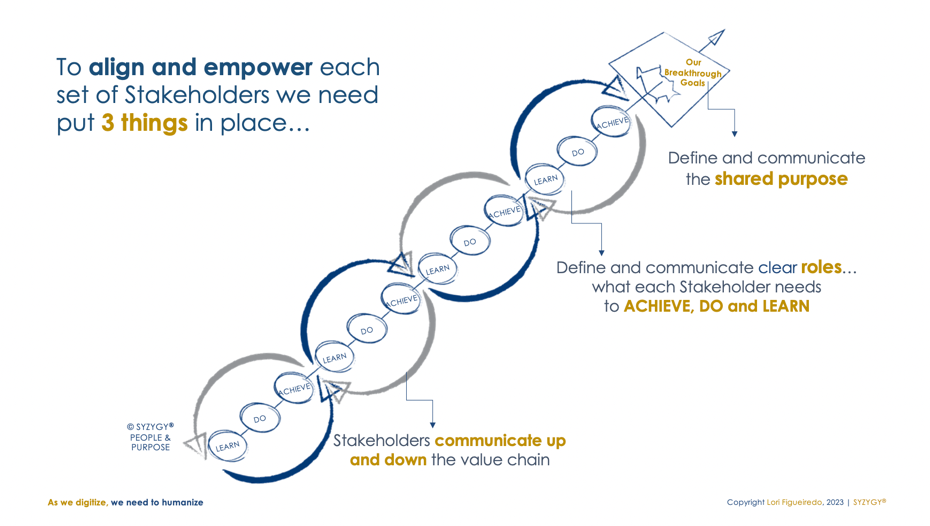
                            He guided the selection of the learntech platforms we explored to enable digital learning. He himself was involved in social and action learning with his peers and subordinates as a daily and conscious habit.  Because of this “operating or engagement model” his people were fully aligned with his strategic priorities and the shared purpose was clearly evident – as depicted in the visual.
                            Diagram

Description automatically generated

                            Therefore, for leaders and teams to work AND LEARN together in a way that is agile, the leaders of any organization, community or ecosystem need to adopt a clear process.  

                            What we mean by that is – as a daily habit – to consciously combine the 3 ways we learn naturally towards achieving the pre-defined change or clear PURPOSE

                            • Learn key content = Education = LEARN IT!
                            • Learn by doing = Experience = APPLY IT!
                            • Learn with/from others = Exposure = REVIEW IT!

                            Let’s use a BIG example, let’s explore the end-to-end professional development journey as a private banker from new hire to being a leader OR a small example, constantly improving how the frontline ensures customers feel welcomed as they enter the store, bank, restaurant or hotel.

                            For both examples when we are highly effective, we would naturally break up a huge, or tiny, body of knowledge into small independent and discrete units.  This natural phenomenon has been labelled microlearning.  

                            For both examples high performing individuals and teams would pre-define the PURPOSE to ensure IMPACT.  

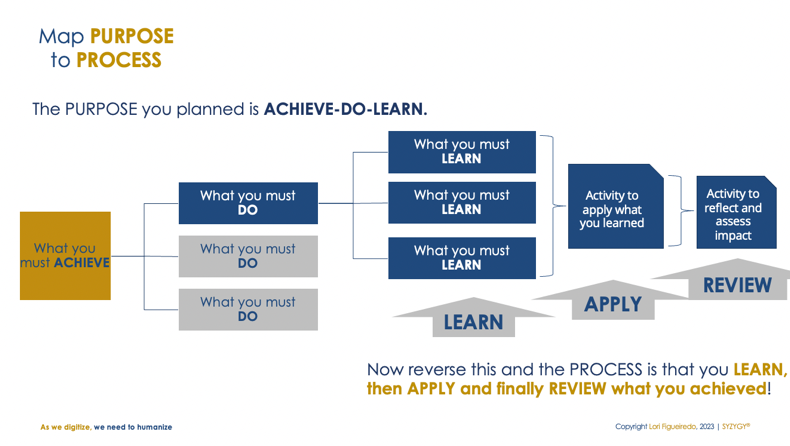
                            As anyone navigating change and their own learning journey, for every microlearning unit, using our PURPOSE, we would have defined what each Learner or group of Learners needs to ACHIEVE (results), DO (behaviours) and LEARN (knowledge, skills and attitudes). 

                            Whether you are the head of learning or the head of Private Banking enabling thousands of private bankers or a private bank navigating your own development, creating this role clarity is critical.

                            Now the PROCESS for the consumer of the learning, we go in the opposite direction. We first LEARN the critical knowledge, skills and attitudes through Education. 

                            Then we immediately APPLY the learning by doing which involves learning through Experience. In addition we REVIEW what we are learning when we exchange, discuss, get coaching, get inputs from others and this has been labelled “Exposure” as part of the highly researched and documented 3Es.

                            Diagram

Description automatically generated

                            Therefore, to create a clear PROCESS, we start by breaking down the learning into bite-size chunks with every microlearning unit being made up of LEARN-APPLY-REVIEW.  

                            Let’s think of these units each as an engaging and meaningful learning experience. Thereafter these series of experiences are strung together into learning journeys.  

                            Finally at an organizational level, many such learning journeys roll up to define the organizational learning strategy. Note that typical organizational strategies when deployed range from including fully end-to-end structured journeys to more dynamic journeys where agile practices are adopted as daily habits.

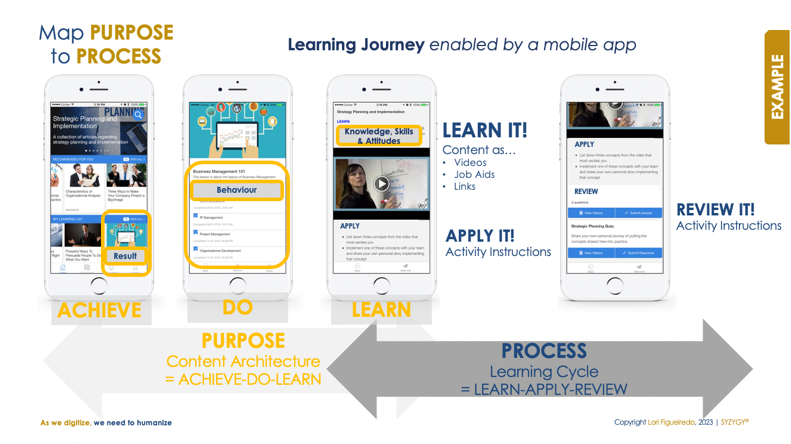
                            This visual shows an example of a mobile learning app where the PURPOSE and PROCESS where embedding in to design and navigation of the end-to-end learning journey to enable the required behaviours and results.

                            From an organisational perspective, we recommend starting with the big picture using the 5P framework to set the overarching learning strategy. Then prototyping specific learning journeys to test and improve the strategy. Over time the specific way of working and learning together for a positive impact is embedded in the culture of the organization.

                            Hello readers! Hope you liked what you read today. Click the like button at the bottom of this page and share insights with your colleagues and friends!

                            For more such amazing content follow Digilah

                            Categories
                            HR Tech

                            Embed clear PRINCIPLES

                            Written by : Lori Figueiredo on Digilah (Tech Thought Leadership)

                            As we are shaping how we work AND LEARN together with our ecosystem of Stakeholders, a clear set of “rules of engagement” or team rules are needed. This is usually assumed that people are on the same page and not discussed. 

                            This may lead to miscommunication, disagreements and stress as there are likely to be different expectations and/or ways of operating.  

                            Being an agile team that is open to learn, adapt and improve as a daily habit, takes some emotional maturity and adaptability amongst all the team members.

                            Though a very simple practice or tool, which is to agree on how the team will work and learn together is a basic fundamental which will increase the chances of success as a group. 

                            This is especially true when we bring together a wide variety of Stakeholders from different backgrounds, professions, areas of expertise and functions.

                            Again, begin with the end in mind – take a moment to imagine NEW possibilities. Imagine creating a safe space that allows you and your various Stakeholders to deliver value to the organization, to each other and to the end customer.

                            You need to be conscious of your set of conscious AND unconscious assumptions about the possible challenges or areas of friction across the set of individuals in the team.  

                            Let’s explore this a bit more deeply. Our assumptions and thoughts determine our behaviours and results.  

                            We each have certain thinking habits which are patterns we keep repeating. These are the “anchors” which influence our view of the world and the way we interact in the world.  These patterns are called our mindset which is based on our past and present experiences (learning and conditioning). 

                            Thinking about our own thinking raises our level of self-awareness. This activity is called Metacognition.  

                            It is a powerful habit to develop. If we are not aware of our mental pictures, we can limit our own success. To help us become more aware, we need to take time out to become conscious of our assumptions and thinking patterns.  

                            A belief is a thought we keep thinking. We can have self-limiting beliefs which block us from progressing. We also have empowering beliefs which enable us to achieve great things and breakthroughs.  

                            To create safe spaces to imagine and create new possibilities while collaborating with others, required conscious positive thinking which will help you develop yourself, your ecosystem as well as improve your collective performance to achieve positive change.

                            Agreeing on the rules or principles will determine how effective you work and learn together in achieving a positive impact. You may also agree on the forums and the frequency you will use to meet and connect. 

                            Raise and discuss the possible obstacles you may have and ways you can minimize them – from the outset. Finally keep checking in to ensure you are adopting these rules as you go about your day or adapt them – if new ones are required. 

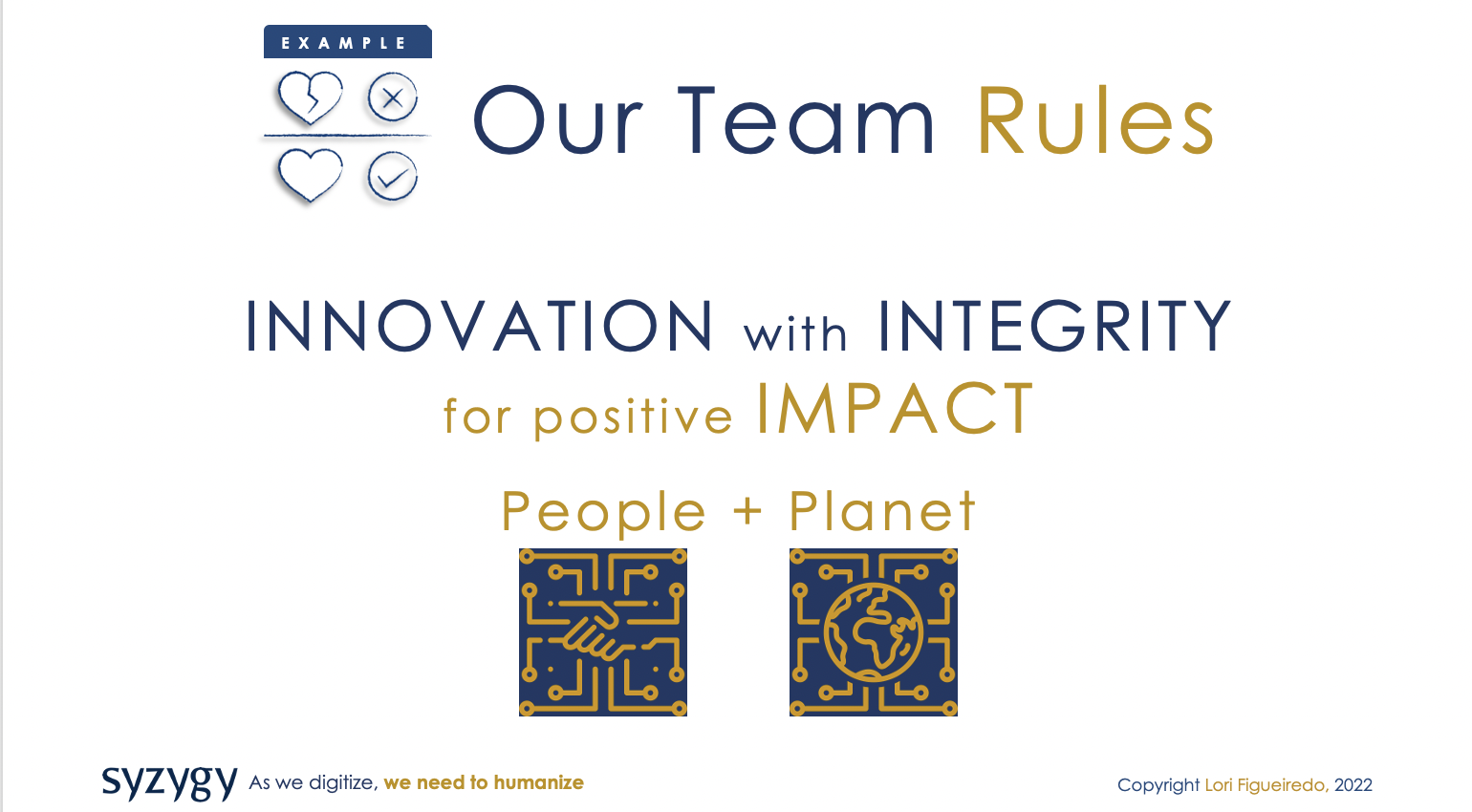
                            Examples of rules could be that “we will…be positive, be open to new ideas and to think out loud as a way to share and generate more ideas”.  

                            Below is one of the rules we have adopted in our Team…whatever we do we must deliver value and have a positive IMPACT.  Or if not possible, we would rather do nothing!

                            Hello readers! Hope you liked what you read today. Click the like button at the bottom of this page and share insights with your colleagues and friends!

                            For more such amazing content follow Digilah

                            Categories
                            HR Tech

                            Define the shared PURPOSE

                            Written by : Lori Figueiredo on Digilah (Tech Thought Leadership)

                            External rewards, such as fair pay, only AVOID dissatisfaction.  

                            External rewards are NOT the most critical motivators.  

                            Internal rewards are the most critical motivators. Striving towards a PURPOSE that is meaningful to you – is a powerful internal reward.  It may include enjoying what you are doing and experiencing personal growth.  

                            Even more powerful than this, is when we have a shared PURPOSE with those whom we respect and connect with.  The larger common purpose we co-create with others is usually:

                            • aligned to our own personal purpose
                            • inspirational and uplifting so we connect to it emotionally and deeply
                            • aspirational as a breakthrough which goes beyond our current achievements

                            Based on these findings, we formulated the SYZYGY® PURPOSE. It is a tool to envisage and define your direction, value and roles of your ecosystem of Stakeholders.  As we get clear on who are the right PEOPLE, co-creating a shared PURPOSE is the next habit.  

                            A pre-defined PURPOSE ensures you target, track and measure the required IMPACT! We always need to begin with this end (shared PURPOSE) in mind to anchor, motivate and inspire ourselves and others. 

                            Think about…? Do you have a clear picture of the impact of your efforts and activities on your organization and people?

                            How might you pre-define a shared PURPOSE as you engage your ecosystem of Stakeholders?

                            With your Stakeholders you discuss and define the broader purpose which is your collective value to the organization and/or larger community:

                            • Your breakthrough goals with concrete measurable indicators
                            • Your strategy which is simply your approach or plan to get there

                            Then you discuss and define the roles. This means you define and communicate what each Stakeholder group needs to:

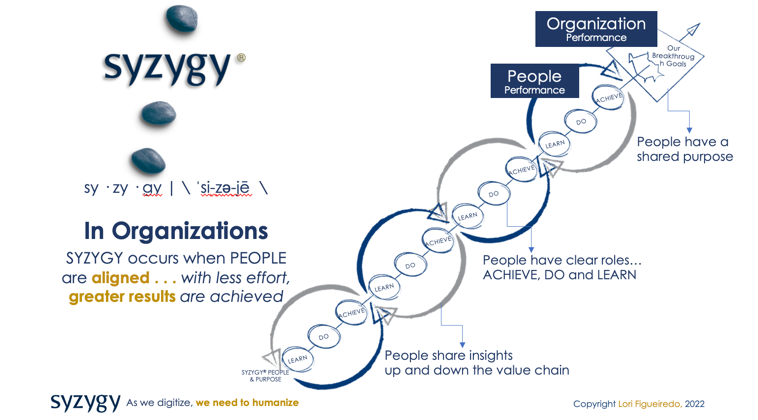
                            • ACHIEVE = results
                            • DO = behaviours
                            • LEARN = knowledge, skills and attitudes

                            When you breakdown performance into very simple, clear and measurable terms, the desired IMPACT on organization performance and people performance becomes very clear. 

                            This role clarity empowers and aligns each Stakeholder group to take targeted, critical and meaningful action. Once all your Stakeholders understand and are aligned to your breakthrough goals and strategy – this state of alignment is called SYZYGY. When aligned, with less effort we achieve greater results.

                            For example, while working, learning, and empowering people to improve their performance – we found it worked best when those involved imagined their own shared purpose.

                            In addition, we found when there is alignment, all the Stakeholders within the ecosystem share information and insights up and down the value chain every day. All those involved can then use this feedback loop to continuously improve what they LEARN and DO to ACHIEVE their shared PURPOSE.   

                            Pre-defining and then targeting to impact the desired performance outcomes is one of the most critical advantages of using the SYZYGY® methodology. Let’s move onto the other 3 of the 5P framework…

                            Hello readers! Hope you liked what you read today. Click the like button at the bottom of this page and share insights with your colleagues and friends!

                            For more such amazing content follow Digilah


                            Categories
                            HR Tech

                            Engage the right PEOPLE

                            Written by : Lori Figueiredo on Digilah (Tech Thought Leadership)

                            During this time of rapid change, Leaders need to slow down to speed up. Leaders that succeed, tune out the noise and stay connected closely to their people – their ecosystem of stakeholders. This is their community or what we might call their modern day “tribe”.

                            They appreciate that we are more successful when we work together with others. Of course, we can be successful on our own. However, we learn and achieve more when collaborating with others.  Engaging a broader group ensures your efforts are supported by all those directly and indirectly involved (versus your efforts being hijacked by others). They can all play a positive role in your journey.

                            In addition, the value of collaboration is that it allows you to tap into a larger pool of expertise and diversity of ideas.  Even our critics – who challenge ideas, actions and assumptions – prove to be very valuable. However, it requires that they are engaged and aligned to the shared purpose.  

                            In any change, strategy or solution design and implementation, think PEOPLE first!  

                            Leaders of positive change, begin by identifying the ecosystem of people most critical to their success. They consider the OUTSIDE-IN view, from the external customers’ lens. 

                            They also consider the INSIDE-OUT view, those up and down the value chain who need to be engaged and involved.

                            For example, from a popular restaurant brand to a leading international bank, the Leaders and Teams mapped all the Stakeholders along a value chain aligned to their strategic direction.

                            They recognised they were unsuccessful when they ONLY engaged the frontline using classroom training at an individual level. Instead, change occurred rapidly when they switched to engaging with the Frontline in their Teams, in their workplace context and together with all their critical stakeholders.

                            In addition, we found such Leaders are curious about understanding basic human psychology. We found successful leaders believe in 3 key human principles.  They assume people have:

                            • an innate wisdom
                            • a natural ability to learn
                            • a need for belonging, connection and shared purpose

                            Furthermore, such Leaders create safe spaces where, together with their Teams, their way of working is:

                              • agile – learning and adapting daily
                              • human centred – focusing on the value and IMPACT on people and our planet
                              • led by a shared purpose – co-creating goals

                              Most important to emphasise… no matter in which field you are, there WILL be some form of technology involved as an enabler. However, leaders of positive change do NOT craft any strategy or solution – leading with technology

                              Instead they shift left, away from defining the technology solution. Instead they start with discovering who are all the PEOPLE (and then PURPOSE – next article) involved.  This ecosystem is engaged to discover the real problems and opportunities to be addressed for positive change.


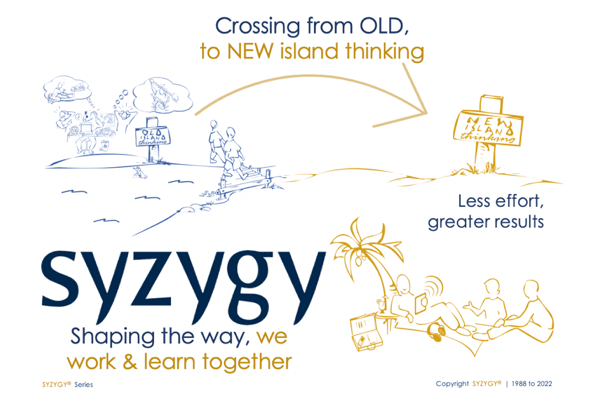
                              Leading with PEOPLE and aligning the 5Ps is part of a journey from OLD to NEW Island thinking. When we BEGIN with right PEOPLE and align them to a shared PURPOSE, the magic happens!  
                              When alignment is attained; breakthroughs are achieved.  We call this state of alignment – SYZYGY.

                              Hello readers! Hope you liked what you read today. Click the like button at the bottom of this page and share insights with your colleagues and friends!

                              For more such amazing content follow Digilah

                              Categories
                              HR Tech

                              Strengthening EM/PM partnership is the key to success in a software shop

                              Written by : Shyvee Shi on Digilah (Tech Thought Leadership)

                              📍 What does a PM (Product Manager) do?


                              PMs articulate the WHY through strategy, define the WHAT through prioritization, and play a supporting role for the HOW. 

                              📍 What does an EM (Engineering Manager) do?


                              EMs work with their teams to figure out HOW the product should be built (e.g., tech stack, frameworks, and architecture, etc.), WHO builds it and WHEN it will ship.

                              🔑 What are the expectations of an EM in a Tech organisation?

                              ▪️ Active involvement in product brainstorming
                              ▪️ Highlight technical complexity of a solution
                              ▪️ Drive technical execution and decisions
                              ▪️ Empathy for user and business needs
                              ▪️ Manage sprint planning + retro
                              ▪️ Embrace big picture thinking
                              ▪️ Assume positive intent 

                              In a software shop, many roles cross paths on a daily basis but not more than the Engineering Manager (EM)’s and the Product Manager (PM)’s path.

                              🤝 This partnership is the one that not only ensures successful delivery of software but also things like motivation, transparency, alignment, prioritization, innovation and everything in between.

                              Starting from exploring the importance of this partnership, to setting the right expectations and sharing best practices. 


                              Here are five tips to strengthen the partnership: 👇

                              1 Build a relationship


                              This is one of the most critical relationships you will ever have at work. And just like any other relationship, you get what you give. Do not leave it up to chance. Get to know each other, understand each other’s goals, priorities, communication preferences, working style, etc. Schedule regular sync-up meetings and invest the time to deepen the relationship. 

                              2 Get on the same page


                              Make sure you represent a united front and be the cheerleaders for the team. There is nothing worse than a conflicting set of priorities for a team and ensuring that doesn’t happen starts with you two.


                              3 Assume Positive Intent (API)


                              The heading says it all. It’s busy, there is a lot going on at all times. There are many communication channels and oftentimes you end up doing or saying something that the other person doesn’t agree with. It’s okay. Assume positive intent. Reach out, verify, and reassure the trust.

                              4 Communicate early and frequently

                              This one cannot be emphasized enough. There should be a direct line of communication between the EM and the PM. Share even if you think it’s something trivial. Share your concerns, ideas, progress, feedback, and any other developing stories necessary. 

                              5 Shorten the feedback loop


                              🤝 The HOW part is a collaboration as both sides need input from each other to choose the optimal solution.

                              Most searched question

                              Why is PM software important to your business?

                              What are the benefits of using project management software?

                              What are the key responsibilities of a project manager?

                              Most searched queries

                              Maintaining software is important

                              How to collaborate effectively

                              Collaboration in the workplace


                              Hello readers! Hope you liked what you read today. Click the like button at the bottom of this page and share insights with your colleagues and friends!

                              For more such amazing content follow Digilah