Digilah

Categories
Sustainability Tech Wellness/Beauty Tech

The Green Age of cosmetics

Written by Science Centre Singapore on Digilah (Tech Thought Leadership)
Illustrations by Lim Daphne

As consumers we have a responsibility to the climate while shopping for personal care items.

The infographic below can be used as a guide to look for what ingredient is climate friendly as we buy our cosmetics.

Text Description automatically generated with low confidence

Hello readers! Hope you liked what you read today. Click the like button at the bottom of this page and share insights with your colleagues and friends!

For more such amazing content follow Digilah

Science Centre Singapore

Categories
Ad Tech

Recycled advertising impressions and eco-friendly campaigns

Written by : Anas Ech-chaoui on Digilah (Tech Thought Leadership)
Illustrations by Lim Daphne

The idea was born from an inventory recycling idea by Thomas OBJOIS and Julien GALIM.

The two co-founders and entrepreneurs used their previous experience, and they have established this unique technology for digital marketers..

During the rise of programmatic in digital, they realised the downside of the complexity of this technology and established a company for recovering lost ad calls and turn them into valuable/monetizable impressions.

The extent of this phenomenon is still little known, as are the various causes of this consequent advertising mess.

This 100% French-origin company has been combating advertising waste and reducing the carbon footprint of digital campaigns through its pipes.
Ampoule et engrenage contour

Sustainable and profitable solution for publishers

Based on our team’s experience at Lagardère Group, we have seen that more than forty technical problems were preventing the distribution of millions of advertising impressions.

We call them “ghost impressions”.

How this works in a nutshell:

After our script is integrated into the publisher’s code base and we start to analyse the site’s inventory pages and advertising placements, we are able to map the loss and suggest the worth of the “ghost impressions”. After the full launch of the solution, we can identify and recycle the lost impressions in real time. It is important to mention that we respect all Core Web Vitals without impacting the quality of the user experience or the page behaviours such as loading time.

Being in the market for years, we see that the recyclable impressions represent on average 20% of a website’s total display inventory.

In 2022, our technology recovered and monetised more than 19 billion ad impressions.

Where do ghost impressions come from ?

ADVERTISING RELATED ISSUES

      • Connection problems during API calls of solutions (SSPs/Ad Servers/bidswitch…). 

      • Glitches in cross-origin requests to REST APIs or calls to solution servers. No ad response.

    SITE RELATED ISSUES

        • Failed or misconfigured lazyload ad logic that does not allow the execution of the slot 

        • Issues in the ad slot CSS that prevent the ad from being displayed

      VISITOR RELATED ISSUES

          • Loss of connection to the user’s device caused by micro-cuts 

          • Website or web tools are not adapted to certain browsers

        How does our solution work for a publisher?

        BCOVERY is a comprehensive technology and it operates by inspecting/scanning the content and HTML structure of the publisher sites.

        When a ghost impression occurs due to any technical reasons, our proprietary algorithm analyses the ad call  and makes the impression available to the publisher/advertisers for monetisation.

        We are is present in 5 countries and continuously growing.

        It supports more than 400 publishers worldwide (France, Germany, Japan, UK, USA)

        Milestone 2022 : 

        We as a company decided to do more for our environment and help digital marketers in maximising their potentials, therefore and to create the first eco-responsible French Marketplace.

        This Marketplace brings together all the publishers’ recycled inventories allowing us to provide incremental, trusted and high-performing impressions to the demand side.

        Advertisers – How do we reduce the carbon impact of media campaigns?

        Agencies and advertisers are increasingly aware of the carbon impact of their campaigns and realise that not all of the supplies emit the same amount of carbon.

        We also see that agencies and advertisers are increasingly favouring low-carbon impact inventories, and we want to help them achieve this…

        Echoing the above, BCOVERY convinced and determined about the need to measure and reduce the carbon emissions of advertising impressions and keep a more sustainable overall nature of digital campaigns.

        As a matter of fact, using our network, an advertiser considerably reduces the carbon footprint of its media activity. Here are the three drivers:

            1.  Recycled and low-carbon impressions

            1.  Reduced creative weight while ensuring effective communication

            1.  A direct and secure delivery channel (vs. a complex programmatic chain)

          Une image contenant texte Description générée automatiquement

          What is next?

          Our next mission is to create similar marketplaces in other countries and help the digital industry to be more sustainable than before.

          The three pillars of our ambition: 

          SENSITIZE 

          on the importance of the delivery channel in its CSR advertising strategy.

          POSITIONING 

          advertising recycling as a solution to buyers’ need for great performance and energy savings.

          REPLACE 

          energy-consuming advertising strategies with investing in recycled, responsible and qualitative inventories.

          Finally, one of our achievements:

          Our recycled campaigns

          ALDI Digital Campaign

              • 80M recycled impressions

              • 60% carbon saving

              • High performance clicks and viewability

            In line with its anti-waste strategy and its desire to reduce the carbon footprint of its advertising campaigns, ALDI has partnered with BCOVERY in 2022 and because of our success we renewed our partnership –  as one of the major partners of ALDI for 2023.

            If your answer is YES to the following:

            You are a publisher and want to know the amount of your recyclable inventory?

            You are an advertiser and want to reduce your carbon emissions?

            Contact us directly by mail at hello@bcovery.com

            Are recycled products eco-friendly?

            What are 5 benefits of recycling?

            Most searched queries

            Eco friendly campaign ideas

            Best green marketing campaigns

            Hello readers! Hope you liked what you read today. Click the like button at the bottom of this page and share insights with your colleagues and friends!

            For more such amazing content follow Digilah

            Categories
            AI Tech

            ChatGPT and Generative AI’s – A Digilah view

            Written by Vidya Dhareshwar on Digilah (Tech Thought Leadership)

            Chatgpt, Bard AI and all the generative AI seems to be the current flavour. There is an insurmountable buzz around and about it . 

            Everyone has an opinion on its impact and the ways that it can change, how we and our future generations engage with and use tech in our daily lives.

            Whilst there have been many concerns on its impact on search engines, students, jobs and livelihoods, the fact remains that this evolution has happened and is here to stay.

            ChatGPT alone has been the fastest growing consumer internet app ever with over 100 million users two months after launch. This itself shows the vast potential of generative AI.

             Just as life evolves, so does technology and yet this revolutionary technology doesn’t take away from human intelligence instead it is trained to learn what humans mean when they ask a question. 

            Many users are awed at its ability to provide human-quality responses, inspiring the feeling that it may eventually have the power to disrupt how humans interact with computers and change how information is retrieved.

            In the context of Digilah, where we like to provide a digital platform for every tech enthusiast to learn and contribute their tech journey and thought leadership, we view chatGPT, Bard AI and all other generative AI’s as an enabler and an opportunity for many of our start up and tech founders to share their learnings.

            Let’s talk about the tech startup market in South East Asia alone. As per a Forbes article, The digital and tech industries of this region have enjoyed an enormous boom over the last few years. 

            According to Jungle Ventures, Southeast Asia’s technology startups had a combined valuation of $340 billion in 2020, and they anticipate this will triple by 2025.

            This is a diverse but very strong prospective market with a focus in Vietnam, Thailand, Indonesia, Malaysia, Singapore and the Philippines.

            This market is quite complicated. Many entrepreneurs are hindered by concerns over a difference in mentality and a lack of understanding of how to do business there. We @ Digilah look at this as a huge opportunity.

            There is a need to get all of the learnings and journeys of these startups and founders so that this rich knowledge repertoire is available to all. 

            Many of them would like to share their journeys and provide their insights but sometimes are busy learning and navigating the markets and business challenges and for some it might also mean a constraint in terms of resources and skills to share their journeys be it content creation or communication skills or just time.

            We present the combined power of Human Experience with the generative AI’s in the form of articles published by us at Digilah. Our submission is to use the vast reach of the generative AI tools to start the journey.

            What this tech will do is provide for a framework, a skeleton, a structure of an article , a startup founders journey as a start point. This can then be brought to life by adding the content  and context of experience, leadership, success, failures and insights by the tech founders.

            These articles are extremely valuable and become a  rich database of insight and knowledge for all knowledge seekers today and for the future.

            In short, in our view, ChatGPT, Bard AI AND Human Experience is the opportunity to build the knowledge here at Digilah, all at the click of a key.

            Hello readers! Hope you liked what you read today. Click the like button at the bottom of this page and share insights with your colleagues and friends!

            For more such amazing content follow DigilahVidya Dhareshwar

            Categories
            HR Tech

            Define the shared PURPOSE

            Written by : Lori Figueiredo on Digilah (Tech Thought Leadership)

            External rewards, such as fair pay, only AVOID dissatisfaction.  

            External rewards are NOT the most critical motivators.  

            Internal rewards are the most critical motivators. Striving towards a PURPOSE that is meaningful to you – is a powerful internal reward.  It may include enjoying what you are doing and experiencing personal growth.  

            Even more powerful than this, is when we have a shared PURPOSE with those whom we respect and connect with.  The larger common purpose we co-create with others is usually:

            • aligned to our own personal purpose
            • inspirational and uplifting so we connect to it emotionally and deeply
            • aspirational as a breakthrough which goes beyond our current achievements

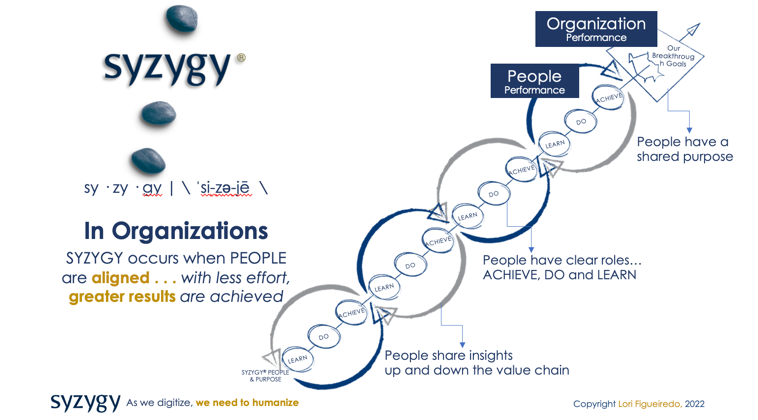
            Based on these findings, we formulated the SYZYGY® PURPOSE. It is a tool to envisage and define your direction, value and roles of your ecosystem of Stakeholders.  As we get clear on who are the right PEOPLE, co-creating a shared PURPOSE is the next habit.  

            A pre-defined PURPOSE ensures you target, track and measure the required IMPACT! We always need to begin with this end (shared PURPOSE) in mind to anchor, motivate and inspire ourselves and others. 

            Think about…? Do you have a clear picture of the impact of your efforts and activities on your organization and people?

            How might you pre-define a shared PURPOSE as you engage your ecosystem of Stakeholders?

            With your Stakeholders you discuss and define the broader purpose which is your collective value to the organization and/or larger community:

            • Your breakthrough goals with concrete measurable indicators
            • Your strategy which is simply your approach or plan to get there

            Then you discuss and define the roles. This means you define and communicate what each Stakeholder group needs to:

            • ACHIEVE = results
            • DO = behaviours
            • LEARN = knowledge, skills and attitudes

            When you breakdown performance into very simple, clear and measurable terms, the desired IMPACT on organization performance and people performance becomes very clear. 

            This role clarity empowers and aligns each Stakeholder group to take targeted, critical and meaningful action. Once all your Stakeholders understand and are aligned to your breakthrough goals and strategy – this state of alignment is called SYZYGY. When aligned, with less effort we achieve greater results.

            For example, while working, learning, and empowering people to improve their performance – we found it worked best when those involved imagined their own shared purpose.

            In addition, we found when there is alignment, all the Stakeholders within the ecosystem share information and insights up and down the value chain every day. All those involved can then use this feedback loop to continuously improve what they LEARN and DO to ACHIEVE their shared PURPOSE.   

            Pre-defining and then targeting to impact the desired performance outcomes is one of the most critical advantages of using the SYZYGY® methodology. Let’s move onto the other 3 of the 5P framework…

            Hello readers! Hope you liked what you read today. Click the like button at the bottom of this page and share insights with your colleagues and friends!

            For more such amazing content follow Digilah


            Categories
            Law Tech Web 3.0 Tech

            “Law and technology produce, together, a kind of regulation of creativity”

            Lawrence Lessig

            Written by : Sophie N. Ngouakang on Digilah (Tech Thought Leadership)

            Sophie N. Ngouakang is the managing partner of Tchinsop Law Firm & founder of “Veritas Bitcoin”. My love for innovation has led me to combine interests in technology and law practicing in a tech-related area of law such as Blockchain which to me is very promising than other law specialties. (No offense to my law colleagues with different interests). That is what I decided to do and have been doing for quite some time.   

            When it comes to law and technology, one could ask several questions among which – if laws will ultimately have to change to keep up with modern tech or tech will have to adapt to keep in line with the law, considering for instance that many terms and conditions on apps are agreed to by minors?

            Minors agreeing to apps is another issue. Parents have an obligation to control what their minor children access. From time-to-time parents have gotten out of financial harm caused by their minor children spending money on apps, but it isn’t always a sure thing. There is a law about collecting information about children under the age of 13, but there isn’t much behind it since the children invariably check the boxes that say their parents have provided permission.

            Laws constantly change to keep up with technology. Unfortunately, they often change too slowly. A good example of that would be the failure of the many governments to enact meaningful reforms related to privacy as technology has become more invasive. Habitually, in the law, we adjust the language of things we write or our approaches to conflict resolutions based on changes in technology. 

            However, sometimes the law does not address underlying problems and without amendments to existing laws or new laws it is difficult to resolve problems, both criminal, commercial, and civil, within the legal system.

            Technology is only as good as the purpose for which we use and not necessarily for which it was intended. It’s essential to state that technology therefore, can’t be considered as a neutral tool since it all depends on how it is used.

            Humans abuse tools more often than the intended designer would prefer. Like screwdrivers being used as murder weapons, the technology is not neutral because human operators are not neutral.

            The most spoken about technology in recent times seems to be the Blockchain technology.

            Blockchain is a decentralized, peer to peer, immutable storage network which is censor free and regulator free because of the absence of one single controlling entity.

            Every transaction that is written is voted upon by a majority of nodes and changing something which was written before in the chain is computationally very difficult.   

            When blockchain matures to the point of being “the law”, the difference will be that “what happened when” will not take up as large a part of court hearings as today. Also, many disputes will not ever reach court because of more automatic settlements occurring before, as contracts automatically settle when parameters are breached.

            You will probably see many systems of law competing for adherents, they will all have to somehow interface with the legacy system until the legacy system either innovates to compete or is abandoned in favor of better regimes.

            Criminal, corporate and civil law firms will need to develop an understanding of how cryptocurrencies can be used to facilitate transfers of value worldwide, which will inevitably creep into cases of all kinds as it becomes clear that currencies like bitcoin are here to stay.

            As it becomes established case law, there will also be increasing numbers of things where the incorporation of information into a blockchain becomes proof that the information existed or that something happened at that point in time.

            Some countries have been much better about dealing with this technology than others as far as amending laws and/or passing new ones are concerned. El Salvador for example being the first country to legalize bitcoin as legal tender. 

            I think joining the tech-space with a legal background is always a plus and the inputs one can bring are countless. The first contribution that one can do is for “Smart Contracts”. 

            Smart Contracts are executable code that get executed upon the activation of an event in a contract.

            I always encourage persons with an interest in law and technology to get an understanding of “Smart contracts” as I see a great demand for people in the near future. We will always rely on human cooperation to uphold the law.

            As an illustration, if a person defaulted continuously on his rent payment for 3 months, a smart contract has the power to remotely lock the appartement.

            Taking the comparison in the real-world contracts, the Terms & Conditions for a lease agreement would have been drafted by the Attorney of the landlord that exists on paper. In case of default in the payment of rents, although the clause gets invoked, the landlord would still have to serve the tenant a notice to quit, before confiscating the keys to the appartement.

            With a “Smart Contract”, it is automated. Indeed, technology and law together produce a kind of creative regulation unprecedented in history, as Lawrence pointed out.

            In the end, laws change over time. We see that constantly. For example, we didn’t always have cars. Then we didn’t have cars that went very fast. Now look at all the laws related to building, owning, and operating cars. 

            Most searched question 

            What is Lawtech?

            What is law technology today?

            Most searched queries

            Legal tech Asia, Africa

            Legal tech industry


            Compliance and law

            Hello readers! Hope you liked what you read today. Click the like button at the bottom of this page and share insights with your colleagues and friends!

            For more such amazing content follow Digilah

            Categories
            Med/Health Tech

            Health tech a boon to Women’s health

            Written by : Bhawana Yadav on Digilah (Tech Thought Leadership)

            Women’s health is the most neglected sector, even after multiple attempts of bringing attention to it on different horizontal and vertical levels. According to WHO health is the culmination of the physical, mental, emotional, and spiritual well-being of an individual

            A woman starts her biological journey from the onset of puberty, fertility years, and menopause, and till life continues. 

            LevelUpForWomen, a women’s health and wellness-based startup working on the niche of reversing PCOS was co-founded by partners Chetan Arora and Bhawana Yadav. Polycystic Ovarian Syndrome is a common endocrine disturbance that affects roughly 6% to 12% of women of reproductive age. The data is still insufficient as most of the women go undiagnosed due to several factors in their lives and the lack of PCOS-based specific scientific research and developments.

             The startup was conceived based on personal experience and lack of guidance by the medical fraternity for the initial years of bearing with PCOS symptoms. It is currently bootstrapped and is already on the profitable side from the business perspective. 

            Technology has been a boon for women’s healthcare, especially in the post-pandemic world. It can be looked at from both the sociological and economic lens to arrive at the conclusion that healthcare and technology are a great combination for the knowledge and wellness revolution. 

            In a research conducted by Mckinsey, they analyzed 763 FemTech companies (FemTech a term coined by entrepreneur Ida Tin) largely tech-based and enabled, consumer-centric solutions addressing women’s health, excluding biopharma and incumbent medical devices as well as the companies which included unisex services.

            It concluded the beginning of the FemTech revolution and domination in public awareness and generating large-scale funding, However, the services were earlier limited to menstrual products, devices, and applications. 

            New startups like LevelUpForWomen have proven to be a one-stop virtual healthcare and wellness platform. 

            In our experience and case studies, technology in terms of social media has become a great tool for social awareness and probing to take an action even if you are sitting in the far remote corner of the country.

            It does not just act as a catalyst and solution provider to the direct consumer but also a great medium to sensitise other genders and generations which have hushed over women’s reproductive health for centuries. 

            In the post-pandemic world, the mental and physical health of women has undergone a major toll, being the bearer of family and trying to manage work-life balance has become even more difficult. The results are visible in hormonal imbalances, increased stress, anxiety, and depression cases. Women feel safer reaching out to judgement

            -free healthcare solutions online rather than visiting traditional clinics where the approach is the same as it was 20 years ago. 

            The FemTech revolution in the healthcare industry is still in a nascent stage and will take time to be accepted in Tier-2 cities with fewer apprehensions but it is the dawn of the future.

            Women are finding a supportive community via these technological mediums and a platform to grow and heal and restore balance in their lives. These developments promise a tomorrow where health tech will not just expand the female consumer-oriented business but also provide an opportunity for groundbreaking research and growth for sustainable women’s health. 

            MOST SEARCHED QUESTION

            What is a common female health concern?

            What is the most important issue in women’s health?

            MOST SEARCHED QUERIES

            Women’s health startups India

            FemTec Health careers

            Hello readers! Hope you liked what you read today. Click the like button at the bottom of this page and share insights with your colleagues and friends!

            For more such amazing content follow Digilah

            Categories
            Logistic & Travel Tech

            Happy employees are key to achieving goals


            Written by Kiran Sidhu on Digilah (Tech Thought Leadership)

            Great top-down leadership doesn’t end at laying down the groundwork. A good business leader knows that a people-first mindset is key to a company’s growth. It is a fact that staff satisfaction tends to reflect on their productivity and loyalty. And who better to represent your company than a loyal and happy employee?

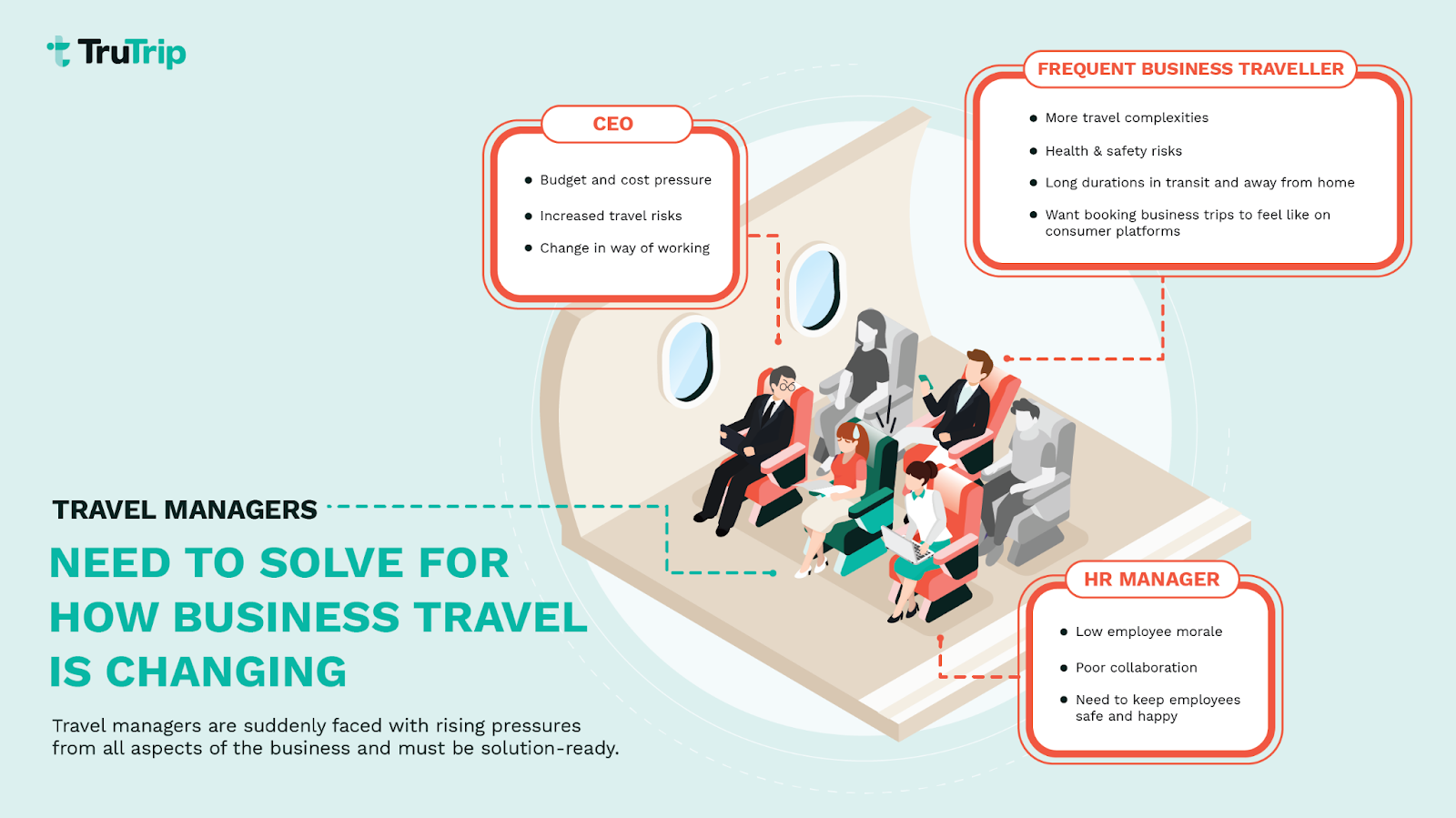
            Business travel today is one aspect of work that is very much changed from how it was pre-2020. It is an area that business leaders must acknowledge has a direct impact on employee happiness. Travel risk and trip preparations call for more energy and closer attention to detail in order to achieve quality business trips. 

            But it is not just “how” business travel is done that has changed. Companies are also assessing the “why” and assessing the rationale behind each trip. Business travel is often pitted against video calls though the former is proven unrivaled in forging connections and winning deals. However, paying more attention to the purpose of travel is worth doing to achieve greater employee happiness, less risk and save costs.

            Are employees happy to travel for business? 

            The novelty of jet setting for work can wane over time – no one likes long layovers, delays and crowded airports. But the bleisure trend shows no sign of slowing. On top of that, people want to deliver their best work and excel in their careers. And research shows that face-to-face meetings and business trips yield better business results. Whether employees like to travel for business comes down to a matter of preference and support. 

            This is where business travel management makes all the difference, not just to those traveling but also to employees in human resources, finance, managers, and other roles. Modern travel management empowers employees to choose how they travel within the parameters of the company travel policy. Travel management done right lets employees know they are well protected, trusted and valued. The culture of a company is determined by how people feel at work.

            Here’s how modern, technology-driven business travel management keeps employees happy.

            Peace of mind with risk & safety tools

            Safety is not just about having a policy in place but communicating it well to ensure employees know how they are covered. Employees having peace of mind is invaluable, especially when in a new and unfamiliar environment. Feeling safe during business trips positively impacts confidence and unwittingly equips them to do better work.

             Your company travel policy may cover how employees are taken care of if something goes wrong but using a modern travel management tool ensures you stay proactive in preventing untoward incidents. 

            Global disease outbreak? TruTrip’s integration with Riskline, for example, alerts you ahead of time so you can choose your next course of action – whether repatriation, treatment or other support. 

            Employees achieve more when admin tasks are fewer

            Business travel requires careful planning, budgeting and reporting. When done manually, one business trip creates spillover tasks for human resources, finance, team managers, travel managers, administrative staff and the traveler itself. That’s a lot of time that can be saved through streamlining and automation.

            Using a travel management platform frees up your employees’ time, letting them do more of the work they take pride in. No more booking and comparing flights and hotels on different platforms; researching travel requirements; reimbursements and reporting; lengthy back and forth travel approvals and requests, and arcane company travel policy. 

            Overall, it sets your company up to do more and better meet your goals.

            Empowering employees to make travel choices 

            Company travel policies inform employees of budgets and other rules to comply with. But despite the best of intentions, business trip bookings and expenses may sometimes fall outside the confines of travel policy. Using a travel management platform takes away the challenge of implementation. Set up your company travel policy and bookings are automatically compliant. 

            Instead of restricting employees to booking with certain hotels and star ratings, smart policy implementation lets them choose travel based on their needs and preferences – whether that is direct or connecting flights, unique accommodation types and other trip extras. Select a travel management partner that gives you extensive travel choices. These minor customisations can go a long way to ensuring business traveler satisfaction. 

            Support and service at every stage of your business trip 

            A dedicated support team that’s one call, chat, or email away at all times can take the edge off traveling in a high-stress environment. Quality travel management gives you easy, self-service options to make planning business trips a breeze. And at any point, if you need help, having someone to talk to makes for a better overall experience. 

            But it is not just pre-trip that support is useful. Employees having access to the right support while on business trips are critical. Things can go wrong when traveling – missing travel documents, injuries, bad hotel experiences and more. Your travel management partner is your dedicated point of contact to help resolve issues for you. 

            TruTrip makes business travel enjoyable and safeWith our modern technology and tools, employees can better dedicate their time to organizational growth. There is no better time than now to get started on impactful business travel. To learn more about TruTrip, schedule a demo or sign up for a free trial.

            Most searched question 

            Why are happy employees essential for a successful business?

            What are 10 ways to motivate employees?


            Most searched queries

            Benefits of happy employees

            Happy employees are productive employees


            Hello readers! Hope you liked what you read today. Click the like button at the bottom of this page and share insights with your colleagues and friends!

            For more such amazing content follow Digilah


            Categories
            Digi Tech

            Top 10 Secrets For A Good Website

            Written by Paul Lim on Digilah (Tech Thought Leadership)

            Today, we live in the world of the Web. It is common for companies to have websites and about 80% of consumers use the Internet to research on a business, product or service before making a purchase. But what if you do not exist on the Internet?

            Establishing a web presence can prevent competitor from poaching your customers and simply setting up an appropriate company website can reel your target audience right in.

            Websites can also improve customer service. As there is no downtime on the Internet, customers can be updated 24/7 and have their queries answered almost immediately. And what better way to provide them with value-added service than to share handy information on your website? Knowledge sharing is one method to connect with potential customers and eventually convert them into sales.

            What is crucial is to build a website with the fundamental capabilities that garner and drive targeted traffic.  Here are 10 website to creating an ideal website to attract visitors and generate revenue.

            1. Know Your Target Market 

            The first step towards recognizing your target market is to have a proper understanding of the problems that your business tackle. Thereafter, identify the groups of people will be affected by these problems, these individuals will make up your target audience.

            Make a list of your target audiences and group them accordingly to categories sure as profession, age, education levels, and gender. Find out how these groups of people may benefit from your products and services by questioning what they lack in their lives and meeting their needs where possible.

            2. A Clear Navigation Bar

            A clear navigation bar is a plus to any website. Choose simple names for the tabs on the navigation bar and the web pages – logical naming of both tabs and web pages should guide and direct visitors to a specific call-to-action.

            3. About Us

            The primary purpose of an About Us page is to inform the user about your company and what you do. The page should furnish visitors with the basic background information they need such as the company’s history, awards and achievements as well as social proof and authentic statements that can give your company image a boost.

            4. Strong Headlines

            There are millions of websites in the cyberspace competing for several keywords trying to be recognized as the first hit on search engines – but how exactly do you get people to read what you write?

            Although good content and aesthetics are of great value to a website, a strong headline could give your website an edge over others. Pay special attention in crafting catchy and compelling titles for your headline and think out of the box to appeal to consumers and obtain the click-through.

            Useful key words that trigger consumer action include Free, Discount, Guaranteed, Incredible Offer, 1-for-1 promotion etc. To truly persuade a visitor to constantly return to your website, use question words such as What, Why, When or How as visitors are often looking for answers to their various queries.

            Take the subject “Driving A Car” for instance. 3 effective examples are:

            • “How to drive a car?”
            • “Why I Love Driving A Car?”
            • “10 Ways to drive a Car safety”

            5. Integrate Social Media & Videos

            Using Social Media and embedding videos in your content can direct traffic to your website on a regular basis. The inbound links to your website from high-profile social media platforms such as Facebook, You Tube, Twitter, Tik Tok and others will increase your search engine results page ranking.

            Consider creating the following social media profiles:

            • Linkedin – A professional site to showcase expertise and reach out to potential clients based on skills set
            • Twitter – A social sharing platform where you can post relevant tips and information with links to corresponding articles on your website
            • You Tube – Upload short yet succinct videos to demonstrate useful tutorials and give advice to

            Always include a link back to an appropriate landing page on your own website and ensure you include a call-to-action on the page, for instance “Retweet” or “Share this video”

            6. Power Pictures and Graphics

            Simplicity and succinctness are key in creating messages that are straightforward to understand. People are often impacted visually than textually; hence good graphic designs and images are more effective in engaging site visitors compared to text alone. A dynamic picture can drive higher consumer engagement which can lead to higher sales figures.

            7. Provide Impressive Testimonials

            Positive and impactful testimonials are excellent for boosting site traffic. If you are in the service industry that replies on customer service and referrals, positive and impactful testimonials that appraise your company’s services will drive greater traffic to your site. For instance, an outdoor event service business could have client testimonials about the excellent service delivery and efficiency.

            8. Order Page

            The main goal of any e-commerce website is to convert visitors to buying customers. The order confirmation page is usually called a ‘Thank You’ page.

            It is only right to thank your customers each time they complete a payment and more importantly, it helps you to maintain healthy relationships and interaction with them, thereby increasing their returns to your site.

            9. An Opt-in Box

            The use of personal data is a sensitive issue today-companies need to gain consumers’ approval with regards to collection, storage, usage and distribution of their information. Using an individual’s data without approval can put an organization in trouble. Hence, providing an “opt-in” box for users will allow them to indicate their consent and method of contact from the company or organization, thereby recording their decision.

            10. Contact Us

            Any business that strives to engage its target audience needs to have a feedback channel where those interested in the company’s services or business can contact the relevant people for more information. Sign up for a customized domain email address and phone number and make sure you attend to your calls and answer your emails promptly.

            Contact for more www.pauldigitaltraining.com

            Categories
            HR Tech

            Fittest Companies – Work Environment Transformation

            Written by Mona Singh on Digilah (Tech Thought Leadership)

            Remote working has significantly impacted various aspects of workspace culture, environment, and interaction across industries. Remote working was only available to few people from the IT industry before, but pandemic led changes have brought digitalization and induced rapid global transformation to many other industries which were initially perceived as traditional and required physical presence.

            Though the remote working practices were adopted as a necessary measure during the pandemic; they seem to be here to stay. WFH (Work from home) / remote working is the ‘new normal’. There are many companies that have decided to switch to work from home permanently and many other companies have adopted the Hybrid Work model. Employees are not ready to return to the offices and this has forced companies to adopt technologies to support remote work styles. Orthodox work culture will not survive in the era of digitalization.

            Global Competition: New technological advancement and adoption has opened the door of global opportunities for job seekers as well as employers. If someone is staying in Delhi (India) and is not flexible to move to another city due to various reasons, they had to look for options only in Delhi. This has changed and the employee can now apply anywhere and can work remotely. Likewise, employers do not have to look for talents only from the location of their office. This is bringing global talents to one platform.

            Missing Human interaction: While this is good for many, there are other dimensions to be investigated. Many employees still prefer to work in physical offices and miss bonding with their team, gossiping with others! or just meet a new person from another team during coffee/tea break.

            According to an article published in Forbes on 13th Oct,2021, a study by Condeco shows that “nearly half of U.S. companies offered remote work options already in 2019. In 2021, this number increased to 58.6%”.

            Remote working can benefit the companies and can increase profits in many ways:

            1. Reduced infrastructure cost: Remote work eliminates overhead costs like lease expenses, office furnishings, utilities, insurance, supplies, upkeep, and repair. Workplace cost and benefits statistics by Global Workplace Analytics reveal that IBM saved $50 million in real estate costs by allowing remote work.
            1. Increased productivity: An employee’s productivity depends on his/her lifestyle. Same 9 to 5 work schedule might not work for everyone. This flexibility will allow employees to work during their most productive hours and this will certainly increase their productivity.
            1. Employee Retention: Flexible remote work will help in employee retention by keeping them happy and healthy. Remote workers have better work- life balance which results in happy employees. Happy employees mean reduced attrition.

            From the employees’ perspective, remote work has also created a different expectation where many companies expect the employees to be available 24*7.  This is the other side of the same coin. There is a tradeoff here.

            We should not hesitate to adopt new technologies if it makes our life easier and better. At the same time human interaction and emotions should not be missing. This is a time where companies are doing their best to be in the list of most employee friendly companies, while others are still clinging to 6 days a week work culture. For these orthodox companies, the well-being of their employees working for them does not matter.

            But, in the long run, only the ‘fittest’ companies will survive.

            Categories
            HR Tech

            Eureka! Unlock the Power of “Remote Intuition” in Zoom/Teams/Google Meet

            Written by (tk) krishna thothadri on Digilah (Tech Thought Leadership)

            Intuition – The X factor critical to generating ideas collaboratively but not something one expects over a Teams workshop involving a dozen people across five time zones, multiple languages and ethnicities. Unlocking the power of collective intuition had been my forte in the hundreds of workshops I had conducted during the pre-COVID decade. I was a firm believer that the revolutionary efficiency of Zoom/ Teams could never deliver the magical inefficiency of unstructured intuition and ideation. Physical workshops were the Hogwarts of collective intuition, and “Remote Meetings” were the Death Eaters! I had completely stopped doing such workshops.

            As COVID dragged on, Teams, Zoom and Google Meet tried to address the issue with rooms, Whiteboard and Jamboard. I experimented with these shiny new toys but quickly realized that remote meetings had become camera-off, mute-on time capsules when people multi-tasked; learning new ways to jam about ideas was an extra behaviour change no one wanted to do.

            One year into COVID, I found inspiration from an unlikely source. My middle-school son was attending remote classes and he was sharing ideas with his classmates! His teachers had found a way to keep self-learning and collaborative intuition alive. There were no new shiny toys, just basic stuff- Google Search( text, images, Youtube), Google Slides, PowerPoint, the laptop’s camera, and the Chat inside Google Meet.

            I had my Eureka moment- stick with the familiar, just tweak it to make it a little unfamiliar.

            1. Define the challenge and expectations with the decision-maker, not the minions co-ordinating the workshop
            2. Zero meeting time for information sharing; send everything as pre-reads a week in advance
            3. Energy is the key to intuition so break up the workshops into several 2-hour sessions
            4. Child-like output format: create a simple, visually evocative frame that can hold 7-15 words to headline the idea (e.g.billboard, front of pack, etc.)
            5. Create trigger questions and populate the frame with idea starters to fire participants’ intuition
            6. Encourage people to submit their ideas a few hours ahead of the session. Curate the ideas into themes
            7. In the session, invite creators to explain their ideas. Allow them to use a few supporting slides by sharing their screens
            8. Use the trigger questions and ideas to generate more ideas
            9. Do not use the session to operationalise the ideas; stop at overall ‘explore/discard’
            10. Let the core team work through the operational implications and send it out as pre-read for the plenary session with the decision-maker and stakeholders.
            11. Close the exercise with a final 60min decision-making session
            12. Cameras on! Ensure 100% attention throughout the session.

            Can this make ” Remote Intuition” scalable, fun and effective? The answer is Yes!

            Want to find out how? Let’s chat over a coffee, WhatsApp me at +6593891694

            Categories
            Smart Tech

            Manual washing machines are back and stronger than ever

            Written by Navjot SawhneySafaa Aouil Ghamzi on Digilah (Tech Thought Leadership)

            Ever since humans started wearing clothes, women have been delegated to wash them. This unpaid labour trap has disproportionately affected women from the beginning of time. During the industrial revolution, a ground breaking invention changed the way humans washed their clothes forever. It was the electric washing machine. Whilst millions of people benefited from the time saved, a gap of inequality was forming in the Global South, where many people still handwash their clothes to this day. Lack of access to electricity, water, and cultural norms mean that 70% of the world’s population does not have access to an electric washing machine and is often not a sustainable option. 

            Furthermore, 4.2 billion people do not have adequate sanitation and hygiene access globally. Unsafe and inadequate Water, Sanitation, and Hygiene practices are the main reason for disease in low-income countries. The top diseases spread by poor hygiene include body lice, diarrhoea, pinworm, and bacterial skin infections. 

            When combining all these factors, handwashing can get incredibly burdensome. Women and children face many health risks associated with handwashing clothes, notably skin irritation and contracting infections and water-borne diseases from direct contact with contaminated water sources. They often lead to health implications further down the line.

            The Washing Machine Project was created to combat the issues associated with handwashing clothes. Fast forward three years, we have carried out research in 16 countries and have piloted our novel manual washing machine in Iraq and Lebanon. 

            Our ethnographic research with 3,000 families, including 900 in Uganda 800 in Jamaica, Nepal and the Philippines, prove that handwashing clothes are disproportionately placed on women and children as young as 6. For children, this burden is detrimental to their education and childhoods. It is a laborious task that inflicts chronic pain for those who spend up to 20 hours per week handwashing clothes. Handwashing clothes is time spent away from family, education, paid work and risking their health. Something had to be done.

            We created Divya, an efficient manual washing machine that saves 50% of water and 70% of the time, resulting in 750 hours saved annually per household. 

            It’s a front-loaded washing machine with a 5kg drum capacity that uses no electricity. Divya spins at 500 revolutions per minute and spin-dries clothes with 75% of the water coming out in the dry cycle. The device is made predominantly from off-the-shelf components that can easily be replaced or fixed in poor communities. With Divya, women can now spend their free time pursuing paid work and benefit from an education instead of spending hours handwashing clothes. 

            For people who are burdened by handwashing clothes, a Divya washing machine is simply a miracle. Here are some testimonials below:

            “I have three girls who stay two or three hours a day washing by hand. We suffer from pain in our hands, back and legs. It’s a fantastic invention.” – Kawsek, a refugee in Lebanon.

            “After this washing machine came to us, things got easier for us. We don’t get exhausted anymore. We are very grateful. Thank you.” – Lamiya, a refugee in Iraq.

            We have now received orders and interest from 25 countries for our Divya washing machines. Our vision is to create a world-leading organisation that brings together Innovation, Research and Development to solve the world’s most pressing humanitarian and development challenges. Whether it’s washing machines, air conditioning or refrigeration, we want to do it all. 

            Donate here to create more Smart Technologies to change lives : https://www.gofundme.com/f/thewashingmachineproject

            Categories
            Digi Tech

            6Cs to Success on Instagram: Are you game?

            Written by Anjuli Gopalakrishna on Digilah (Tech Thought Leadership)

            Instagram started as a photo sharing app in 2010 and has made its way in the past 12 years into an app that offers multiple content formats: Instagram Stories, Lives, long form videos, Reels, Interaction features and much more. The people who use Instagram daily have grown to around 2 billion in numbers. And 500+ million people use Instagram Stories daily. More than 200+ million businesses are on Instagram. A diversified user base makes it an ideal platform for your brand or business to reach out to your target audience and influence them.

            So how exactly can you build your tribe on Instagram and get them to know, like and trust you and eventually to buy from you?

            I poured over many successful Instagram accounts, went through 100s of YouTube videos from the internet gurus, tried all the black hat hacks touted out there on the Instagram to grow your following. I studied the exact system the ace Instagrammers followed to try and understand what really works on this platform.

            After months of deep dive, I cracked the code and came up with my own 6 C framework to success on this amazing platform. This is a step-by-step framework that will enable you to attract your dream audience, grow your genuine following and influence on Instagram and convert them into paying customers without the overwhelm and anxiety or the need to be glued to mobile phone 24/7. Read on if you want o learn more.

            The first C: Clarity

            This is the fundamental step. You need to know you ‘why’ to be on Instagram before ‘what’ and ‘how’ to be successful. Why do you need to be on Instagram? Who do you want to serve? What problem can you solve for them? What reasons can you give them to follow you? What’s your niche? Who is your ideal customer avatar?  What keeps them up at night? These deep and fundamental questions are essential to answer to build the strategic foundation for your Instagram success.

            From optimizing your Instagram bio / profile to planning your feed content and story highlights, this clarity will pave the way for building blocks of your content messaging and formats.

            The 2nd C: Content

            Out of the clarity of purpose flows the best content that resonates with your target audience.  There are possibly only three reasons that people consume content on any platform. It educates, it entertains, or it inspires.  Your job is to figure out what might be of use to your target audience. Remember everybody wants to listen to the ‘WIIFM” radio (What’s in it for me). Place your focus on what they need and serve them with that content that fulfills that need. And given the digital world we live in today, it is easy to figure out what your target audience needs, if you care to listen. A simple Google Suggest can be used to glean into the minds of your people. Keyword planner tool, Answer the Public or many such tools are available for you to do your content research and create your content plan.

            The 3rd C: Consistency

            To build the ‘KLT” factor or the ‘know, like and trust’ factor with your tribe, you need to show up for them consistently. There is no other way to build a community around your brand or business. Mere exposure effect will ensure that you stay top of the mind of your tribe. I see many businesses lose heart when they don’t see instant results from their content lose their motivation to post and share useful content consistently. The steam dies off. But here’s the point you are missing. It is those who may not have interacted with your content, but the silent lurkers who simply watch and consume your content without giving out any signals that end up becoming your customers when their time of need arrives. So don’t be disheartened and be guided by vanity metrics of ‘likes’ and ‘follows’, instead focus on consistently providing value to your tribe and sure enough they will convert.

            A strategy of content pillars and category-based system works best to make the job of consistent content pipeline flowing. Think of 10-12 categories that you can place your content in, catering to different needs at different stages of your target audience in their buying journey. There are many content-scheduling tools available out there that can help you to stay consistent with your content. My favorite is Social Bee.io which enables you to manage and automate your content posting for all your profiles in one place and is super value for money for the paid version.

            The 4th C: Community

            When you start showing up consistently with value adding content, you are bound to start attracting your tribe to your Instagram profile and slowly building a community.  One thing to remember when building your community is that social media platforms are meant for being ‘social’. It is not a place where you just sell or talk about yourself all the time. That would be such a big put off. Instead engage with others, leave genuine comments on other’s content, join the conversations, leave meaningful value adding bits to the conversations and the community will reward you with engagement. Instagram has so many features for you to build a high engagement with your tribe through stickers like polls, ask me a question, emoji slider bars in the Stories. Make use of them all to truly engage and learn from your tribe.

            The 5th C: Connection

            Once you have active engaged community on your Instagram profile, it is time for you to build deeper connections with your people. Take the effort to connect with them through conversations in the DMs. Instagram Stories allows you to directly start conversations with your story engagers in the DMs. Again, remember to keep the conversation flow natural. Be interested in them and try to understand their needs first before rushing to pitch your product or service or making a sales offer. Just talk to them. Warm them up, nurture them by offering a freebie or something of value so that you can take the conversation to the next level through other channels such as email or even DMs.

            It is a slow process. Like dating. You don’t ask the person to marry you on the first date. It takes time and effort to get to know each other, build trust, before you can go for the big ask, the proposal to marry. Take it slow and easy and keep the conversation flow natural.

            There are many innovative features available in Instagram DMs to take advantage of. Voice notes, video messages, video calls, saved replies, gifs and even automation for you to engage with your tribe in Instagram DMs. Sky is the limit if you can make use of all the features with your imagination and creativity.

            The 6th C: Conversion

            Converting your prospects into paying customers is the final and the most rewarding steps in the framework literally speaking. Afterall, you want all your efforts to finally end up making some money for you. This is the step you need to be well prepared for with a well set up sales conversion funnel that makes it easy and friction free for your warm leads to convert and make the purchase. Your landing pages for your products and services must be able to act as your salesperson to answer all their questions or objections. Be ready with your offers and bonuses to get them to open their wallets and credit cards for you.

            Now there you have it! The 6 Cs to Success Step by Step framework for you to follow on Instagram. I would like to invite you to join my free online course Instagram Influence Foundations at this link. Once you are happy with my style of teaching and are ready to take your Instagram strategy to the next level, you can take a deep dive with the deep dive online course Instagram Influence Mastery 2022 and beyond with 60+ video lessons. You can take this course anytime anywhere at your own pace. Once you buy it, you get a lifetime access, and all the updated content comes to you for free.

            That’s true, we need to keep adding content as the Instagram platform keeps changing and evolving. 

            Categories
            Digi Tech

            Who Wants To Be a (Digital) Millionaire?

            Written by Wendy Scott on Digilah (Tech Thought Leadership)

            I do.

            If you recognize the reference to the Frank Sinatra/Celeste Holm song from the 1956 film, High Society, you are probably a Boomer like me. So what business does a fifty-nine-year-old have wanting to be a digital anything, let alone a digital millionaire?

            I didn’t grow up with tech. We didn’t even have a landline at home. I took my ‘O’ Levels in 1978, which was the first year in the UK we were allowed to take calculators into exams. I struggle with tech, and I say ‘interweb’ to annoy the kids.

            But what I do have is at least forty years of leadership and learning & development knowledge that I can share online. And technology has made it possible for me to make money doing that.

            What the heck is a digital millionaire?

            Otherwise known as a digital entrepreneur or content creator, it’s someone who sells digital products online such as templates, books, or courses. It’s also possible to sell membership newsletters, coaching, and exclusive coaching groups called masterminds.

            How it all works

            I’ve spent the last eighteen months reading, doing courses, and attending webinars to find out how to be a content creator, and as far as I can tell, this is what digital millionaires do:

            Step One – Create online content – whether you create a blog, an Instagram post, a podcast, or articles, put free content online.

            I write articles on Medium, a writing platform anyone can post on. When people read an article, the author gets a small amount of the reader’s membership fee.

            Medium writers share articles on FB, Instagram, LinkedIn, Twitter, Quora, and Pinterest.

            Step Two – Collect email addresses – Followers on Instagram or other social media are useful, but you’d have to start again if the platform disappears. The trick is to collect the email addresses of people that like your work. The list can’t disappear overnight, and you use the list to send newsletters and sell your products.

            I’ve just started an email newsletter that goes out weekly and contains free links to my training, leadership and dating articles.

            It’s said that successful online creators make one dollar a month income from each email subscriber.

            I’m using convertkit for my list; They provide helpful resources, such as an online creator community, online tutorials, and live zoom tutorials.

            Step Three – Give free content to your email list – Email your list once a week and give them valuable content for free. Content could be an article in the body of the email, sources you have found helpful, book recommendations, templates, short email courses, short video courses, or access to an exclusive podcast episode.

            Step Four – Sell your content via your email list – You can sell templates, ebooks, and courses. I’ve seen online courses from $29 US to $3000 US, and some big earners sell masterminds for $10,000 US per year.

            Currently, I’m writing an ebook and a course which will be my first digital products.

            I use Atticus for my book, Teachable to create my course, and Canva to create the slides and workbooks.

            Next tech on the list

            A subscription to Later to automatically schedule my posts on social media.

            I also use a writing assistant called Jasper.ai and a note-taking tool called RoamResearch.

            How I’m finding all the tech

            I believe in a growth mindset, so after the screaming, tears, and tech-induced lie-downs with a nice cup of tea, I persevere. Google is my friend. I’m learning very slowly, but each gain I make is a small step forward.

            The upside is that I’m enjoying myself while learning about a whole new world. The downside is that none of my friends can understand what I’m talking about and think I’m getting mixed up in an online pyramid scheme scam.

            Am I a Digital Millionaire yet?

            No. I’ve made a loss with the subscriptions to tech and courses I’ve taken. But I’m having fun, learning heaps, and keeping current with new tech.

            And you never know, this time next year I could be a millionaire…

            Digital Millionaires I follow: Denise Duffield-Thomas, Jeff Walker, Amy Porterfield, Marie Forleo, and Dr. Benjamin Hardy.

            Movers and Shakers on Medium: Tim Denning, Zulie Rane, Ayodeji Awosika, Tom Kueglar, Sean Kearnan, Nicolas Cole, Sinem Gunel.

            Categories
            Decision Making Tech

            Better than Before: Making sense of data in an age of information overload

            Written by Ira Gilani Lal  on Digilah (Tech Thought Leadership)

            In a 2016 Harvard Business Review article, Scott Anthony shared some insights from a study on S&P 500 companies:

            • 61-year tenure for average firm in 1958 narrowed to 25 years in 1980 – to 18 years in 2012
            • At current churn rate, 75% of the S&P 500 companies will be replaced by 2027

            Business leaders commonly refer to the military acronym VUCA (Volatility, Uncertainty, Complexity, Ambiguity) to describe the world today. The external environment is changing at a rapid pace and companies cannot afford to be caught off guard. How can companies continue to thrive, in this ever-changing external environment? While there are several challenges, and there are also plenty of opportunities. Deep-rooted assumptions hold us back from unlocking this hidden potential.

            Today’s information and digital systems are capable of providing a huge amount of data at the click of a button. Most organizations measure a large number of metrics for each business unit, division, department, employee level etc. The underlying assumption is that the more we measure, better we are! Most senior executives are quite familiar with their local measurements (e.g. tons, units produced, order book, number of subscribers etc.) but are ignorant of the overall financial measurements. 

            Everyone in the company should understand financials; it is not just for Accounts or Finance function. In most organizations, the top management team does not have a good understanding of Free Cash Flow. In his book, Conspiracy of Fools, Kurt Eichenwald writes that in 2001, just a month before the collapse of Enron, its chairman Kenneth Lay, CEO Jeffery Skilling, and CFO Andrew Fastow did not know that Enron would run out of cash in a matter of weeks!

            Dr. Eli Goldratt, author of the best-selling book The Goal, repeatedly emphasized that “Measurements Drive Behavior!”. The purpose of measurements is to take decisions for corrective actions. At the organization level, a few simple parameters are good enough. Timely data and corrective actions can help individuals to connect the dots and see the big picture.

            Most companies review performance monthly. This leads to a significant time lag in getting key data or MIS. We recommend a weekly review mechanism with focus on 3-5 key metrics. The objective of the review is only to take decisions for corrective action. The weekly report should be simple and accurate, leaving no room for analysis paralysis, and facilitating effective decision-making.

            Increasing digitization of data across the organization has been a key enabler for running the weekly reviews successfully. Companies that have adapted this methodology, provide a very high degree of focus on getting the reports right first time, as soon as the week ends. Many companies have integrated their digital systems (based on ERP such as SAP, Oracle, Tally, Zoho) and provide simple excel based reports and dashboards which can be accessed across devices such as mobile phones or tablets.

            During the last two years of the pandemic, there have been lot of uncertainties in supply chain. Moving to a digitally enabled model has allowed these companies to be extremely nimble and agile in their decision making. Several companies have pivoted their business model quickly in order to capitalize on the emerging opportunities in the market. These decisions have been backed by analysis of marketing trends using simple AI and ML based algorithms, dynamic decision making matrix and partnerships across the digital ecosystem.

            Technology acceleration has also helped some companies to take specific actions to address business challenges posed by the pandemic. For e.g. to deal with the disruption in logistics, companies have invested in GPS based end to end tracking systems. In manufacturing businesses, use of IOT based sensors has picked up significantly to collect data, and share timely alerts for predictive maintenance.

            At Goldratt India, we have been working with Indian companies for over 23 years to help them increase their sales, profit and cash flow by an order of magnitude. Weekly reviews have been the cornerstone of all our engagements. Companies have been able to achieve quantum improvement in performance, just by changing a few metrics and review processes. Some of our learnings are  encapsulated below:

            1. Measure performance weekly instead of monthly
            2. Don’t get stuck in analysis paralysis, focus on corrective actions only
            3. Instead of chasing benchmarks or budgets, always strive to “Better than Before” with respect to own past performance
            4. Monitor plan vs. actual every week: The more our planning improves, the gap between plan vs. actual reduces
            5. Better than Before: Each week, strive to improve upon past 13 week moving average, irrespective of the external environment

            Our client JSPL has been practicing these principles for over 5 years and is well on its way to becoming a debt free company. The company has reduced debt by over Rs 25000 crores in the last 4 years.

            Short video from the case study presented at TOCICO international conference in USA:

            In conversation with Mr. Naveen Jindal, Chairman, JSPL

            Categories
            Wellness/Beauty Tech

            Trust In the Age Of Digital

            Written by Sabina Ariff/Munshi on Digilah (Tech Thought Leadership)

            The skincare industry has always been a very traditional space in the way business was done. Heavily brick and mortar, mass targeting when it came to marketing, touch and feel factor was crucial and only the big boys had a stake in the game. Well, all of that is being challenged and the disruptors are here to stay.

            The health and well-being industry went through a seismic shift during the pandemic when, time at home increased exponentially and the need to engage and connect reached an unusual high. This interesting combination led to niche skin care brands finding innovative ways to not only build a community but use digital platforms to engage, interact and show customers how to maximize their time at home while achieving that sought after glow and Zen vibe.

            Online shopping platforms and social media tools gave brands the much needed space to create content that was amplified to customers who were hungry for relatable content and the need to find a calm in the chaos of the pandemic. Customers interacted with each other and shared feedback on the efficacy of brands and were not shy to voice their opinions about the drawbacks of a product. This forced brands not only to be transparent about their sources but also held accountable to high standards which in turn made online skincare shopping more appealing.

            Taking this conversation forward we talk about business growth alongside trust and community in the skincare world. The natural and organic beauty product market is expected to touch $54Billion by 2027 and digital has a strong role to play in this. Direct to consumer on online market places has been a game changer and will contribute heavily to this forecast. Social media product tags will also be a big part of the sales numbers for skincare brands.

            Never before has it been this pivotal for brands to be present and be seen on the phone screens of Gen Z to Millennials.

            Baréskin calls its’ customer base the “CircleOfTrust” which cements how important the factor of trust is in a world where digital interaction is the only option sometimes. Community building and a strong story, backs this brands success and there is no looking back. Frequent LIVE sessions with the founder, supporting other female-led brands, taking transparency of toxic ingredients seriously and authenticity of its content are all part of the brand ethos which the founder has ingrained in all aspects of the business. This has to seamlessly translate to the customer which is when the magic happens.

            Baréskin production unit

            Capturing this wave will mean staying agile and on the ball more than ever before but fortunately for us, we take this challenge on as an opportunity to grow to our full potential.