Digilah

Categories
Mar Tech AI Tech

Transforming Marketing using Generative AI

Written by Shivani Koul on Digilah (Tech Thought Leadership).

As marketers, we fundamentally learn about the 4 Ps of Marketing: Product, Price, Place, and Promotion. Later, three more Ps were added: People, Process, and Physical evidence. Whatever we do revolves around the customer.

AI will disrupt all the Ps in many ways going forward, and many times there is an argument: will that take jobs? My assumption is that it will take non-productive jobs and give space to marketers to work on something newer, something smarter.

This is the role of technology! To assist humans in making the best possible product, but never forgetting that “human touch”. Marketing is all about creativity, empathy, and understanding human behavior. Successful marketing needs originality and a creative spark only humans can possess.

Having said that, a 2020 Deloitte global survey of early AI adopters showed that three of the top five AI objectives were marketing-oriented: enhancing existing products and services, creating new products and services, and enhancing relationships with customers.

The main job of any marketer is understanding the need of the customer, matching it with the offerings like product and services, and persuading the customer to buy the product and service. 

This looks simply, a 3-step process, but there are a lot of critical steps & information involved in-between where marketers must analyze a lot of data and tweak the marketing strategy accordingly.

Let’s discuss it here with some real-time examples and see how marketers are using AI to support them.

1. Content Marketing –

Currently, AI can help in customizing the marketing content like product information, email writing, blogs, marketing messages, and copywriting. All this can be done using open AI tools available and should work on simple prompts.

With machine learning, this data can be used further for creating sales pitch, cross-selling pitch, customer engagement, last-minute deal or offer by considering different variables like demographics of the target consumer, behavior, demographic, along with deep analysis of the impact of communication. Example AI tools.

2. Data Analytics –

Slicing and dicing of data was done earlier as well, but AI has taken it to the next level where one can get predictive analysis and prompts/suggestions to enhance the content/marketing campaign. 

Customer data like preferences, engagement, status as in which ladder of purchase funnel the customer and CRM, and that gives space to marketers for redefining the market strategy. Example CRM tools.

3. Search Engine Optimization –

This has been a game-changer with real-time examples like Google, Netflix, and other search engines. This will help segmentation of customers and suggest target advertising. This has also helped marketers to leverage cross-functional platforms.

So, if you search for some product on Amazon and open any social media like Instagram or Facebook, you will see recommendations of the same or similar products on that platform as well. By doing this, marketers can enhance the recall value of products or services.

4. Placement of advertisement –

This has been very important: where to post an advertisement for the best ROI. AI has made it easy to target or place advertisements based on consumer data like purchase history, preference, and context of purchase. 

Example Google/YouTube advertisement.

5. E-commerce and Digital Marketing –

AI has been widely used by e-commerce websites and digital marketing to reach out to the right customers, understand their needs and buying patterns, and automate marketing workflows and course correction of marketing efforts which otherwise would have taken a lot of resources. Example any AI-enabled fitness app.

AI can be a game-changer in many ways, but Human decision-making is typically reserved for the most consequential questions, such as whether to continue a campaign or to approve expensive TV ads.

Training your algorithm enough that it should give expected results, training algorithms with correct prompts, and above all, safety and security of data.

Data privacy is going to be of utmost importance for AI. Clear and transparent policies need to be drafted against data security and privacy.

I believe AI is like a child which needs to be trained to become a responsible assistant; hence humans have a greater role as to how they are raising this child to serve mankind. 

As marketers continue to embrace AI technologies, they must strike a balance between innovation and ethical considerations, leveraging AI’s capabilities to enhance customer experiences while upholding trust and transparency.

References:

https://hbr.org/2021/07/how-to-design-an-ai-marketing-strategy

Most asked questions

What are the 4 P’s of marketing?

4 P’s of Marketing: Product, Price, Place, and Promotion. Later, three more P’s were added: People, Process, and Physical evidence. 

What is the key to successful marketing?

Successful marketing needs originality and a creative spark.

How is machine learning serving the marketing industry?

With machine learning, data is used for creating sales pitches, cross-selling pitches, customer engagements, last-minute deals, or offers along with deep analysis of the impact of communication.

Most searched queries

Machine learning

CRM (Customer Relationship Management)

SEO (Search Engine Optimization)

ROI (Return on Investment)

Hello readers! Hope you liked what you read today. Click the like button at the bottom of this page and share insights with your colleagues and friends!

For more such amazing thought leadership articles on technology follow Digilah people.

Categories
Ad Tech

Sustainability Standards – How Did the French Market Organize Itself for a More Sustainable World?

Written by Estelle Reale on Digilah (Tech Thought Leadership).

The advertising industry, like others, must respond to the urgency of climate change. It should promote responsible consumption, transparently communicate commitments, and integrate emissions reduction across various media platforms (Digital, TV, Radio, OOH, Print…).

The good news is that sustainability standards

are being implemented.

In October, the Global Alliance for Responsible Media (GARM) and Ad Net Zero established several working groups to create a global framework for media sustainability. The complete set of guidelines is expected to be published at the Cannes Lions Festival.

As France has been at the forefront of this topic, here’s an overview of what has happened over the past year.

Ad Sustainability Frameworks

Last year saw the launch of several cross-industry initiatives, including the implementation of frameworks that provide general guidelines for carbon footprint management. 

French trade bodies and associations, such as Bureau de la Radio for Radio & Digital Audio, SNPTV for Linear TV and CTV, Le SRI and Alliance Digitale for Digital, published their framework for carbon evaluation focusing on the campaigns’ delivery.

These standards were then incorporated into the Union des Marques meta-framework (local Federation of Advertisers) published last month under the name “OneFrame.” It is likely that the GARM and the WFA may draw inspiration from this industry initiative.

Methodology Used to Evaluate Carbon Footprint

Each trade body agreed on specific rules and practices to enable carbon footprint analysis. For example, they excluded the production of creative assets from the analysis. They also decided to assess the evaluation based on the delivery of the campaign life-cycle.

The Life Cycle Assessment (LCA) methodology was developed with the assistance of carbon experts and industry professionals from the buy-side and sell-side of the business.

The analysis includes several scopes: the manufacturing and life-cycle of users’ devices, the manufacturing and life-cycle of network components and allocation, and the manufacturing and life-cycle of networks and servers required for delivering the ad.

For CTV, Catch-up TV, or Audio campaigns, the LCA methodology is based on the SRI/Alliance Digitale guideline. The methodology considers the campaign’s booking method (programmatically or IO based) and the number of paths required for delivery in programmatic.

What followed?

In addition to the trade bodies, the industry is becoming increasingly mature in this area, with agencies such as GroupM, Publicis Media, and Dentsu developing their own evaluation tools and providing numerous trainings for their teams to better consider environmental responsibility.

Alliance Digitale also published a guide promoting a list of sustainable practices for programmatic buyers and traders. The guide offers recommendations grouped around several key principles:


      • Eliminating wasted ad impressions and unnecessary data

      • Activating low-carbon targeting (e.g., Wi-Fi vs 4G for mobile campaigns, contextual vs data…)

      • Delivering lighter creatives and formats (by reducing the weight of the creative with relevant tools)

      • Measuring and evaluating the carbon footprint of campaigns with appropriate solutions like the one proposed by DK.

    A guide including best practices with proven case studies is available. All this shows that sustainable development is no longer an option.

    What’s Next?

    To manage campaigns with sustainability in mind, the market is discussing a new KPI that can include carbon data. Although nothing has been finalized, many imagine a common cross-media KPI.

    Discussions revolve around the carbon weight per euro of media spent and the carbon weight per second. The former encourages optimizing the formats used with a constant marketing budget, while the latter enables comparing the footprint per second of exposure of the ad message.

    This KPI can also be easily used alongside classic KPIs such as viewability, view-on-time, CTR, attention, etc. Measurement solutions like DK offer to directly integrate this KPI into clients’ dashboards.

    Founded in 2021, DK is a French company that aims to promote the transition of media and advertising towards a more responsible and sustainable world. DK provides three types of solutions based on the client’s level of sustainability maturity:


        • Audit & Consulting: Conducting campaign audits on various channels including CTV, Linear TV, Radio, Digital, Audio, Streaming Video, and Display.

        • SaaS platform with dashboards for visualizing data.

        • Estimation API for directly integrating carbon data into clients’ dashboards.

      As the market moves forward, we are seeing the first consolidation of tech and measurement players. For example, DK has recently acquired its main competitor, Bilobay.

      Most asked questions

      What is meant by carbon footprint?

      How does advertising affect climate

      Most asked queries

      SaaS(Software as a service)

      Carbon footprint

      API integration

      Hello readers! Hope you liked what you read today. Click the like button at the bottom of this page and share insights with your colleagues and friends!

      For more such amazing thought leadership articles on technology follow Digilah people.

      Categories
      Ad Tech

      As Drake once proclaimed “nothing was the same”

      Written by Niraj Nagpal on Digilah (Tech Thought Leadership).

      While comical it may be to quote a famous rapper/singer, I couldn’t help but think of a relatable way to speak to marketers and their agencies that are living in a form of collective denial.

      Starting Jan 4, 2024, nearly 30 million Chrome browsers will block third party cookies, with the rest of the 99% of users to be following this in Q4/Q1 2025. 

      This says nothing of the fact that other major browsers including Apple’s Safari and Mozilla Firefox made this very change years ago effectively making 30% of the global internet population untraceable for attribution, reporting, and frequency capping purposes. 

      And yet, are marketers really taking this seriously or waiting for a single magic cookie replacement to come along?

      My opinion is that marketers that are seriously preparing with their agencies help will end up reaping the rewards of better targeting, improved customer experience and reducing media wastage.

      So, knowing what there is to gain, let’s look at a few steps and realities that marketers need to take and consider.

      Your 1st party data when assigned to a use case has value. Data for data sake without alignment across teams in your organization to solve for a specific challenge has no value.

      Investing in the right type of CDP/data lake infrastructure and working backwards on why you are collecting data, what is its purpose, and what you will do with it will help keep you focused and privacy compliant. 

        • Once your 1st party data is in a hygienic state, begin to work with other parties to augment your customer profiles in a privacy centric approach such as data clean rooms. 
        • Privacy enhanced technologies come in many flavors that preserve trust between parties without data being exposed and, in some providers, not moved at all. 
        • Again, begin with the use case and select your match partners and methodology accordingly. Hit singles and not try for home runs. 

        • Experiment with alternative ID’s now. For example, UID 2.0, LiveRamp Ramp ID, ID5, etc.  15+ different alternative ID’s exist, many which are aiming to be interoperable with each other. 
        • In parallel, invest the time and resources to begin testing the Privacy Sandbox API’s now from Google which will not be a 1:1 replacement for cookies and their functionality, but still pivotal moving forward. 

        • Work with publishers and encourage them to adapt IAB’s seller defined audience as a trusted signal for media activation in addition to contextual targeting solutions. 
        • With buyer support, this technology will only gain support. Otherwise, publishers will continue to lose out in the programmatic value exchange which benefits no one, including your consumers in the long run.  

        • Understand the importance of retail media networks. E.g. Amazon, Tesco, Carousell, Grab, Coles, etc. This new category of inventory and data supply will be a $100B industry in the years to come. 
        • The persistent signal of transactional data/ride sharing will augment the loss of cookie and identity signals. By leaning in today, marketers have the opportunity to perfect their marketing budget mix, ask for unique data sets, and tie back media dollars to sales. 

      It’s easy and understandable for marketers and agencies to live in denial that one solution or approach will suddenly manifest.

      However, now is the only chance marketers have to control their destiny and mitigate the pain of complete signal loss. 

      The harsh reality is that measurement and targeting will be broken, that there will be no one single third party cookie replacement (interoperability is key).

      While nothing will be the same, the future has never looked brighter. “Take care.”

      Most asked questions

      What is a cookie and how it is used in marketing?

      What is programmatic advertising?

      Most searched queries

      Programmatic value exchange

      Cookieless future

      Cdp

      Hello readers! Hope you liked what you read today. Click the like button at the bottom of this page and share insights with your colleagues and friends!

      For more such amazing thought leadership articles on technology follow Digilah people.

      Categories
      Mar Tech

      Best Practices Guide: Navigating Omnichannel Retail Successfully in Asia

      Written by Marlene Vicaire on Digilah (Tech Thought Leadership).

      Omnichannel retailing has evolved into a pivotal strategy for success in today’s dynamic consumer landscape, particularly in Asia. Retailers in this region are increasingly adopting this approach to provide seamless shopping experiences across diverse touchpoints. This comprehensive guide compiles insights gleaned from industry leaders and experts, supported by recent research findings:

      Understanding Omnichannel Retailing

      Defining Customer-Centricity: In Asia, 78% of consumers expect companies to personalize their shopping experience. Omnichannel strategies cater to this demand, aiming to meet the unique needs of this interconnected consumer base.

      Bridging Online and Offline Expertise: Statistics in Asia show that 63% of consumers prefer to use both online and offline channels while shopping. Understanding market dynamics, especially dominant players like Alibaba and marketplaces in APAC, becomes crucial. Models like direct-to-consumer (D2C) channels, such as Razer’s, facilitate direct customer data acquisition and address evolving market challenges.

      Elevating Customer Experience

      Seamless Integration: Research in Asia indicates that 82% of consumers prioritize a seamless shopping experience. Strategies like pop-up stores effectively merge digital and offline experiences, embodying the successful “Online to Offline” strategy.

      Enhancing Mobile Channels: Asia boasts a significant mobile commerce presence, with mobile transactions contributing to 60% of e-commerce sales. Advanced user experience analysis tools like Contentsquare are instrumental in comprehending and optimizing consumer behavior across mobile apps and websites.

      Embracing Sustainability and Ethics

      Integrating Eco-Conscious Practices: Reports in Asia suggest that 67% of consumers are willing to pay more for sustainable products. Yves Rocher’s shift to eco-friendly alternatives showcases the potential environmental and cost efficiencies in sustainable practices within omnichannel strategies, resonating well with Asian consumers.

      Leveraging Technology for Personalization

      Data-Driven Personalization: Leveraging customer data, market insights, and collaborations with tech giants like Google and Meta enable retailers in Asia to tailor offerings based on regional preferences and behaviors, aligning with the diverse and unique demands of Asian markets.

      Maximizing Social Media Impact

      Direct Customer Interaction: In Asia, social media plays a significant role in shaping consumer behavior, with 56% of shoppers using social platforms for product research. Live streaming and social commerce serve as effective tools for direct customer engagement, enabling interaction and feedback collection in this region.

      Monitoring Performance and Strategy Adaptation

      KPIs and Performance Analysis: Defined KPIs and rigorous analysis of campaigns are critical in Asia, where companies with well-defined KPIs are 65% more likely to meet their objectives. This region’s market dynamics necessitate constant monitoring for ongoing performance enhancement.

      Crafting Global Omnichannel Strategies

      Understanding Local Markets: Asia’s diverse consumer landscape requires adapting to local consumer profiles, purchasing behaviors, and cultural nuances. Localization of content and strategic partnerships are instrumental in embedding brands in the intricate and varied consumer habits across the region.

      Addressing Challenges in Specific Markets

      Navigating APAC Markets: With unique challenges like marketplace dominance, educating partners, fostering relationships, and aligning operational tools become vital for successful navigation in these diverse markets in Asia.

      Conclusion

      In essence, adopting omnichannel strategies presents both challenges and opportunities for retailers in Asia. Success hinges on adapting to the diverse needs of Asian consumers, leveraging technology effectively, prioritizing customer experience and sustainability, and overcoming region-specific hurdles in this ever-evolving retail landscape.

      Most searched questions

      What is omnichannel retailing?

      How is omnichannel retailing customer centric?

      Future of omnichannel retailing?

      Most searched queries

      Omnichannel

      Sustainability

      Hello readers! Hope you liked what you read today. Click the like button at the bottom of this page and share insights with your colleagues and friends!

      For more such amazing thought leadership articles on technology follow Digilah people.

      Categories
      Food Tech

      Cold Chain Technology: Optimal Product Quality and Safety

      Written by Mark Alzawahra on Digilah (Tech Thought Leadership).

      I started-up Catch of Norway Seafood to serve the Indian market with premium Norwegian salmon and seafood products from Norway. Our company is based in Bangalore.

      We market and distribute fresh and frozen seafood across India. Our company is involved in procurement, logistics, cold chain technology, branding and marketing. 

      We have a presence online and offline; with our online presence being very important in building a brand and growing the business financially.

      We started Catch of Norway Seafood as b2b wholesale business to gain market share with volume. We did our primary research on the ground and our due diligence before fully investing in this venture.

      Once we established the company, we did some old fashioned word-of-mouth marketing which was useful.

      This will always be useful. Crucially, we also began a digital marketing campaign on Facebook and LinkedIn without sponsoring or paying for ads. 

      This is the power of the digital world. Decisions makers, executive chefs, procurement directors, managing directors, and CEOs were able to view what we were offering through their own personal and professional interests.

      We could easily engage with our target audiences, users, and end-users in a meaningful way and learn more about the Indian market for our products.

      Once we established our brand as a leader in premium in Norwegian salmon and imported seafood in India, we decided to enter the direct-to-consumer market in Bangalore, and later in other major cities in India.

      Platforms such as Shopify have enabled us to reach d2c customers in Bangalore and other cities in India. 

      Our partnerships with fully online digital logistics service providers enable us to easily deliver to these customers without compromising on quality and time.

      Customized online dashboards that allow us to take a 360 degree view of all financial and operational aspects of our company, that can also create and store crucial documentation needed to source, purchase, and deliver goods and services are crucial to maintaining cost control and savings we can pass on to our customers.

      We are leveraging technology to keep operational costs done without compromising our customer service and product quality.

      Being able to operate in the digital and technology age, has made it easier for me to manage and operate our various businesses across multiple geographies. 

      I can access our company P&Ls via real-time online dashboard, issue invoices with a few taps of the phone, our team can manage our wholesale and retail distribution pan-India with logistics platforms such as Porter and Pidge.

      We can track our deliveries through our own tracking systems or through the third-party partners that provide this service.

      In addition to logistics technology, cold chain management technology helps us with quality control throughout our entire supply chain.

      When dealing with highly perishable food products such as fresh seafood, it is crucial that we are able to know that the correct temperature ranges are maintained from production to packing to export until it reaches our final destination.

      This is done by utilizing USB temperature readers placed in boxes that record the temperature in the boxes. This data can be accessed by plugging in the USB to a laptop and it automatically provides the driver and screen of the temperature log.

      As we have gone on this journey in building a premium Norwegian salmon & seafood company in India, we have seen great improvements and innovations in technology that can help us continue to grow our business and increase brand awareness.

      Now that we are serving more than 15 major cities in India through a variety of sales channels, we have learned about better technological solutions that can be customized to serve our needs and goals. 

      This allows us to go out and actively pursue our ambitions confidently with tailor-made solutions we know are available.

      Most searched questions

      What is Catch of Norway?

      Salmon

      How did Catch of Norway develop in India?

      Most searched queries

      Catch of Norway

      B2C

      Hello readers! Hope you liked what you read today. Click the like button at the bottom of this page and share insights with your colleagues and friends!

      For more such amazing thought leadership articles on technology follow Digilah people.

      Categories
      Mar Tech

      Transforming the marketing function with technology

      Written by Rena Tan on Digilah (Tech Thought Leadership)

      The world of work has undergone a remarkable transformation in recent years, driven by the relentless march of digital and technological advancements. 

      In the Marketing and Communications field, we have seen how the adoption of technological and digital tools have similarly caused a seismic shift in the way we work.

      Our marketing and digital tech stack now cuts across various marketing and communications disciplines, ranging from content development, SEO, lead generation, media monitoring and database, inbound marketing, right through to project management and customer experience.

      This article will highlight some of these game-changing tools that have completely enabled me and my team at Randstad Singapore to work better – and more efficiently.

      Engaging and qualifying prospects with conversational AI chatbots

      The digital revolution has upended traditional work paradigms, and this transformation has been particularly pronounced in my line of work.

      One of the most significant changes has been the way businesses interact with their customers. With the advent of chatbots like Drift, our company’s website has become more than just a static online presence.

      Drift, a sophisticated AI-powered chatbot, allows us to engage with website visitors in real-time, delivering personalised experiences, answering queries, and providing assistance 24/7

      With the ability to deploy various playbooks based on web visitors behaviours and personas, our AI chatbot can speed up sales cycles by engaging prospects with valuable, real-time conversations that lead to opportunities.

      This has not only improved customer satisfaction but has also generated leads and conversions that were previously untapped.

      With A/B testing, we were able to find out that almost 50% of our web visitors (potential customers) prefer to chat with the bot than fill up a query form, which led to us dropping all query forms from our website.

      This significantly improves user engagement and experience – which in turn resulted in more visitors converting to actual marketing and sales qualified leads.

      Bridging the gap between sales and marketing

      Another area where technology has revolutionised my work is email marketing. One of the main gripes marketing leaders have with their sales teams is the lack of follow ups for the leads that have been handed over from Marketing to Sales.

      The introduction of AI-assisted email marketing tools, such as 6sensehas been truly pivotal in bridging this gap between sales and marketing. It brings lead conversion to a whole new level.

      6sense AI assistant is programmed to understand intent, which allows it to determine if a lead has expressed interest and choose the right responses. 

      Depending on how the campaign playbooks are being deployed, this email bot can understand specific customer requests, personalise email responses and follow ups, and engage with leads automatically.

      It helps marketers like me automate conversations with leads and lead nurturing, converting them into sales meetings, and ensuring that no potential customer falls through the cracks.

      Every single lead is being followed up on, and handed off to the sales guys once the intent matches the objectives we have set for the bot (e.g book a meeting).

      The sales guys are now getting super-hot leads that have already been nurtured and qualified by the bot, which means they can now move in and take over clients who are ready to meet or buy.

      The result has been a significant increase in conversion rates and revenue, improved customer experience, and a more streamlined email marketing process – cutting down the time the sales guys have to spend on call calling and lead chasing. 

      In addition, the sales guys can now spend more time delivering better and more personalised services to leads that are worth their time.

      Effortless content creation with Jasper

      Content creation is a crucial aspect of me and my team’s work, and here too, technology has made a significant impact. Jasper, an AI-powered content writing tool, has been instrumental in simplifying the content creation process. 

      It can generate high-quality and optimised articles, blog posts, and reports with remarkable speed and accuracy.

      Besides articles and blogs, my team also uses Jasper to craft responses for Google reviews, generate headlines for Google or LinkedIn ads, suggest video captions for Youtube and Tiktok, write press releases, summarise email content into persuasive bullet points, generate landing page content and create polls, just to name a few.

      While we still provide the creative input and direction, Jasper takes care of the heavy lifting, saving us valuable time and energy in the creation of content and other relevant assets.

      The quality of the content produced by Jasper is so impressive that it has become an indispensable tool in our arsenal.

      SEO optimization made easy with Frase.io

      Effective SEO (Search Engine Optimization) is vital for ensuring our online content reaches a wider audience, more so in this answer-driven economy. Frase.io is a next-gen content and SEO optimisation tool powered by AI, and claims to be the fastest and easiest way to create content that ranks on Google.

      This tool not only helps us to generate content that incorporates facts and background research from the top search results of any query, it also provides keyword suggestions, analyses competitor content and offers recommendations for optimising our content to rank higher in search engine results. 

      Definitely a real time and life-saver!

      Growing share of voice with Telum Media

      In the ever-evolving landscape of public relations and media outreach, staying connected with journalists, influencers, and media professionals is paramount for building brand awareness and share of voice. 

      This is where Telum Media, a cutting-edge media intelligence platform, has made a significant impact on our communications work. 

      Telum Media is the most comprehensive, earned-media database in the Asia Pacific region – a live platform connecting PR and communications professionals with media contacts across the globe.

      This online media platform provides real-time updates and alerts, allowing us to track media mentions, industry developments, media requests, editorial opportunities and journalist movements. 

      Its user-friendly interface enables us to craft personalised pitches and communications tailored to the interests and preferences of specific media contacts and journalists.

      This level of customisation not only increases the likelihood of securing media coverage but also fosters stronger relationships with journalists and influencers who appreciate relevant and thoughtful outreach.

      Using this tool has empowered our team with timely insights, ensuring we are always in the know and allowing us to capitalise on relevant news and opportunities to enhance our media outreach strategies and grow our share of voice.

      Challenges in Embracing Digital and Tech Tools

      While the benefits of adopting digital and tech tools in the workplace are undeniable, there are also challenges that come with their implementation and use. Some of the common challenges include:

      Learning Curve: Many digital and tech tools require a learning curve, and employees may initially find it challenging to adapt to new software or platforms. 

      Training and support are essential to help employees overcome this hurdle.

      Integration: Integrating various tools and ensuring they work seamlessly together can be complex. 

      Compatibility issues and data synchronisation problems can arise, leading to inefficiencies.

      Data Security: With the increasing use of digital and SAAS tools, data security is a paramount concern. 

      Protecting sensitive information from cyber threats and breaches requires constant vigilance and investment in cybersecurity measures.

      Costs: Implementing and maintaining digital and tech solutions can be expensive. 

      Companies need to carefully assess the return on investment and budget accordingly.

      Human Resistance: Some employees may resist the adoption of technology due to fear of job displacement or concerns about their job security. 

      Overcoming this resistance requires effective communication and reassurance.

      Conclusion: The Power of Integration

      In conclusion, my journey with digital and tech tools over the past five years has been nothing short of transformative.

      These tools, including Drift, 6sense, Jasper, Frase.io and Telum Media, have not only accelerated our work, but also significantly improved its quality and efficiency.

      These tools have enabled us to connect with prospects, clients and talent, automate marketing processes, create content effortlessly, and optimise SEO strategies. 

      However, it’s crucial to acknowledge and address the challenges that come with embracing these tools.

      The learning curve, integration complexities, data security concerns, costs, and human resistance are all valid issues that need to be considered and tackled proactively.

      As leaders in our respective fields, we must recognize that the integration of technology with work processes is not a choice but a necessity in today’s fast-paced digital world.

      It’s imperative to invest in the right tools and provide the necessary training and support to our teams.

      Embracing digital and tech solutions can significantly improve efficiencies and productivity, ultimately driving greater performance in our ever-evolving work environments. 

      By doing so, we position ourselves and our organizations for continued growth and success in the digital age.

      The future belongs to those who are willing to adapt and harness the power of technology to work smarter and better.

      “What new technology does is create new opportunities to do a job that customers want done.” – Tim O’Reilly

      Most asked questions

      How AI can be used in improving marketing?

      What is integrated marketing communications?

      Most asked queries

      Email marketing?

      Jasper

      Hello readers! Hope you liked what you read today. Click the like button at the bottom of this page and share insights with your colleagues and  friends!

      For more such amazing thought leadership articles on technology follow Digilah People 

      Categories
      Digi Tech

      How Email Marketing Can Empower Your Business

      Written by Sheenah Lozada  on Digilah (Tech Thought Leadership)

      Let’s go back to memory lane. Imagine the day when there was no email. Most of the marketers rely heavy on traditional mail for advertising. These are in the forms of flyers, catalogues, promotional letters sent via snail mail and delivered by your favorite postman.

      When I was growing up and now, my mom an avid fan of Readers Digest, and we always looked forward in the mail on a monthly basis for it to arrive. She has cooking book subscriptions as well that we are eager to receive and try out some of the recipes. 

      The agony of waiting……… 

      Thankfully today, it is very convenient in just few clicks you can subscribe to your favorite brands, cookbook, etc.  No more waiting… 

      Email has tremendously transformed how many businesses can reach through their customers immediately and establish a rapport where they have the option to choose the content they want to receive.

      Let’s dive in to know the History for Email Marketing 

      1971 Ray Tomlinson sent the first email message which either said “Test 123” or the top row keys, “QWERTYUIOP”

      1972 Larry Roberts created an email management database that let users list, select, forward and respond to email messages.

      1978Gary Thuerk, a marketing manager at Digital Equipment Corporation, sent the first email blast to 400 Arpanet advertising machines. This generated $13 million in sales.

      1982 Electronic mail message becomes the “EMAIL”.

      1988Spam was introduced.  Inspired by those who are angry receiving email blast the word spam is added to the Oxford English dictionally. 

      1989Lotus Notes 1.0, was launched as the first widely use email software service.

      1991 – The internet was born. Everyone was using it. 

      Late 1990s – Email service was introduced. Microsoft released Internet Mail (now Outlook) and Hotmail launched in 1998. The same time HTML was introduced to add characters to emails using custom fonts, colors, graphics and formatting.

      2003 CAN-SPAM was introduced in the U.S, it was signed by President George W. Bush. This prompts businesses to reduce sending unsolicited emails and include sender details and unsubscribe link in every message.

      2009 – The introduction of Responsive Emails which enables readers to use their desktop, smartphones, or tablet to access and read emails.

      TodayEmail marketing is an integral part of the any digital marketing strategies that marketers are using to nurture their customer communication in the most cost effective way.

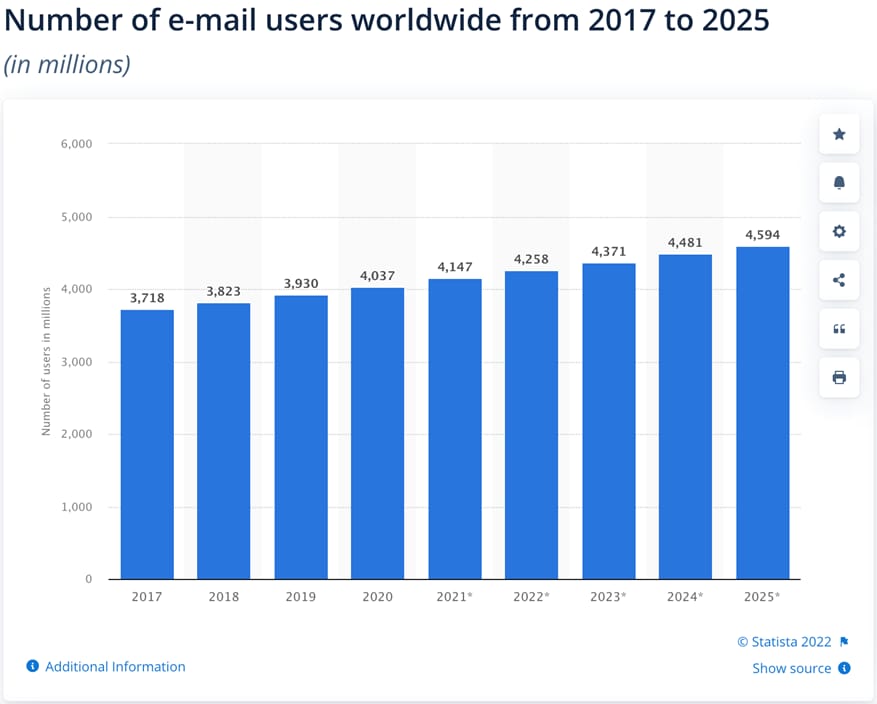
      Source: https://www.statista.com/statistics/255080/number-of-e-mail-users-worldwide/

      Despite the growth and prominence of mobile messengers and chat apps, email global users amounted to 4 billion and is set to grow to 4.6 billion users in 2025.

      The global emails received and sent worldwide was approximately 306 billion in 2020. It is projected to increase to over 376 billion emails on 2025. This data shows that the trend towards mobile also is true for email.

      As we know that the consumers interaction is multi-event and multichannel

      These are some of the marketing strategies that you can invest with.

      • Inbound marketing
      • Content marketing
      • Email marketing
      • Search Engine Optimization(SEO)
      • Social Media
      • Paid Advertising
      • Mobile Marketing

      One thing for sure is that email for marketing isn’t going anywhere. It will continue to be a staple part of any marketing strategy for all types of businesses.

      COMMON SEARCHES:

      Email marketing tools

      Email marketing meaning 

      Email marketing example 

      Email marketing service

      Email marketing examples 

      Types of email marketing

      Email marketing ideas

      Email marketing benefits

      WHAT PEOPLE GENERALLY ASK

      What is email marketing and example?

      How do businesses marketing?

      What is an email marketing strategy?

      What is email marketing and its benefits?

      Categories
      Ad Tech

      Shaping the way of digital advertising

      Written by Alex Martinez on Digilah (Tech Thought Leadership)

      The relationship that people have with the consumption of content in digital platforms is constantly changing.

      As an audience, our needs change, the way we consume information and what we expect from the online experience when we enter a website or an app. The truth is that as digital consumers we are increasingly demanding.

      All the parts that make up the digital world make a great effort to adapt to these demands.

      One of these is to provide a pleasant online experience. What factors can determine this? A well-worked UX (user experience), and that the user finds advertisements according to their interests.

      It is on this last point that we decided to work in order to contribute our technological value.

      Five years ago, together with Ricard Luquero and Pablo Salinas, we founded Adpone, an advertising technology company with a very clear mission: to shape the future of advertising with in-house technology to achieve high performance.

      We developed a technology that is little known to most people: a solution that places premium brand ads on websites from all over the world.

      This solution meets the needs of digital players so that they can continue to offer their audiences free and quality content.

      What are website owners and advertisers looking for? Let’s break it down.

      Publishers want to make the most out of their traffic.

      By monetizing advertising inventory

      The vast majority of websites generate income through advertising. This can be done in different ways, but it is usually done by placing banners or videos in the body of the website.

      By ensuring a great online experience

      Journalists and content creators make a great effort to generate original and quality content, and to position it organically in search engines. All this, to build trust in their audiences and make them want to return to the website.

      For this to be possible -and at the same time profitable- the advertising they show must be consistent with each content.

      Advertisers seek to make good impressions.

      By reaching their target audiences

      Every advertising campaign has at least two parts. The first is to design compelling creative content. The second, to implement this campaign by placing the ads on websites according to their content. This used to be done intuitively, now it is done through advertising technology.

      By placing their content in the right place

      Context matters. Let’s imagine that a user is reading a news story about the use of toxic fertilizers in soy production and suddenly a banner of a brand of soy-containing veggie burgers appears. Obviously the impression of the brand will not be positive.

      Agencies like Adpone are responsible for placing the ads in the right context.

      In short, providing a pleasant online experience, having a profitable website and providing adequate advertisements is possible thanks to adtech companies.

      At Adpone, we sum it up as #impressionsmatter.

      Categories
      Mar Tech

      Marketers in the “Marketing 5.0” era

      Written by Clare Wong on Digilah (Tech Thought Leadership)

      Convergence of Marketing 5.0 and T-Shaped Marketing

      Here we are, on the precipice of a post-covid world, yet another one is brewing…(It’s not the emergence of Omicron if you are reading this in early 2022).

      Ever-present Marketing 5.0

      You might have heard of Industry 4.0, but I recently came to know of Marketing 5.0 by Philip Kotler – which essentially is the backbone of Industry 4.0. Marketing 2.0 to 4.0 was “Mad Men meets The Social Network with a sprinkle of Suits”, but Marketing 5.0 is “Black Mirror meets Love, Death and Robots” (but there are the good bits, like iOS 14 with their privacy move). Since 2019, Covid got us embracing a kaleidoscope of Digitization, Digitalization, and Digital Transformation. Industry 4.0 effects of Automation, Next Tech and Accelerated Digitalisation, in tandem, Marketing 5.0’s Hyper-Personalisation, Responsible Innovation and Smart-Connectivity. This inevitably caused considerable transformations within societies and market disruptions. Naturally, marketers had to react to this change.

      Industry 4.0’s impact on many facets of human lives and societies (Image Source: The Marketing Journal)

      Convergence of New Customer Experience and “Next Tech” (Image Source: The Marketing Journal)

      Customer Empathy first, Technology second

      So, how do marketers fit into this ‘next tech’ vision?

      As the book’s name suggests “Technology for humanity”, humans are central to successful applications and marketers are still at the core of Marketing 5.0.

      It is not about replacing the human with computer intelligence but rather finding ways in which “machines and people might fit and deliver the most value across the customer journey.” 

      Mercè C. (Co-founder, Lead Consultant & Chartered Marketer)

      In today’s connected and on-demand economy, relevance is the most important currency. This harkens back to the drivers of marketing evolutions, which are marketing technology and consumer needs. To stay relevant, marketers must adopt a customer-centric approach.

      The 5 components of Marketing 5.0 (Image Source: Think Beyond)

      Next Technologies’ main purpose is to amplify the capabilities of marketers to create and deliver value. With the rapidly-changing consumer behaviours due to the pandemic, marketers can create solutions that are more relevant than those created by the current-state AI.

      Kolter touches on how Technology is adding value to marketing through the above five components with society and sustainability in mind.

      Stepping into Marketing 5.0, T-shaped marketers would see the expansion and deepening of various domains (e.g. Behavioural Psychology, Digital Analytics, AR/VR, Service & UX Design).

      Am I ready for Marketing 5.0?

      The biggest challenge marketers face is the journey from strategy to execution!
      Let alone being ready for Marketing 5.0.

      In my career journey, I am neither on track with Jack Ma’s career advice nor ready to take on the entrepreneurship path. ​​I believe there is no rush to setting deadlines to attain your career goals (something that Jack Ma begs to differ).

      My current goal is to advance from being a T-Shaped to a V-Shaped Marketer by broadening my business acumen, technical know-how while strengthening interpersonal skills. Individuals are rarely capable of achieving a true, deep “V” shape in their skill sets, but a collective unit can. I am blessed to have the opportunity to learn alongside similarly-minded, differentiated knowledge-experts within Google.

      If you are just starting your digital marketing journey or at the cusp of a career-pivot, don’t fret – here are some readings that will help you get up to speed with the MarTech Universe (not the Marvel Universe!) and pivot to becoming a T-shaped marketer.

      Good Reads and Frameworks:  Marketing 5.0’s Marketer

      Have an Awesome 2022, Everyone!

      Categories
      Ad Tech

      An overview of Location-based Marketing

      Written by Christian Geissendoerfer – Digilah (Thought Leadership)

      Here we are in today’s world of Marketing 5.0, where technology and digital transformation play a significant part, it is essential that marketers leverage this to address customers’ needs and truly make an impact with their marketing strategies.

      Over the past decades, the older approach to marketing at the local level has undergone a paradigm shift. Businesses are all required to adjust and adapt new technologies to keep up with the dramatic shifts in consumer behaviours.

      Increasing brand awareness and position in the hearts of consumers has become extremely difficult, particularly in today’s fiercely competitive market.

      • How to increase revenue?
      • How to interact and attract customers to shop?
      • How to optimize marketing activities?

      Those are problems that keep every business owner up at night but have yet been solved.

      So how do businesses step up their marketing game? By integrating technological tactics to deliver their messages to target customers at a granular and personal level. In this article, we would like to discuss a new marketing strategy that is Location-based Marketing.

      How does it work?

      Location-based marketing is the technology of using location data that is shared from GPS, online transactions at shopping malls, grocery stores, or photos. Using this data, marketers will be able to reach their desired audiences with more relevant advertising and content. 

      Location-based marketing works great for any and all retailers, brick and mortars, restaurants, and small local businesses. It is the best fit with these industries because of customers’ physical footprint, which synchronizes with location data. Based on their actual previous customers, marketers can create an exact set of lookalike audiences for their strategy, thus retargeting and driving those customers to return and increase loyalty.

      Let’s take a deep dive into the reasons to use Location-based marketing.

      Attract more customers and increase engagement

      Location-based marketing can help attract more customers by bringing a business to the users at a time when they are interested in purchasing that business’s product/service. For example, there is a gym and its customers are people who live in that area. What they can do is to create ads on Facebook and limit the range to people in this area, which increases the potential customers for their services.

      Build trust relationship between your target audience and your business

      When selecting a target in a specific location, you can include in the advertising information about your business for the target based on the specific characteristics they represent in that area. The content should be relevant and help them feel more connected to your business. From there, nurture their beliefs with your business.

      Increase profits from Active Marketing

      The ultimate goal of the business is to increase sales and profits through marketing activities. Collecting, analysing, and using location data can help businesses entice more people to participate in promotions, helping to optimize marketing.

      To conclude marketers love location-based marketing because it allows them to provide the users with relevant and personalized offers and messages. “Factual reports that “84% of marketers currently use location data in their marketing and ad campaigns, and 94% plan to in the future.” Hence like with any technology the key with location-based marketing, is to test, measure and refine. 

      At YOOSE, we combine cutting edge technology with deep expertise, experience and passion to help global brands and advertisers capture the opportunities of this fast-paced, ever-changing world of mobile advertising. Our location-based marketing solution is tailored to deliver the most impactful campaigns and ensure the best ROI for our customers.