Digilah

Categories
Digi Tech

India’s Digital Transformation

Written by Rishi Suri on Digilah (Tech Thought Leadership).

India’s digital evolution has significantly advanced, moving beyond the foundational Aadhaar system (Digital India) to encompass a broader spectrum of digital innovations aimed at enhancing governance and service delivery.

The Digital India program, inaugurated in 2015, represents the backbone of this transformation. Its mission is to provide electronic access to government services, boost online infrastructure, and improve Internet connectivity. The initiative revolves around three main pillars: digital infrastructure as a utility for every citizen, on-demand governance and services, and empowering citizens through digital means.

Aadhaar: The Digital Identity Revolution

Aadhaar, the world’s largest biometric identification system, has been a cornerstone of India’s digital framework. Over the past decade, its role has expanded significantly, offering a reliable digital identity for Indian residents. This system has facilitated access to a variety of services, including banking, mobile connectivity, and government subsidies. By streamlining bureaucratic processes and minimizing fraud, Aadhaar exemplifies how digital solutions can enhance governance.

Unified Payments Interface (UPI)

The Unified Payments Interface (UPI) has revolutionized payment methods in India. Developed by the National Payments Corporation of India and supported by the Reserve Bank of India, UPI allows users to effortlessly transfer money between different banks. Its user-friendly design and efficiency have driven widespread adoption, positioning it as a key component of India’s fintech progress.

Digital Health Innovations

India’s health sector is also experiencing a digital transformation. The Ayushman Bharat Digital Mission aims to build a comprehensive digital health ecosystem, providing universal health coverage in an accessible and efficient manner. This initiative includes creating unique health IDs, maintaining digital health records, and enhancing interoperability within the healthcare system.

Advancing Education Through Digital Means

The National Education Policy 2020 (NEP 2020) underscores the role of digital technologies in expanding educational access and quality. Platforms such as Diksha, which offers a wide range of educational resources, and the National Digital Library of India, reflect the commitment to leveraging digital tools for educational improvement.

Connecting Rural Areas

The BharatNet project is working to deliver high-speed Internet to all Gram Panchayats, ensuring that digital services reach even the most remote areas. Complementarily, the Digital Village initiative aims to transform rural regions by enhancing technology access, digital literacy, and essential services, thus narrowing the urban-rural divide.

Addressing Challenges

Despite these advancements, challenges such as digital literacy, privacy issues, and cybersecurity threats remain. Addressing these concerns through policies like the Personal Data Protection Bill and improving cybersecurity measures and digital literacy programs demonstrates a commitment to overcoming these obstacles.

Over the past decade, India’s digital landscape has evolved remarkably. By fostering technological innovation, streamlining governance, and empowering citizens, these initiatives set a benchmark for digital transformation. India’s journey underscores the transformative potential of technology in shaping governance and society, paving the way for a digitally empowered future.

(The Writer is the editor of the oldest and largest Urdu newspaper of India, The Daily Milap (www.thedailymilap.com). He also the co founder of Global Order (www.globalorder.live), a foreign policy publication).

Most asked questions

How is Aadhar enhancing the governance?

By streamlining bureaucratic processes and minimizing fraud, Aadhaar exemplifies how digital solutions can enhance governance.

What is the aim of Digital Village initiative?

The Digital Village initiative aims to transform rural regions by enhancing technology access, digital literacy, and essential services, thus narrowing the urban-rural divide.

Most searched queries

Unified Payments Interface (UPI)

National Education Policy 2020

Personal Data Protection Bill

Hello readers! Hope you liked what you read today. Click the like button at the bottom of this page and share insights with your colleagues and friends!

For more such amazing thought leadership articles on technology follow Digilah people.

Categories
Digi Tech Fin Tech

Empowering Women in India: Bridging the Digital Divide

Written by Suki Iyer on Digilah (Tech Thought Leadership).

In the heart of Bangalore, India, lives a woman whose life has been transformed by the power of technology. Ashvini from Yadgiri has been living in the Windmills labor colony for the past three years. 

Her daughter has been going to Sampark’s ECCD center since she was 6 months old. Ashvini works as a domestic helper in Windmill Apartments. She did not have a bank account or an UPI account.

However, her life took a significant turn when she was provided with a simple tool that opened up a world of possibilities – a mobile phone. Once she got a mobile phone, she opened a bank account, and installed GPay and other applications.

This hugely increased her agency – she is able to easily send money every month to her family back in the village; she is able to keep track of her expenses and thus save up to Rs 1500 (USD$ 18) a month. She also able to leverage apps on the phone for several other benefits for her children and family.

With her newfound access to a smartphone, Ashvini’s life underwent a remarkable transformation. No longer confined by tech limitations, she was able to connect with other members of the community, markets, and learn new skills through online platforms. 

Ashvini became a more informed and empowered individual, mother, employee and a huge source of family support.

Ashvini’s story is not unique.

Across India, millions of women like her are benefiting from the digital revolution, which has the potential to bridge longstanding socio-economic gaps. Empowering women with phones not only provides them with access to information and resources but also serves as a catalyst for economic and social empowerment. Here are some of the key benefits:

Access to Information and Resources:

Mobile phones enable women to access vital information on healthcare, education, and government schemes. From learning about maternal health practices to accessing educational resources for their children, these devices serve as a gateway to knowledge that was once out of reach.

Economic and Social Empowerment:

By connecting women to markets and financial services, mobile phones empower them to participate more actively in economic activities. Mobile phones facilitate social networking and community engagement, allowing women to connect with peers, mentors, and support groups. Through digital platforms, they can share experiences, seek advice, and collaborate on various initiatives, fostering a sense of solidarity and empowerment.

Access to Education and Skill Development:

Digital literacy is increasingly becoming essential in today’s world. By providing women with smartphones, they can access educational content, online courses, and skill development programs, enhancing their knowledge and employability prospects.

While empowering women with phones is undoubtedly beneficial, it’s essential to recognize that technology alone is not enough to address the complex challenges they face. To maximize the impact of digital empowerment initiatives, complementary non-technology support is crucial. 

These include services such as like digital literacy training so that women can be equipped with the knowledge and confidence to harness the full potential of technology.

It is also necessary to provide tailored support services that recognizing the diverse needs and challenges faced by women and address their specific circumstances. This may include access to healthcare, childcare facilities, transportation services, and market linkages to ensure holistic empowerment.

In conclusion, empowering women in India with phones is a transformative intervention that has the potential to bridge the digital divide and unlock opportunities for socio-economic advancement.

However, to realize the full benefits of digital empowerment, it’s imperative to complement technology interventions with targeted non-technology support that addresses the unique needs and challenges of women. By doing so, we can create a more inclusive and equitable society where every woman has the opportunity to thrive and succeed.

———————————————————————–

This Women’ day month Sampark launches the #Mobile4akka campaign to empower her with a smartphone! This is where you come in! By donating, you can help us provide smartphones to migrant women, opening doors to education, entrepreneurship, and financial independence. Let’s bridge the gap and empower women through digital literacy.

Together, we can make amazing things happen! Join us this March in celebrating women and empowering through digital literacy! Donate now and be a part of this transformative journey.

https://bit.ly/3Iocgpw (Link to donate) (Indian Nationals)

 http://goto.gg/63435 (Link to donate) (Foreign Nationals)

More about Sampark https://sampark.org/

Most asked questions

How do mobile phones help in women empowerment?

How does Sampark help women in India?

Most asked queries

Sampark

UPI

Hello readers! Hope you liked what you read today. Click the like button at the bottom of this page and share insights with your colleagues and friends!

For more such amazing thought leadership articles on technology follow Digilah people.

Categories
Digi Tech

Transforming Asia-Pacific: Sealing the future with 5G

Editorial Leadership pickup by Digilah on Digilah (Tech Thought Leadership).

In a pivotal move toward Asia Pacific’s digital evolution, the GSMA, in collaboration with the Malaysia Digital Economy Corporation (MDEC), inaugurated the GSMA DXAF’s Digital Transformation Leaders’ CxO Summit in Kuala Lumpur in November, 2023.

As the region hurtles towards a digital apex, the summit aimed to assemble luminaries from government corridors and tech sectors to deliberate on the pivotal technological strides required for Malaysia’s and, by extension, Asia Pacific’s digital metamorphosis over the coming decade.

Projections unveil a staggering contribution of nearly one trillion dollars (approximately $990 billion) to the Asia Pacific economy by 2030, primarily propelled by digital transformation advancements and the pervasive adoption of mobile services. The GSMA’s recently released Mobile Economy APAC 2023 Report forecasts around 1.4 billion 5G connections in the region by the decade’s end, constituting a significant 41% of total mobile connections.

Malaysia, standing as a digital powerhouse in Southeast Asia, was chosen to host this year’s summit due to its prominent role in digital infrastructure, services, applications, and platforms within a burgeoning digital ecosystem.

At the core of the deliberation was a dedicated exploration of “Intelligent Digital Transformation in the 5G Era.” Key focal points include propelling digital transformation in Malaysia and extracting value from, and monetizing, 5G. Discussions will delve into commercial strategies, technological innovations, and industry policies aimed at expediting comprehensive intelligent digital transformation in the 5G era.

Keynote speakers, including Malaysia’s Honourable Minister of Communications and Digital, Mr. Ahmad Fahmi Mohamed Fadzil, and CEO of Malaysia Digital Economy Corporation, Ts. Mahadhir Aziz will steer discussions around opportunities and challenges in this digital voyage.

Ts. Mahadhir Aziz, CEO of MDEC, emphasized MDEC’s commitment to catalysing Malaysia’s digital economy, fostering innovation, growth, and sustainable development. This collaboration with GDIN aims to propel Malaysia into a future characterized by cutting-edge advancements and limitless digital potential.

In a bid to translate discussions into actionable strategies, the summit aligned with the themes explored in the GSMA’s latest report, ‘Digital societies in Asia Pacific: Harnessing emerging technologies to advance digital nations.’ This report outlines the roadmap for governments in the region, including Malaysia, to integrate digital technologies into every facet of the economy, marking a significant stride towards becoming truly “digital nations.”

This transformative event marks a crucial milestone in reshaping Asia-Pacific’s digital landscape, signifying a collaborative endeavour between GSMA and the Malaysian Government towards a digitally connected and resilient future.

Source: PR Newswire

Most searched questions

What is digital metamorphosis?

How will 5G help the economy of the Asia-Pacific?

Most searched queries

Digital apex

Digital metamorphosis

Hello readers! Hope you liked what you read today. Click the like button at the bottom of this page and share insights with your colleagues and friends!

For more such amazing thought leadership articles on technology follow Digilah people.

Categories
Digi Tech Decision Making Tech

How Digital Platforms are disrupting Businesses

Written by Raghu Kaimal on Digilah (Tech Thought Leadership).

The History of Digital Platforms and how it evolved to become what we see now:

The concept of digital platforms as we know them today has undergone a significant evolution over the past few decades. In the 1990s, the internet gave birth to basic digital platforms such as email. However, it is limited in scope and functionality.

With the rise of e-commerce, online marketplaces like eBay emerged, allowing individuals to buy and sell goods online. This marked the first step towards connecting buyers and sellers on a digital platform.

Then came the Social Media Boom, early 2000s witnessed the rise of social media platforms, with MySpace started in 2003. Later, Facebook started in 2004 becoming pioneers in this space. Social media platforms fundamentally changed the way people interacted and shared information online.

The early platforms were focusing on the B2C customers but later we saw many B2B platform flourishing like AWS, Microsoft and so on later part of 2010.

The introduction of mobile app stores, such as Apple’s App Store and Google Play in 2008, transformed how software was distributed and consumed. App stores enabled the creation of a vast ecosystem of mobile applications, further expanding the digital platform landscape.

Companies like Airbnb and Uber disrupted traditional industries by creating digital platforms that allowed individuals to share resources like accommodations and rides in new ways.

The Cloud and SaaS Platforms: Cloud computing platforms, like Amazon Web Services (AWS) and Microsoft Azure, revolutionized the way businesses access and use computing resources. Software as a Service (SaaS) platforms, such as Salesforce and Google Workspace, provided cloud-based software solutions, changing the software delivery model.

How Digital Platforms transformed various Industries:

Digital platforms have had a profound impact on a wide range of industries.

Retail and E-Commerce: Amazon is a prime example of how digital platforms have revolutionized online shopping. It created a vast online marketplace, streamlined supply chains, and personalized the shopping experience.

Social Networking and Communication: Facebook and Instagram have reshaped how people connect, communicate, and share information globally. They’ve also become advertising platforms, transforming the marketing industry.

Hospitality and Travel: Airbnb disrupted the traditional hotel industry by enabling individuals to rent their homes to travelers. This innovative platform changed the way people find accommodations when traveling.

Transportation: Uber and Lyft transformed the transportation industry by providing on-demand ridesharing services. These platforms offered convenience and cost-effectiveness, challenging traditional taxi services.

Entertainment and Media: Netflix is an example of a digital platform that reshaped the entertainment industry. It introduced streaming services, changing how people consume content and impacting traditional cable and broadcast TV.

Finance and Fintech: Digital platforms like PayPal and Square have made online payments and financial transactions easier. Additionally, fintech platforms like Robinhood and Coinbase have democratized investing in stocks and cryptocurrencies.

How Ecosystems Drive Platform Growth and Innovation:

Platform ecosystems are intricate networks of interconnected products, services, and technologies built around a central platform. These ecosystems thrive on collaboration, with various players – individuals, businesses, and developers – creating value for one another and, in turn, for the platform itself.

The significance of platform ecosystems lies in their ability to foster growth, innovation, and sustainability in the digital age.

Network Effects: Ecosystems capitalize on network effects, where the value of the platform increases as more users, developers, and complementary services join.

For example, a larger user base on a social media platform like Facebook attracts more content creators and advertisers, creating a self-reinforcing cycle of growth.

Diverse Services: Ecosystems allow a diverse range of third-party services and apps to integrate with the platform. This diversity expands the platform’s utility and attracts a wider user base.

Consider the Apple App Store, where developers create apps that enhance the functionality of Apple devices, leading to the platform’s growth.

Innovation: Ecosystems foster innovation as third-party developers create new features and functionalities for the platform. These innovations can address user needs that the platform’s parent company may not have anticipated.

For instance, the Android ecosystem benefits from the innovations of app developers who continually expand the capabilities of Android devices.

Monetization: Ecosystems provide revenue opportunities for platform owners and third-party developers. Companies can charge for platform access, take a share of transactions, or offer in-app purchases.

This monetization encourages more stakeholders to participate, further driving growth.

Data Synergy: Ecosystems leverage data synergy, with various components of the ecosystem contributing to data collection and analysis.

This data sharing and utilization enables more precise targeting, personalization, and insights, improving the overall user experience.

Data Utilization on Digital Platforms and its concerns

Data is at the heart of platform revelation. Digital platforms, in their various forms, rely on vast amounts of data to function efficiently, provide personalized experiences, and create value.

The collection, utilization, and analysis of data have become integral to the success of these platforms, shaping their operations, and influencing decisions.

Here’s an exploration of the role of data in platform revelation:

Personalization: User data allows platforms to offer personalized content, recommendations, and advertisements, enhancing user experiences.

Analytics: Data analytics provide insights into user behavior, trends, and performance metrics, helping platforms optimize their services.

Monetization: Platforms often monetize user data by selling it to advertisers or using it for targeted advertising.

Privacy Concerns: Collecting and utilizing user data raises privacy issues. Users may be unaware of the extent of data collection or how their data is used.

Data Security: Data breaches and cyberattacks can expose sensitive user information, leading to security and identity theft risks.

Data Ownership: Determining who owns user data and how it can be used is a contentious issue. Users, platforms, and third parties may have different interests.

Algorithmic Bias: Data-driven platforms can inadvertently perpetuate bias if algorithms are trained on biased data, resulting in unfair outcomes.

Regulatory Compliance: Data usage is subject to evolving laws and regulations, such as GDPR in Europe and CCPA in California. Platforms must comply with these rules.

Future Trends and Developments in Digital Platforms

The digital platform landscape is poised for significant evolution in the coming decade. Several key trends and emerging technologies will shape the future of these platforms and how they influence various industries and aspects of our lives.

GenAI Supporting the Sales and Marketing function:  GenAI helps create content in text, audio, video formats, Customer service automation, Sales enhancement though co-pilot which will help buys with rich content and sales support.

AI-Driven Recommendations: Artificial intelligence and machine learning will continue to power highly personalized content, product recommendations, and user experiences.

Context-Aware Platforms: Platforms will increasingly consider the user’s context, location, and preferences to deliver contextually relevant content and services.

AR and VR Integration: Digital platforms will integrate augmented and virtual reality technologies to offer immersive experiences for gaming, shopping, education, and more.

Social VR: Social media platforms may expand into the metaverse, enabling users to interact in virtual spaces.

Edge Computing: Edge computing will enhance platform responsiveness and support real-time processing for applications like autonomous vehicles and IoT.

Green Computing: Platforms will emphasize eco-friendly practices and data center sustainability to reduce their carbon footprint.

Sustainability Reporting: Users will demand greater transparency regarding a platform’s environmental impact.

The Importance of Platform Revelation in the Digital Era

In the digital age, understanding and appreciating the concept of platform revelation is more crucial than ever. It is the key to unlocking the profound impact that digital platforms have on our lives, economies, and societies. Recognizing the significance of platform revelation is not just a matter of staying informed; it’s a means to actively engage with the rapidly evolving landscape of digital platforms.

Here’s why it matters:

Empowerment Through Knowledge: Understanding how digital platforms work empowers individuals to make informed choices.

It allows users to protect their data privacy, control their online presence, and maximize the benefits these platforms offer.

Economic Transformation: Digital platforms are reshaping industries, creating new economic opportunities, and altering the nature of work.

For entrepreneurs and businesses, platform revelation is essential for staying competitive and adapting to changing market dynamics.

Societal Impact: Social media platforms influence public discourse, while e-commerce and service platforms impact how we consume and interact.

Recognizing the power of platforms enables citizens to engage thoughtfully in societal discussions and debates.

Ethical Considerations: As digital platforms collect data, influence opinions, and shape our online experiences, understanding their ethical implications is paramount.

It enables us to advocate for responsible platform practices and hold companies accountable.

Future Readiness: The digital platform landscape is dynamic and continually evolving.

Staying informed about trends, innovations, and challenges prepares individuals and organizations for what lies ahead.

Most searched questions

What is impact of digitalization on businesses?

What is green computing?

Most searched queries

SaaS(Software as a Service)

Augmented reality

Hello readers! Hope you liked what you read today. Click the like button at the bottom of this page and share insights with your colleagues and friends!

For more such amazing thought leadership articles on technology follow Digilah people.

Categories
Digi Tech Decision Making Tech

Innovating on a Budget: Exploring Cloud Cost Optimization for Agile Businesses

Written by Adora Nwodo on  Digilah (Tech Thought Leadership).

In today’s business landscape, staying competitive and driving technological innovation requires businesses to adapt quickly and optimize costs.

The cloud has revolutionized operations by offering advantages like scalable resources, operational efficiency, and global accessibility.

However, effectively leveraging cloud environments within budget limitations can be challenging, especially for agile businesses with limited financial resources.

This article provides multiple strategies for businesses to optimize their cloud costs. By implementing these strategies, businesses can encourage innovation, facilitate expansion, and achieve cost optimization.

To optimize cloud costs, businesses must first understand the cloud cost landscape. Infrastructure, compute resources, storage, networking, and additional services like databases, AI/ML, and analytics are typically part of cloud costs.

Cloud service providers offer different pricing models, including pay-as-you-go and reserved instances, each with its own cost implications. Businesses can make informed decisions and devise cost-cutting strategies by understanding these elements.

They can evaluate pricing options, customize resource usage, and balance innovation and cost optimization without sacrificing performance.

Cloud Cost Optimization Techniques

This section explores three cloud cost optimization techniques that businesses can use to reduce cloud costs and increase financial efficiency.

Rightsizing Cloud Resources for Efficiency

Businesses often struggle with the challenge of inefficiently provisioning cloud resources, leading to unnecessary expenses. To tackle this, rightsizing optimizes resource allocation to strike the right balance between performance and cost.

This involves closely monitoring resource usage and analyzing metrics such as CPU usage, memory utilization, and network traffic.

By understanding the connection between resource allocation and workload requirements, businesses can make informed decisions to ensure optimal performance.

Automation tools play a crucial role in the rightsizing process, enabling businesses to dynamically allocate or deallocate resources based on real-time demand.

These tools automate tasks like scheduling non-production resource start and stop times, allowing businesses to pay only for the actual hours of usage.

Adopting Cloud Cost Management Tools

Cloud service providers offer cost-management tools that enable businesses to effectively monitor, analyse, and control their cloud spending.

These tools provide insights into various aspects of cloud costs, helping businesses identify cost drivers, evaluate resource utilization, and track cost trends.

By leveraging the data provided by these tools, businesses can pinpoint areas where cost-cutting efforts can have the most impact and prioritize their cost-cutting strategies accordingly.

Cost management tools also enable businesses to track cost trends over time, offering historical cost data and visualizations of cost patterns and fluctuations.

This allows businesses to identify cost variations, seasonal patterns, and unexpected cost spikes, empowering them to proactively plan and optimize their cloud spending for better cost management.

Examples of cloud cost management tools include Densify, CloudZero, and Apptio Cloudability.

Leveraging Server less Architecture

Server less computing has transformed cloud cost optimization by shifting from infrastructure management to code execution. 

This change eliminates the need for continuous provisioning, management, and scaling of server resources, resulting in significant cost savings.

The pay-per-use pricing model of server less platforms ensures businesses only pay for the resources consumed during function execution, eliminating idle capacity and wasteful spending. 

Additionally, server less architectures enable agile businesses to accelerate application development and deployment. 

With modular server less functions, developers can focus on specific features or functions, leading to shorter development cycles and a faster time-to-market. 

This agility allows businesses to seize opportunities and drive innovation while staying within budget constraints.

Conclusion

Innovating on a budget is a challenge that many agile businesses face.  These businesses, however, can achieve a delicate balance between innovation and financial caution by investigating cloud cost optimization solutions.

Understanding the cloud cost landscape, rightsizing resources, adopting cost management tools, and leveraging server less computing can help drive innovation while controlling expenses.

Most searched questions

What is cloud computing?

What are the cloud tools which can be used to reduce the cloud costs?

Most searched queries

Cloud services

Cloud resources.

Hello readers! Hope you liked what you read today. Click the like button at the bottom of this page and share insights with your colleagues and friends!

For more such amazing thought leadership articles on technology follow Digilah People

Categories
HR Tech Digi Tech

The technological and digital evolution of a remote business 

Written by Kiran Bhatia Tandon on Digilah (Tech Thought Leadership)

As the world becomes more connected and technology continues to advance, remote work has become increasingly popular among businesses. 

The demand for digital and technological tools has increased more than ever as a result of the COVID-19 pandemic, which forced many businesses to move to remote work. 

A remote company’s digital and technological journey can be both exciting and difficult. Companies have had to modify their strategies and tools to meet the demands of a distributed workforce as a result of technological advancements and the rise of remote work. 

The need for constant adaptation to new technologies and tools was one of the biggest obstacles the company faced on its digital and tech journey. They recognized that technology is constantly evolving, and they needed to be agile and adaptable in order to stay ahead of the curve. 

This meant investing in ongoing training and development for their employees to ensure that they had the skills and knowledge needed to work with the latest tools and technologies.

Here are some common strategies adopted by companies to manage a distributed workforce:

1. Use of collaboration tools

One of the most difficult aspects of managing a distributed workforce is ensuring effective communication and collaboration among team members who may work in different locations and time zones. 

To get around this problem, companies used a variety of strategies and tools to improve communication and collaboration, such as Zoom, Microsoft Teams, and Slack for video conferencing, instant messaging, and project management. 

2. Regular check-ins

Regular check-ins with remote employees can help to ensure that they are on track and that any issues are addressed in a timely manner. These can be done with the use of collaboration tools

3. Clearly defined goals and expectations

Clear goals and expectations can help remote employees stay focused and productive. These goals should be measurable and communicated effectively.  These can be defined using technology in a variety of ways. Here are a few examples: 

  • Project management software: Project management software, such as Asana or Trello, clickup can be used to create tasks and assign them to team members. This allows for clear expectations and deadlines to be set, and progress to be tracked in real-time.
  • Performance tracking tools: Performance tracking tools, such as OKRs or KPIs, can be used to set measurable goals and track progress towards achieving them. This provides a clear framework for employees to work toward specific outcomes.
  • Communication tools: As stated above, tools, such as Slack or Microsoft Teams, can be used to facilitate regular check-ins and goal-setting conversations between managers and team members. This helps to ensure that goals and expectations are clearly understood and can be adjusted as needed.
  • Learning management systems: Learning management systems, such as Udemy or Coursera for Business, can be used to provide employees with training and development opportunities that align with organizational goals and expectations.

4. Flexible work schedules

Companies can offer flexible work schedules to their remote employees to help them balance their work and personal lives.

5. Performance-based assessments

Performance-based assessments can help managers evaluate the productivity of remote employees and provide feedback to help them improve.

6. Regular team meetings

Regular team meetings can help remote employees feel connected to their team and can improve communication and collaboration.

7. Virtual team-building activities:

Virtual team-building activities such as online games and virtual happy hours using collaboration tools can help build a sense of camaraderie and boost morale among remote employees.

8. Training and development

Companies can provide training and development opportunities to help remote employees improve their skills and stay up-to-date with industry trends.

In addition to the above, companies had created well-defined policies and guidelines for remote work and provided employees with the necessary support and resources to ensure that they remained productive and engaged while working remotely.

Cybersecurity has become a top concern for remote companies, as remote workers often use their personal devices to access company data. To address this challenge, remote companies have had to implement robust cybersecurity measures, such as two-factor authentication, encryption, and virtual private networks (VPNs).

Companies need to be flexible and adaptable in their approach to managing a distributed workforce, and they should be willing to experiment with different strategies and tools to find what works best for their organization.

Overall, the company’s digital and tech journey is a critical part of their success as a remote company. By embracing technology and using it to their advantage, they will be able to overcome the challenges of remote work and build a thriving remote workplace that could compete with traditional brick-and-mortar companies. Their journey is a testament to the power of technology to transform businesses and create new opportunities for growth and success.

Hello readers! Hope you liked what you read today. Click the like button at the bottom of this page and share insights with your colleagues and friends!

For more such amazing content follow Digilah People

Most asked questions

How advancing technology affect remote business?

How remote employees cope with advancement in technology?


Categories
Digi Tech HR Tech

The hidden life-changing (and money-making) power of Change Management

Written by : Lata Hamilton on Digilah (Tech Thought Leadership)

It’s no secret that digital transformation is the hottest thing since sliced bread, and everyone wants a piece of this money-making pie.

Whether it’s going to make your company money or save your company money, the future is new technologies that turn old, manual processes into faster, simpler, automated magic.

But what happens when your digital transformation dream goes up in smoke, and you’re left holding the ashes? You’ve spent bucketloads on innovation and development but for some reason your amazing platform, system or app hasn’t hit the mark, isn’t being used properly by your staff, customers or clients, has run over deadline, and left you feeling you’ve wasted not just money, but also time, effort, energy and hope.

You wouldn’t be alone. 

A massive number of digital projects fail. A 2020 Forbes article found that the number of technology projects which experience serious issues in things like cost, schedule, and goals can be up to 60%! I’ve seen it myself on major digital transformation projects that I’ve worked on with some of Australia’s biggest companies.

But there is a silver lining. The same Forbes article found that the secret to reducing technology project failure rate is often: people.

How?

Through the power of Change Management – which can not only transform your transformation, but also your results.

My simple definition of Change Management is: “moving people from one way of doing something to a new way of doing something, through communications, training, and business readiness, to realise the benefits of the change.”

People are the users of any digital technology – they are the ones that unlock its potential. The sad truth is that people are hard-wired to hate change. 

Even when a new technology could save time, effort and expense, most people will still resist it. 

Change Management encourages inviting people in to co-create and co-design what the change will mean for them, give them, and bring them. It builds trust instead of fear, empowers your people to own their future, and helps them get ready for a new way of doing things.

Here are some practical Change Management-inspired approaches you can use to help launch your digital technology more successfully with staff, customers and clients:

  • Co-design the features and processes of the new system with actual end users so it’s fit-for-purpose, user-friendly, and loved before launch.
  • Get your teams ready for the new way of doing things by clearly explaining to them how their processes and tools will be different and what they need to do to prepare.
  • Build a microsite and provide regular project updates, news, training tools, and resources – as well as a countdown to launch and a forum to ask questions!
  • Do live demos of the technology all the way through development – seeing is believing!
  • Give people the chance to get hands-on with the system before it’s launched – even if there’s still bugs, it will help build confidence in the solution.
  • Create an exciting launch event – bring it to life with a quiz, competition, or lucky draw that requires people to try out the new system, with super cool prizes on offer.

Bringing people on the journey not only changes your experience of leading a digital project, but improves the likelihood of success.

The Forbes article also suggests building soft skills, supporting leadership, and offering better training experiences – which are all things a great Change Management expert can provide.

If you want to learn more about the power of Change Management, download my free “Change Hackathon Planning Workbook” here which steps through how to crowdsource and co-create future ways of working during transformation and change.

Name and title:

Lata Hamilton – Change Leadership and Confidence expert

Bio:

Lata Hamilton is a pocket rocket burst of energy with a big heart… and big hair! She helps women carve their own paths for change in their career, leadership and life. Lata is a Change Leadership and Confidence expert, the creator of the “Leading Successful Change” program, and the Founder & CEO of Passion Pioneers.

Websites:

www.latahamilton.com 

www.passionpioneers.com.au 

Most searched question

What are the 5 key elements of change management? 

What are the 3 C’s of change management?

Most searched queries

Change management failures examples


Hello readers! Hope you liked what you read today. Click the like button at the bottom of this page and share insights with your colleagues and friends!

For more such amazing content follow Digilah

Categories
Mar Tech Digi Tech

SMS Marketing Is Your Key to Success: Tips and Best Practices

Written by: Shadz Loresco on Digilah (Tech Thought Leadership)

“Dear Diner, you have an upcoming reservation at La Pergola today. Save up to 30% when you purchase a voucher with us via Pergola. Terms and Conditions apply.” 

I’m sure you must have seen similar promotional text messages on your mobile phones. The messages are short and thoughtful, and it has the potential to grab the attention of the recipient. 

The message also serves as a reminder, which is a very important factor when it comes to marketing.

If you want your customers to remember something about your business, it has to be memorable and meaningful. 

And what better way than through SMS Marketing?

Let’s take a look at why SMS Marketing is the best thing in business.

What is SMS Marketing

SMS marketing means sending marketing messages by text to communicate with customers. Businesses can use SMS to send promotional messages, notifications, and alerts to their customers’ mobile phones. 

This can include things like special offers, discounts, and event invitations. 

SMS marketing is often used as a means to reach customers quickly and effectively, as most people have their mobile phones with them at all times.

According to Statista, the use of mobile devices such as smartphones and tablets has become so widespread that these handheld electronics have become almost indispensable tools for reaching customers. 

As more than half of the global population uses them to access the internet, businesses from around the world are seizing this opportunity to promote their products and services online.

SMS marketing is extremely effective, with high engagement and conversion rates, as well as lower costs than many other forms of marketing. 

It’s also more personal, fostering stronger customer relationships between businesses and their consumers.

For successful SMS marketing, businesses that rely on text message as a primary means of reaching existing customers must comply with the local laws and structure their campaigns correctly. They also need to provide leads that are easily traceable and useful.

Best practices for SMS Marketing

Text marketing requires sales representatives to maximize the benefits customers receive from interaction with their company while minimizing the amount of time and effort customers have to invest in that interaction.

To get your SMS marketing services off to a good start, let’s consider these 6 best practices. 

  1. Make sure you have a clear opt-in

It is important to ask for written permission from your subscribers before you send them any kind of message via SMS. Your message should include words like ‘Subscribe’, ‘Yes’, or ‘Deals’. 

Similarly, make sure your recipients have a clear way to opt out of receiving your messages. You can configure these keywords to specific lists for easy campaign management.

  1. Be SMS compliant

Businesses that send text messages to customers should consider partnering with global SMS providers to ensure they are compliant with regulations. 

Such providers offer the added protection of a secure authorization process, allowing companies to avoid penalties for noncompliance and keep their brands above reproach.

  1. Don’t bombard your customers

Sending too many text messages will mark you as a spammer, but sending too few leave your customers wondering about your business. 

By localizing the content, managing dissemination times across multiple time zones, and segmenting customers to create individual experiences, you can keep them engaged with consistently interesting experiences. 

A steady messaging schedule is key to a successful text message campaign and keeping your customers in the loop.

  1. Keep texts short and thoughtful

To ensure that people read your messages, keep them brief and to the point. Long messages can cause users to stop reading or even opt out of receiving future messages from you.

Also, text messages are limited to 160 characters, so it’s smart to grab your customer’s attention with an exciting greeting and then relay details about the coupon or special offer. 

For example, “Come to our restaurant and receive a 15% discount on your meal by texting YES to 123456789.”

  1. Identify yourself

Don’t assume that your customers have your number in their mobile phone contacts. If you want them to open the message and read further, start by identifying yourself immediately. 

You can do this by putting your brand name at the start of the message, followed by a colon. For example, “Smith Restaurant: Come in today and receive a 15% discount on your meal.” Businesses should also use local numbers for their customers, as this lowers their OPEX (operational costs). 

  1. Offer 2-way communication services

When offering two-way communication, be quick and responsive. If your text messages include live chat or call links, you can personalize your service by pairing customers with the same agent they may have communicated with earlier. Keep the channel open to receive feedback from customers and respond to their inquiries.

You can also use the channel to send out surveys, which is a great way to collect feedback and improve your business. 

Schedule these series of messages so that they are automatically sent out at a certain time of day or week. If you want to make sure people have received their message, include an “SMS Read Receipt” link so customers can confirm whether they did in fact receive them.

Video: https://www.youtube.com/watch?v=31283gPCwvA

Graphical user interface, text, application, chat or text message

Description automatically generated

SMS Marketing campaigns

You’ll find many SMS marketing platforms that can help you send bulk text messages, personalize them, and measure the effectiveness of your campaigns. Most platforms have an API that allows developers to integrate SMS into existing systems.

You can also use these tools to track when people open the message and click on links within it—as well as which ones they choose not to open.

If you’re planning to send SMS messages in bulk, it’s important to choose a platform that has strong scalability and reliability. Many platforms also offer mobile apps that will allow you to view reports and manage campaigns on the go.

Create and send scalable campaigns that are customized to your target audience and your message content. SMS and WhatsApp campaigns can be used to send promotional or transaction-related messages for marketing purposes.

SMS sounds primitive but it’s still powerful

The power of SMS is undeniable; it’s the most effective way to reach your target audience and drive action. With the right messaging, you can build trust and rapport with your customers, increase brand loyalty, improve customer retention rates, and boost sales. 

For businesses with limited resources, it can be overwhelming to identify which channels to use for marketing.

Fortunately, SMS is an inexpensive and effective channel that can be used in conjunction with other digital marketing strategies. 

SMS marketing is on the rise because it works—when done correctly, it reaches 95% of mobile users. To ensure your campaign is a success, you’ll need a sophisticated SMS service provider that can support your mobile marketing programs.

Most searched question

What are the rules and best practices for SMS marketing?

Why SMS marketing is the best?

Most searched queries

SMS marketing strategy

Types of SMS marketing

Hello readers! Hope you liked what you read today. Click the like button at the bottom of this page and share insights with your colleagues and friends!

For more such amazing content follow Digilah

Categories
Digi Tech

I am Neelam Agrawal

Written by : Neelam Agarwal on Digilah (Tech Thought Leadership)

I am a passionate digital marketer and co-founder of our Digital Marketing Agency,Brandstrate Solutions”. 

After a break of 7 years from corporate life, performing my duties as a full-time homemaker, my second innings started during covid times as a sales manager and that’s when I realized my capabilities and the evolving technology and digitalization. All these put together, my aspirations took a new flight and “Brandstrate Solutions” came into existence and we started ‘Brandstrate Solutions’ with just one idea and a laptop and a few leads in hand. 

During Covid 2019, we saw the biggest digital transformation ever. 

To name a few,

Transactions changed from cash to Debit/credit cards to fully Digital Gpay/payTM, Phonepe mode. 

Schools and educational institutes were forced to understand the nuances on online teaching and educationalists had to become tech savvy to support the learning process.

Even hospitals and the health care fraternity apart from covid care had to establish a digital presence and connect with technology to take care of their out-patient treatments. 

Product based companies surviving just with in-store purchases had to look for new promotion strategies to promote their product/brand.

During lockdown, many companies struggled to create their digital presence, and as an experienced Senior Business Development Executive with a demonstrated history of working in the marketing and advertising industry and skilled in 

Analytical Skills, Communication, Marketing and Project Management, my passion for work took a new turn…a one stop solution for all digital marketing needs. 

Technology is impacting the way we; digital marketers organize our client’s budgets. Where traditional marketing efforts meant spending money on newspaper or TV advertisements, we, digital marketers utilize technology such as Google Analytics. With investing resources into search engine optimization (SEO) , we improve the ranking of our client’s website so that they are able to target specific keywords and attract website traffic from their target audience.

From internet-of-things technology and remote collaboration to AI and business data analytics, new technology has and continues to greatly impact business marketing. 

To start, more devices than ever before are connected to the internet.

In a single day, you could be checking your email on your laptop, scrolling through Instagram on your phone, and binge-watching Netflix on your smart TV. Internet-of-things technology has resulted in a large network of smart devices meaning unprecedented opportunities for new lines of business and increased revenue.

Thanks to technology, we as digital marketers have more data and tools at our disposal, and are able to devote more resources to tasks that drive business growth and bring in revenue. 

Some digital marketers are adopting a multi-channel, multi-device approach to accurately track consumers through their entire buyer’s journey. They are doing this instead of just looking at the last touchpoint before the purchase occurred. AI and machine learning offer impressive tracking and analytics capabilities. This makes it possible to determine which touchpoints are most effective in leading to a conversion.

Social media channels like Instagram, Pinterest, Facebook etc have innumerable stories of businesses that started with just social media presence and through proper marketing and campaigning are way ahead of their competitors. 

Businesses must adapt the way they do business in order to keep up with advancements in technology. It’s equally important to stay up to date with how technological advancements are influencing consumer expectations. For example, Instead of hiring (and paying) someone to help with customer service issues, you could use online chatbots to assist with communication.

In the ever-evolving landscape, I am glad to be able to serve newbies in the business network through Brandstrate ‘s new technology supportive strategies. Our happy clients, their testimonials and their revenue graph become self-explanatory when it comes to Brandstrate’s contribution into effective marketing.

Thanks, NEELAM

Most searched question

In which rank is India in technology?

What kind of technology does India have?

Most searched queries

Digitech Technology

Digitech india


Hello readers! Hope you liked what you read today. Click the like button at the bottom of this page and share insights with your colleagues and friends!

For more such amazing content follow Digilah

Categories
Digi Tech

Digitally Yours

Written by Shivam Sharma on Digilah (Tech Thought Leadership)

In today’s time, technology is even in the deepest corners of each and every existing community of this world.

If I specifically speak about my own journey as an avid user of technology, I’ve been using technology ever since it came into popularity, but the density of use just multiplied by magnitudes when the pandemic hit.

Post-pandemic, things started bending towards creating content rather than just consuming it. Until the pandemic hit, I only used the technology towards a certain tangent and to a limit, which usually included digital classrooms, emails and just some YouTube videos. But, post-pandemic, the limit just became limitless with every dimension, everything just changed. 

Things like LinkedIn and Twitter came into my life and with that, creating content became a part of my life henceforth the digital journey became even more vivid and deep. You see, with the purge of this digital era, every single person on this planet has started building their own “digital personality” which generally comes with a cost, the cost of mental stability. Talking about myself, obviously, I am not the same person as I am on any social media platform, because it is just a part of my overall personality and not my only personality.

My journey has been very amazing because I have been witnessing the process of progress in the digital world ever since and it feels genuinely amazing to be a part of such a generation.

I mean with platforms like Google Meet, Zoom call or even Skype you can technically meet any human being in any corner of the world. With platforms like Notion you can basically create a second brain of yours with everything in and out of your brain and even your mind. 

With platforms like WhatsApp or messenger you can essentially talk to anybody without even meeting them.

With platforms like Slack and Wurker you can just make a virtual workspace altogether, just like your office.

With things like your own mobile phone or laptops you can just do whatever you want to and possibilities are just endless, literally, you may start tens of businesses just by an internet connection and a good laptop or workstation.

With things like Google Maps or any maps, you can just hop on to any place in the world in your choice of comfort!

 I, in my personal as well as my professional life, have been using such beautiful and radical pieces of technology and they have made my life much more efficient, all because of obvious reasons.

As a concluding note, I would just like to mention a cliche which is indeed the truth of the century, which is, “life wouldn’t have been fair without digitalisation”, also now that every digital element is it smartphones, laptops or even the internet is becoming so pocket-friendly with an amazing durability and quality, this saying just makes even more sense!

As you can probably see in the featured image, everything and anything which is visible is pretty much possible because of the digitalisation of major elements of life, be it communicating (telling and listening, not just hearing), expressing, sensing, feeling etc. 

Most searched question

What are the three types of digital technology?

How does digital tech work?

Most searched queries

Digital technology

Digital technology in education


Hello readers! Hope you liked what you read today. Click the like button at the bottom of this page and share insights with your colleagues and friends!

For more such amazing content follow Digilah

Categories
HR Tech Digi Tech

TODAY’S WORK ENVIRONMENT AND DELICACY OF TECHNOLOGY 

Written by: Shubhra Aggarwal on  Digilah (Tech Thought Leadership)

“Our future success is directly proportional to our ability to understand, adopt and integrate new technology into our work”- Sukant Ratnakar

Workplace technology is growing exponentially. From the industrial age to current day, technology has changed manifolds. Not only has it helped in increasing productivity, it has also made “Work from anywhere” super easy and a reality.

Due to modern interpersonal communication technology, employees communicate more clearly and that’s leading to better results.

The onset of the global pandemic reshuffled the world of work. Businesses digitized themselves and shifted to working remotely overnight, all thanks to technology. With flexible workforces and mass adoption of remote and hybrid work models, many untapped talents are now shining bright. With talent not being restricted by geographical boundaries, both employers and employees are participating in the “Gig Economy.” Moving on an exponential growth trajectory, the gig economy workforce is projected to increase 3X from 7.7 million in 2021 to 23.5 million in 2030.

With every pros, comes the cons and the same is true for technology.

From separating employees by screens creating miscommunications, to the world of automated voicemails that can make customers upset, many believe that “Old is Gold.”

At the same time, with greater flexibility due to Work from Home or freelancing in the gig economy, people are often working overtime, over the weekend and even while sick. This has disbalanced the “Work life balance” and has mentally affected many people. From burnout, insomnia to depression, all have risen with more stress.

According to Technology and Innovation Report 2021, every spurt of progress has been associated with sharper inequality between countries. New technologies can have severe downsides if they outpace a society’s ability to adapt. To benefit from frontier technologies, countries need to promote their use, adoption, and adaptation, while addressing their potential adverse effects. 

Moreover, International cooperation should: 

Build stronger national capacities in STI,

Smooth technology transfer,

Increase women’s participation,

Improve foresight and technological assessment and promote inclusivity.

Moreover, Policymakers should direct technological change towards meeting societal needs and reducing inequalities; developing countries should adopt frontier technologies while continuing to diversify their production bases by mastering existing technologies; social protection systems should be strengthened to provide safety nets to workers who may lose their livelihoods.

Everything is a boon and a brain, it depends on us how to take it. To make technology a boon, effective communication, connectivity, being flexible but not insensible is the key! We must master the art of balancing our work and our life, otherwise we might not enjoy the super delicacy that the technology provides!

Most searched question

What role does technology play in today’s workforce?

What are the 10 advantages of technology?

What are the effects of technology on employees?

Most searched queries  

Impact of technology on organizations

Beneficial and ill effects of technology in work

Negative impact of technology in the workplace

Hello readers! Hope you liked what you read today. Click the like button at the bottom of this page and share insights with your colleagues and friends!

For more such amazing content follow Digilah

Categories
Digi Tech

How to keep up with macro tech trends as a PM?

Written by Shyvee Shi on Digilah (Tech Thought Leadership)

If you aren’t keeping abreast with the latest IT, Tech, and Digital trends, you’re behind the curve. Tech innovations are important for continuous education and tech development. Yet, keeping track of all of them is incredibly time-consuming. 

Even IT professionals spend a lot of time gathering information, as there are hundreds of expert sources and even more technologies. So, I have a few simple steps on

How to Stay on Top Of Modern Technological Innovation

[1] Read: Spend some time reading about new technologies and concepts through sites like TechCrunch, Digilah. Also, try to keep yourself updated about the Tech stack your team is already using.

[2] Monitor Competition: Not just direct competition, it helps to follow companies in same problem domain/space. It’s good to be one up the competition, but since it is not always possible, following them closely gives a good insight about new concepts and tech that they might be aware of.

[3] Watch annual Developer conferences from major tech companies (e.g. Google, Apple, Meta, Amazon)

[4] Read commentary from Industry analysts (e.g. Ben ThompsonBenedict Evans, etc.)

[5] Follow Tech influencers and pay attention to trends they’re bullish on (e.g., Michael SpencerMartin HarbechAlex KantrowitzTom Emrich, etc.)

[6] Discover new markets and ideas with 5-minute reports from Trends.vc by Dru Riley

[7] Pay attention to what company’s top VCs are investing in, and follow those companies

[8] Read engineering blogs to learn how systems work in relatively simple language and understand how world-class teams solve product problems and eng challenges!

[9] Internal Tech Team: My biggest resource is my teammates who are generally more updated. I am curious about implementation and architecture, and I keep asking them questions, and they are kind enough to explain stuff to me stuff. This is quickest way to get all updates.

[10] Events and Meetups: All the latest technologies kind of breed communities around them. That’s a great way to know the latest trends and keep yourself updated. You can become a part of the Digilah Tech community.

Keeping up with modern technologies allows businesses to increase sales, transform business models, launch innovative products, and improve customer experience.

However, the number of emerging technologies is constantly increasing. It’s highly time-consuming to keep track of them since there are numerous sources to study, but they don’t provide accurate and full definitions, let alone cover all the latest IT trends.

To overcome the challenge, product managers must find ways to help their teams stay on top of this changing world by contributing to the community, subscribing to trade publications, joining professional communities (Digilah Linkedin page) and attending seminars, technological events.

Most searched question 

What are the current macro trends?

What is macro technology?

What are the latest trends in technology?

Most searched queries

Technology trends
Macroeconomic trends
Global macroeconomic trends

Hello readers! Hope you liked what you read today. Click the like button at the bottom of this page and share insights with your colleagues and friends!

For more such amazing content follow Digilah

Categories
Digi Tech

How Email Marketing Can Empower Your Business

Written by Sheenah Lozada  on Digilah (Tech Thought Leadership)

Let’s go back to memory lane. Imagine the day when there was no email. Most of the marketers rely heavy on traditional mail for advertising. These are in the forms of flyers, catalogues, promotional letters sent via snail mail and delivered by your favorite postman.

When I was growing up and now, my mom an avid fan of Readers Digest, and we always looked forward in the mail on a monthly basis for it to arrive. She has cooking book subscriptions as well that we are eager to receive and try out some of the recipes. 

The agony of waiting……… 

Thankfully today, it is very convenient in just few clicks you can subscribe to your favorite brands, cookbook, etc.  No more waiting… 

Email has tremendously transformed how many businesses can reach through their customers immediately and establish a rapport where they have the option to choose the content they want to receive.

Let’s dive in to know the History for Email Marketing 

1971 Ray Tomlinson sent the first email message which either said “Test 123” or the top row keys, “QWERTYUIOP”

1972 Larry Roberts created an email management database that let users list, select, forward and respond to email messages.

1978Gary Thuerk, a marketing manager at Digital Equipment Corporation, sent the first email blast to 400 Arpanet advertising machines. This generated $13 million in sales.

1982 Electronic mail message becomes the “EMAIL”.

1988Spam was introduced.  Inspired by those who are angry receiving email blast the word spam is added to the Oxford English dictionally. 

1989Lotus Notes 1.0, was launched as the first widely use email software service.

1991 – The internet was born. Everyone was using it. 

Late 1990s – Email service was introduced. Microsoft released Internet Mail (now Outlook) and Hotmail launched in 1998. The same time HTML was introduced to add characters to emails using custom fonts, colors, graphics and formatting.

2003 CAN-SPAM was introduced in the U.S, it was signed by President George W. Bush. This prompts businesses to reduce sending unsolicited emails and include sender details and unsubscribe link in every message.

2009 – The introduction of Responsive Emails which enables readers to use their desktop, smartphones, or tablet to access and read emails.

TodayEmail marketing is an integral part of the any digital marketing strategies that marketers are using to nurture their customer communication in the most cost effective way.

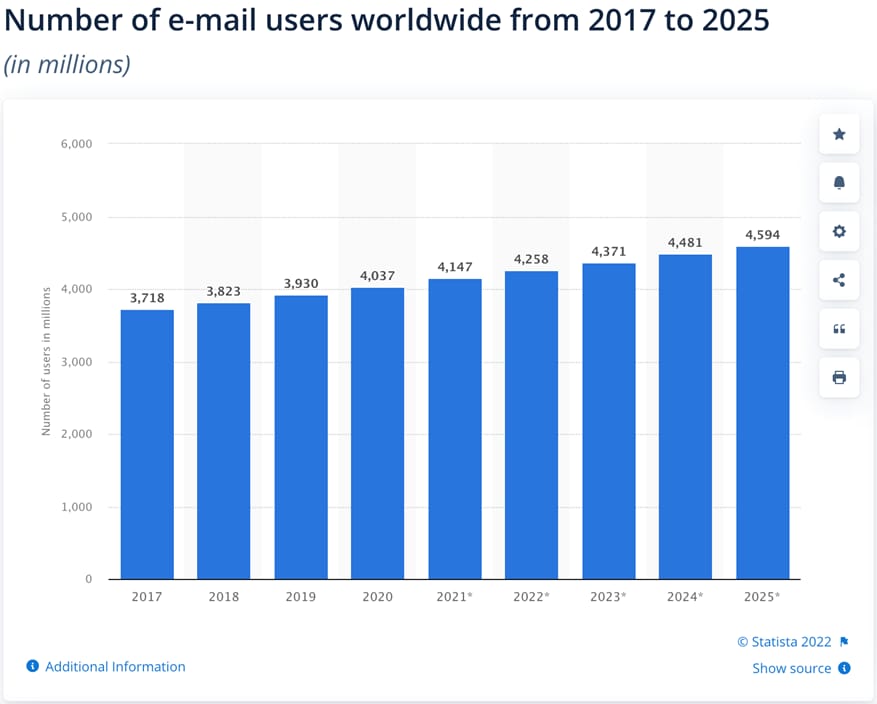
Source: https://www.statista.com/statistics/255080/number-of-e-mail-users-worldwide/

Despite the growth and prominence of mobile messengers and chat apps, email global users amounted to 4 billion and is set to grow to 4.6 billion users in 2025.

The global emails received and sent worldwide was approximately 306 billion in 2020. It is projected to increase to over 376 billion emails on 2025. This data shows that the trend towards mobile also is true for email.

As we know that the consumers interaction is multi-event and multichannel

These are some of the marketing strategies that you can invest with.

  • Inbound marketing
  • Content marketing
  • Email marketing
  • Search Engine Optimization(SEO)
  • Social Media
  • Paid Advertising
  • Mobile Marketing

One thing for sure is that email for marketing isn’t going anywhere. It will continue to be a staple part of any marketing strategy for all types of businesses.

COMMON SEARCHES:

Email marketing tools

Email marketing meaning 

Email marketing example 

Email marketing service

Email marketing examples 

Types of email marketing

Email marketing ideas

Email marketing benefits

WHAT PEOPLE GENERALLY ASK

What is email marketing and example?

How do businesses marketing?

What is an email marketing strategy?

What is email marketing and its benefits?

Categories
Digi Tech

Top 10 Secrets For A Good Website

Written by Paul Lim on Digilah (Tech Thought Leadership)

Today, we live in the world of the Web. It is common for companies to have websites and about 80% of consumers use the Internet to research on a business, product or service before making a purchase. But what if you do not exist on the Internet?

Establishing a web presence can prevent competitor from poaching your customers and simply setting up an appropriate company website can reel your target audience right in.

Websites can also improve customer service. As there is no downtime on the Internet, customers can be updated 24/7 and have their queries answered almost immediately. And what better way to provide them with value-added service than to share handy information on your website? Knowledge sharing is one method to connect with potential customers and eventually convert them into sales.

What is crucial is to build a website with the fundamental capabilities that garner and drive targeted traffic.  Here are 10 website to creating an ideal website to attract visitors and generate revenue.

1. Know Your Target Market 

The first step towards recognizing your target market is to have a proper understanding of the problems that your business tackle. Thereafter, identify the groups of people will be affected by these problems, these individuals will make up your target audience.

Make a list of your target audiences and group them accordingly to categories sure as profession, age, education levels, and gender. Find out how these groups of people may benefit from your products and services by questioning what they lack in their lives and meeting their needs where possible.

2. A Clear Navigation Bar

A clear navigation bar is a plus to any website. Choose simple names for the tabs on the navigation bar and the web pages – logical naming of both tabs and web pages should guide and direct visitors to a specific call-to-action.

3. About Us

The primary purpose of an About Us page is to inform the user about your company and what you do. The page should furnish visitors with the basic background information they need such as the company’s history, awards and achievements as well as social proof and authentic statements that can give your company image a boost.

4. Strong Headlines

There are millions of websites in the cyberspace competing for several keywords trying to be recognized as the first hit on search engines – but how exactly do you get people to read what you write?

Although good content and aesthetics are of great value to a website, a strong headline could give your website an edge over others. Pay special attention in crafting catchy and compelling titles for your headline and think out of the box to appeal to consumers and obtain the click-through.

Useful key words that trigger consumer action include Free, Discount, Guaranteed, Incredible Offer, 1-for-1 promotion etc. To truly persuade a visitor to constantly return to your website, use question words such as What, Why, When or How as visitors are often looking for answers to their various queries.

Take the subject “Driving A Car” for instance. 3 effective examples are:

  • “How to drive a car?”
  • “Why I Love Driving A Car?”
  • “10 Ways to drive a Car safety”

5. Integrate Social Media & Videos

Using Social Media and embedding videos in your content can direct traffic to your website on a regular basis. The inbound links to your website from high-profile social media platforms such as Facebook, You Tube, Twitter, Tik Tok and others will increase your search engine results page ranking.

Consider creating the following social media profiles:

  • Linkedin – A professional site to showcase expertise and reach out to potential clients based on skills set
  • Twitter – A social sharing platform where you can post relevant tips and information with links to corresponding articles on your website
  • You Tube – Upload short yet succinct videos to demonstrate useful tutorials and give advice to

Always include a link back to an appropriate landing page on your own website and ensure you include a call-to-action on the page, for instance “Retweet” or “Share this video”

6. Power Pictures and Graphics

Simplicity and succinctness are key in creating messages that are straightforward to understand. People are often impacted visually than textually; hence good graphic designs and images are more effective in engaging site visitors compared to text alone. A dynamic picture can drive higher consumer engagement which can lead to higher sales figures.

7. Provide Impressive Testimonials

Positive and impactful testimonials are excellent for boosting site traffic. If you are in the service industry that replies on customer service and referrals, positive and impactful testimonials that appraise your company’s services will drive greater traffic to your site. For instance, an outdoor event service business could have client testimonials about the excellent service delivery and efficiency.

8. Order Page

The main goal of any e-commerce website is to convert visitors to buying customers. The order confirmation page is usually called a ‘Thank You’ page.

It is only right to thank your customers each time they complete a payment and more importantly, it helps you to maintain healthy relationships and interaction with them, thereby increasing their returns to your site.

9. An Opt-in Box

The use of personal data is a sensitive issue today-companies need to gain consumers’ approval with regards to collection, storage, usage and distribution of their information. Using an individual’s data without approval can put an organization in trouble. Hence, providing an “opt-in” box for users will allow them to indicate their consent and method of contact from the company or organization, thereby recording their decision.

10. Contact Us

Any business that strives to engage its target audience needs to have a feedback channel where those interested in the company’s services or business can contact the relevant people for more information. Sign up for a customized domain email address and phone number and make sure you attend to your calls and answer your emails promptly.

Contact for more www.pauldigitaltraining.com

Categories
Digi Tech

“Technology and Digital – A Double-Edged Sword”!!

Written by Christina Min Shyan Tan on Digilah (Tech Thought Leadership)

Just like any tools, they can be a double-edged sword.

During this Covid period, businesses are affected, ranging from sales, operations, finance to cybersecurity, as most businesses now have to rely more heavily on digital technology.

Christina Min Shyan Tan at her desk doing business

In my business of sales coaching, training and consultancy, Digital and Tech have the following :

The Pros, The Positiveness

Borderless outreach

Now I can work across borders seamlessly, reaching out to global participants and customers via virtual meetings and webinars, compared to my original plans of only focusing the local market for a start.

Through digital networking and connections, I have managed to reach out to more than 10,000 contact points across multiple countries and new industries within months, which would definitely be impossible with traditional approaches.

High productivity

With virtual meetings, travelling time is virtually eliminated. This allows back-to-back meetings for optimal time efficiency in a forever time-scarce fast paced business environment. I have managed to save a few hours of travelling time a day and double my meeting output weekly.

I am also able to attend live and recorded business webinars and e-networking sessions off business hours.

With productivity applications being easily accessible, my virtual work productivity has also increased with tech adoption from my customers’ end too.

Increased marketing avenues

My business has not been spared from the impact of the pandemic. I have been working on improving on my resourcefulness and creativity to use multiple lead generation streams.

I capitalise on eCommerce in my business operations and eMarketing in my business development. These include optimising LinkedIn and other platforms for business growth and collaboration, building strong branding and digital presence, turning eConnections to physical connections for business wins.

Sales cycles have also been largely shortened due to more effective communication, information sharing and social proofs in the digital space.

The Cons, The Challenges

Reduction in social interactions

Digital and tech allow multimedia communication via text, email, phone calls and virtual meetings. The constraints of regulations have also pushed us into increased virtual interactions inevitably, reducing (if not replacing) face-to-face socialising which is critical for business networking.

The human touch and connection have weakened with also increased skill sets required to harness strong customer engagements and relationships.

Fatigue on eyes, mind and body

While the digital and tech space drive higher productivity, it also results in screen fatigue.

In my case, I meet customers, hold webinars and conduct coaching and training sessions virtually. I hold 2-full-day intensive workshops consecutively. These inevitably strain my eyes and cause body aches with limited physical movement and prolonged sitting.

Having to focus on multiple participants and engaging them virtually needs extra effort, although if done well, will still not hamper business outcome.

Distractions

The avalanche of digital information across media and platforms can cause information overload. News, social media, professional articles, virtual events and webinars come streaming in and popping up on screen, thanks to the power of data analytics and artificial intelligence.

With the push of relevant information online, they can also be my source of distractions, enticing me to read them. If I am not disciplined and practise discernment and prioritisation, this may result in time-consuming distractions despite their relevance.

Nevertheless, overall “DIGITAL AND TECH JOURNEY” has enabled me to work better despite some downsides.

Ensure that Digital and Tech is our powerful servant instead of a bad master. Control them instead of letting them run our lives.

May we capitalise on Digital and Tech to grow both our people and business.