Digilah

Categories
Fin Tech Web 3.0 Tech

Guarding the Vault: Fintech Cyber Security and a Finance 101

Collaboratively written by Danielle Teboul and Ajit Padmanabh on Digilah (Tech Thought Leadership).

In this article Danielle (Financial Investment expert) and Ajit (AR, VR and Web 3 expert) jointly explore:

  • Fintech Cyber Security dos and donts
  • Investment education on Finance 101

Below is a video by the writers themselves high lighting the key take aways from the writeup. Reach out to them if you want a 101 with them to learn more.


Danielle’s thoughts on Fintech Cyber Security

The need for cyber security has become paramount in today’s modern age, particularly in the fintech and financial space. Being in this industry myself, I handle sensitive client data daily, and have access to their online wealth accounts; it is therefore vital that their information stays safe and inaccessible to fraudsters. Robust security measures must be in place, and I am constantly having to upgrade and refresh my skills to keep my clients safe.

Whilst fintech has allowed for financial services to become more streamlined, convenient, and efficient, it has somewhat opened the floodgates for cyber-attacks and threats. Harvard Business Review reported a 20% increase in data breaches from 2022 to 2023, and this is set to increase further as the years progress. Not only does this mean we have to constantly upgrade our software and infrastructure, but human area can become a massive opportunity for cyber criminals. I truly believe that a two-pronged approach of new regulatory processes, along with using AI in cybersecurity is a dynamic tactic to tackle this ever-evolving problem.

Cyber security is now seeing the same level of regulation as every other type of security, which means that fintech companies in particular must adhere to stringent rules and procedures. Regulations such as the General Data Protection Regulation (GDPR) and the Payment Card Industry Data Security Standard (PCI DSS) must be followed. Whilst of course this is best practice to ensure that clients’ data is safe, it therefore adds an extra strain onto the company and its employees; this may lead to delayed admin processes, longer lead time for new business submission and therefore, a time delay in profit for the company. Time is money, and the longer it takes for profit to be made, it essentially means smaller margins for the company.

One way this can be tackled is with Artificial Intelligence. Whilst using manpower takes time and money (not to mention the risk of human error), AI systems can scan masses of data sets, analyse data, spot anomalies, and therefore detect possible cyber risks before they have even happened. This preventative method ensures that risks are managed efficiently, and before they become breaches, which means a safer system for the clients, and mitigates possible reputation risk for the company.

However, AI is not a final solution; with cybercriminals’ techniques ever evolving, it means that AI will have to do the same. Not only that, employees must keep re-training when new systems are introduced, to ensure that human error is kept to a minimum. Moreover, one must ensure that the third-party companies engaged to deliver this AI system, is also compliant, safe, and follows the stringent regulations set in place for fintech companies to adhere to.

But the buck doesn’t just stop with the company- clients and customers must also stay vigilant so that they don’t fall victim to cyber-crime.

For example, being able to spot a phishing email, not clicking on unknown links, and not giving out all your banking details to someone over the phone. In order for an individual to be savvy, particularly when it comes to fintech and online financial transactions, they must be aware of risks and know when and where it is appropriate to give out their financial information. If you engage a professional for your financial planning, of course you will have to make them aware of your personal details and possibly even bank details. But do take note that they should be encrypting or password-protecting any sensitive documents that are being sent to you.

Even if you are planning your finances alone, and are using platforms for your investing, be sure to do your own due diligence; ensure that the apps you are using are regulated and have secure payment systems. Do take note that most will require you to upload some form of identification, as well as declaring your tax residency. Whilst to a layman, this may seem intrusive, this is actually a sign that the platform is doing its part to adhere to compliance and regulations. If they don’t ask of these from you, it could be a sign that the platform is not regulated.

For those that plan their investing and finances alone, cybersecurity becomes an even bigger risk, as this is normally something that a large corporation would have to ensure the safety of first, but now it is being left to the individual investor. If you are considering planning your finances yourself, having basic understanding and knowledge is incredibly important.

Therefore, I often suggest that people understand four main areas before they start investing, which I will explore further in this article.

Over to my co-writer Ajit who introduces how metaverse and block chain technology will probably bring future solutions to curtail fraud in our highly susceptible finance industry.

Ajit’s thoughts on Fintech Cyber Security

Background

When we analyse the extent of online fraud and scams, it’s a bit bewildering! As per FTC in US, online scams tend to harm more young people than the elderly. In 2021, Gen Xers, Millennials, and Gen Z young adults (ages 18-59) were 34% more likely than older adults (ages 60 and over) to report losing money to fraud like online shopping scams as well as job scams. Most of the elderly, on the other hand, are victims of tech support calls duping them of their earnings. The median reported loss was $800 for people 70-79, and a whopping $1,500 for those 80 and over. On the other hand, the median individual reported fraud loss by people 18-59 was $500 in 2021.

As the fastest growing economy in the world, India is no stranger to online frauds. 62% of the frauds affect the age group 18-52 as per data from 2018. With robust infrastructure around UPI, this number is bound to decrease.

Blockchain Technology to the Rescue

With weakening currencies in countries like Zimbabwe and Venezuela and hackers from China and Russia, the attacks will only amplify, in the years ahead. There is an urgent need to safeguard individual financial earnings, leveraging technologies like AI and Blockchain. While they are large and independent technologies, they form a core part of the Metaverse. They are the processing as well as the security layer of the Metaverse. Many futurists have predicted that our interactions will be with digital twins of institutions and banks in the Metaverse.

Fast forward to 5 years from now and the permutations and combinations of frauds and financial losses for individuals will only amplify. The promise of Blockchain is to essentially safeguard the assets and investments of individuals as well as organizations. By utilising blockchain, banks can set up a secure and tamper-proof ledger of all financial transactions.

With real-time monitoring and instant access to transaction records across the blockchain, organizations can track and analyze transactions in real-time, allowing them to detect and prevent fraud as it occurs. The trust architected within the technology enables seamless detection.

Challenges with Emerging Technologies

As has been the scenario with any technologies when they are new, be it Television or Computers or even Gaming, new technologies take time to be accepted mainstream owing to numerous challenges. Some of the challenges with Blockchain technology are as follows.

    • Evolving Technology – Until a technology is adopted mainstream, the maturity of the technology is determined by its limited set of users. The technology is tested for various scenarios by the very same users. Much like the planets move across the solar system with time, in addition to their rotation and revolution, the world is ever evolving with all its volatilities, uncertainties, complexities and ambiguities. No system can be tested for robustness without the volume of usage which only comes with higher adoption. Blockchain technology needs to cross this bridge to deliver on its promises of safety, security, and robustness.

    • Data Privacy Concerns – The more data that’s visible to Blockchain (and AI), the more seamless the tracking of frauds. But, from a user’s perspective, it warrants sensitive data to be made available, traceable at all times. With GDPR norms in Europe as well as upcoming Data Privacy Bill in India, Blockchain as it stands today, seems to conflict with the regulations.

    • Energy Consumption and Infrastructure – With ESG goals being one of the focus areas across organizations and Governments, the carbon footprint recorded by emerging technologies like Blockchain and AI, with cloud-based high-compute, tends to be on the higher side. There is a need for hardware optimization to be able to leverage the technology to its potential, in an environmentally responsible way.

In conclusion, Blockchain technology will serve as the protective layer of the Metaverse and will be at the forefront of minimising frauds and innovations around it. There is a need to accelerate the adoption of the technology to ensure its robustness to enable us to face the challenges of Metaverse in time.

Over to my co-writer Danielle who simplifies investing basics and how your hard earned money can work harder for you.

Danielle on Finance 101

I have many clients and connections that I come across asking me for advice on how to get their finances in order. ‘How can we maximise what we have now, so that we can make the most of our money later?’. Of course, one of the best passive things we can do, is to invest.

Investing is the concept of allocating assets, usually money, into different financial vehicles to create a profit. The bare minimum investment should be doing is beating inflation, because over time our hard-earned money is worth less, due to the rising cost of products. Before one starts investing, it is best to have a clear strategy, and get the basics covered first. Here are a few key financial areas you should have planned for:

1. Build an Emergency Fund

At a glance investing may seem like an obvious choice when it comes to saving money. Why not just throw all your savings into investment if it means high returns? The answer is that investment returns are NOT guaranteed– even the safest investments come with some risk, and sometimes the lock in periods are high, or the penalty for withdrawing early is expensive. To ensure that you are not over-investing, make sure that you have an emergency savings fund that is easily accessible. That way should an emergency arise (like a large hospital bill or having to pay for car repairs), you can use your emergency money instead of jeopardising your investments.

The recommended amount you should have in your emergency fund is 3-6 months of your monthly salary. This should be a healthy buffer should the worst happen. If you already have more than that, then that’s a great time to consider investing.

2. Know How to Budget

Of course, setting aside for investment would be impossible if you didn’t know how much to set aside. That’s why organising your budget is a crucial step in your financial planning. There are many ways and methods for planning, but a good starting point would be the 50/20/30 rule:

    • 50% of your monthly salary maximum should go on things you need to pay for: housing, bills, groceries & insurance.

    • 30% can go on doing the things you enjoy: hobbies, drinks and travel.

    • 20% should go into your savings: think about your long term savings and investment goals.

If you have surplus each month, you can even consider increasing this 20% to a higher proportion and allocate more into your investment goals.

3. Be Debt-Free

Before you do any investing, you should really consider paying off your debt. Having a credit card bill is fine, but having any large or bad debt will hinder you in your long-term goals. It seems counter-productive attempting to make lots of money with investments, whilst paying off lots of debt. It may be difficult paying off student debt or large loans, but you will reap the benefits in the long run when your debt isn’t eating into your assets.

4. Set Your Investment Goals

This is arguably the most important step, defining your goals. What is the reason for investing? If you are doing it out of pure greed, then your judgment will become clouded when it comes to riskier investments, and you risk losing it all. So have a long and hard think about why you want to invest. You are putting your money, that you worked hard for, somewhere that could give you high returns, or give you nothing.

Therefore, it’s best to have a long think and define some clear goals for your future. Do you want to plan for your retirement? Save for a house? Pass something on to your children? Whatever it is, decide how much you would need and by when. Most investments give better returns if you have a longer-term commitment, so it’s OK to think big. If you have no clue and are just investing for the sake of it, you will quickly lose your drive and passion for making money.

These steps may seem simple, but they really are the key to an effective investment strategy. I work with clients every day to ensure that they have budgeted correctly, serviced their debt, and built an emergency fund, and together we work together to work towards their financial goals. Many find that this is more complex than they first thought and will include tax planning and ensuring that their assets are protected. This is of course one of the added benefits of hiring a professional. If you feel that these services are something you would require, feel free to reach out at Danielle.teboul@sjpp.asia or click here.

Over to my co-writer Ajit who tells us that finance 101 is best learnt by engaging emerging technologies like AR, VR as it helps in educating about financial products to customers in a more engaging and impactful manner and to all age groups, across the economic strata.

Ajit on Finance 101

Background

In its “Economic Well-Being of U.S. Households in 2022” report, the U.S. Federal Reserve System Board of Governors found that many Americans are unprepared for retirement. Twenty-eight percent indicated that they have no retirement savings, and about 31% of those not yet retired felt that their retirement savings are on track. Among those who have self-directed retirement savings, about 63% admitted to feeling low levels of confidence in making retirement decisions. Low financial literacy has left millennials—the largest share of the American workforce—unprepared for a severe financial crisis, according to research by the TIAA Institute. Even among those who report having a high knowledge of personal finance, only 19% answered questions about fundamental financial concepts correctly.

A 2021 survey by the Federal Reserve Bank of San Francisco revealed that 28% of all payments were via credit card, with only 20% being made in cash. In India this is bound to be much more skewed in favour of digital payments, with the ubiquitous presence of UPI. Given high volume of online transactions and multiple banking products for individuals, there is a need for greater financial literacy to ensure every individual makes the most of her hard-earned money.

Financial Literacy can cover short-term as well as long-term financial strategies. The key is to simulate WHAT-IF scenarios of various investment decisions and visualise their impact across years and even decades, well in advance. Today, most of this occurs in MS Excel and is largely based on linear data projections or on a logarithmic scale. Can we visualize the consequences of our financial choices with the advent of technologies like AI and machine learning (ML) models? I believe so. To top it, consider it as a visualised, gamified scenario builder in Virtual Reality (VR), the visual layer of the Metaverse.

Role of Immersive Technologies

Imagine your financial investments playing out their profit-loss cycles across decades, thanks to AI modelling. These What-if scenarios would provide greater education and retention of one’s decision-making as far as financial instruments are concerned. As newer products enter the market, a constant training to these models will ensure the What-if scenarios remain invaluable for you as in individual investor. Taking it a step further and looking at visually gamifying the entire basics of financial literacy (Finance 101), it could prove to be a powerful learning tool for students in schools and colleges as well as working professionals.

Memory retention with VR is far greater than attending lectures, videos or e-learning modules. While the learning retention is only 5 percent for lectures and 10 percent for reading, we find VR among the top 2 with a learning retention of 75 percent. VR training is only beaten by learning that happens through educating others, where the learning retention is at 90 percent.

The learnability and application of knowledge would become second nature for every individual, thereby raising financial literacy, exponentially. There is a need to tap into the power of this technology for a crucial knowledge capsule that’s absent in the masses. This would ensure financial stability and growth in every individual beyond the cycles of survival and existence.

In conclusion there is a need to increase financial literacy in global population and immersive technologies like VR ably powered by AI could prove to be transformative in serving this need. Technology is the biggest leveller across urban and rural communities worldwide and hence could serve as a powerful tool ushering in this much needed aspect among various facets of literacy, financial or otherwise.

References:

    1. https://www.ftc.gov/news-events/data-visualizations/data-spotlight/2022/12/who-experiences-scams-story-all-ages

    1. https://www.ncoa.org/article/top-5-financial-scams-targeting-older-adults

    1. https://www.statista.com/statistics/871207/india-share-of-financial-fraud-victims-by-age-group/

    1. https://www.investopedia.com/terms/f/financial-literacy.asp 

    1. https://fintechmagazine.com/articles/nvidia-advancing-cybersecurity-efforts-with-gen-ai

    1. https://hbr.org/2023/04/cyber-risk-is-growing-heres-how-companies-can-keep-up

Most Asked Questions

How AI can help in avoiding cyber threats?

Whilst using manpower takes time and money, AI systems can scan masses of data sets, analyse data, spot anomalies, and therefore detect possible cyber risks before they have even happened.

What is 50/20/30 rule of financial planning?

50% of your monthly salary maximum should go on things you need to pay for: housing, bills, groceries & insurance.
30% can go on doing the things you enjoy: hobbies, drinks and travel.
20% should go into your savings: think about your long term savings and investment goals.

Most Seached Queries

Virtual Reality (VR)

General Data Protection Regulation (GDPR)

Payment Card Industry Data Security Standard (PCI DSS)

Financial literacy

Investment planning
For more on investment planning read Danielle’s blog

Hello readers! Hope you liked what you read today. Click the like button at the bottom of this page and share insights with your colleagues and friends!

For more such amazing thought leadership articles on technology follow Digilah people.

Categories
Web 3.0 Tech Edu Tech

BLOCKCHAIN AND WEB3: A NEW ERA FOR LIBRARIES

Written by Alison Alexander on Digilah (Tech Thought Leadership).

An analysis of how blockchain and Web3 technologies can revolutionize library services and operations.

As a thought leader in enhancing public services through adoption of the evolving technology of Web3 tools, Blockchain, AI, Metaverse, and Crypto.

Libraries at the Forefront of Technological Adoption

Today I thought I would write about a specific local government resource that all politicians, community members feel passionate about – especially when the point is raised about potential closure to save money.

The community resource I am referring to is the Library

Blockchain and Web3: A New Era for Libraries

I believe that the integration of blockchain and Web3 technologies offers a tantalizing glimpse into a future where libraries are more accessible, secure, and democratically managed than ever before.

So a few thoughts on how the new technologies could transform our beloved public libraries.

Decentralized Access to Information – imagine a library system where access to information is not governed by a single authority but distributed across a network, ensuring democratic access to even the rarest texts.

Blockchain can make this a reality, providing equitable access to all, a step forward in democratizing knowledge.

Digital Identity and Privacy – in our data-sensitive world, blockchain can reassure library users that their personal information remains secure and private.

By creating secure digital identities, libraries can offer a wide range of services without compromising user privacy.

Enhanced Cataloguing and Metadata Management – Blockchain’s ability to maintain tamper-proof and up-to-date records can revolutionize how libraries catalogue their resources.

This means more efficient resource management and easier discovery for users, streamlining what has traditionally been a complex process.

Digital Asset Management – the transparent, immutable nature of blockchain is perfect for managing digital assets.

It ensures that digital books and resources are tracked effectively, respecting digital rights, and ensuring fair compensation for creators.

Smart Contracts for Streamlined Operations – from issuing library cards to managing book loans, smart contracts can automate and simplify library operations.

These contracts, embedded with the terms of agreements, can significantly reduce administrative burdens, allowing libraries to focus more on service and less on paperwork.

Conclusion: Embracing Change for Community Empowerment

Community Engagement through Tokenization – Blockchain can also foster a more engaged community. By rewarding contributions like book reviews or workshop hosting with tokens, libraries can encourage active participation, creating a vibrant, collaborative environment.

Preservation of History – for historical and rare documents, blockchain offers an unprecedented preservation tool. By storing detailed information on a blockchain, libraries can maintain a permanent record of these documents, safeguarding our history for future generations.

Global Collaboration – blockchain facilitates unprecedented global collaboration. UK libraries could partner with international institutions, sharing resources and information more efficiently, and greatly expanding the resources available to patrons worldwide.

Education on Cutting-Edge Technologies – finally libraries have always been pillars of learning. Wouldn’t it be great to see them host workshops on blockchain and Web3 technologies, they can continue this legacy, helping to bridge the digital divide and bringing these advanced technologies to the forefront of public education.

I really think the potential of blockchain and Web3 in transforming UK public libraries is immense. 

I don’t think it is just about keeping pace with technological advancements but about reimagining what libraries can be in the 21st century: more inclusive, more accessible, and more integrated into the digital fabric of our society.

This article is not about revolutionize libraries for the sake of innovation, but for the enrichment of our communities and the preservation of our collective knowledge.

Most searched questions

What is block chain?

What is web3?

Most searched queries

Block chain

Web3

Education and Web3

Hello readers! Hope you liked what you read today. Click the like button at the bottom of this page and share insights with your colleagues and friends!

For more such amazing thought leadership articles on technology follow Digilah people.

Categories
Web 3.0 Tech Law Tech

Pixels to Possibilities: Unravelling India’s Gaming Odyssey

Written by : Ankita Sambyal on Digilah (Tech Thought Leadership

Who isn’t fond of video games? From teens to adults, isn’t it? Some play video games as a source of living or to relieve stress. 

The genesis of video games dates back to their early development when a human being used to interact with a massive video device and an analog remote to give commands to the machine to move a pixelated character. 

The earliest recorded U.S. video game patent dates back to 1948, known as the ‘Cathode-ray tube Amusement Device.’ Some of the earliest video game examples include the Nimrod Computer, a massive machine weighing over a ton, as well as Oxo (1952), Tennis for Two (1958), and Spacewar (1961). 

However, these early video games were not available for public purchase due to their immense size and high costs.

The evolution in video game technology has witnessed the progression from classic games like Mario to multiplayer gaming and now to the concept of metaverse gaming.

 Ralph Baer, the Father of Video Games, played a significant role in advancing the Gaming Industry.

In 1967, he invented the prototype called the ‘T.V. Game Unit #1,’ followed by other inventions like the ‘Brown Box Light Gun’ and the ‘Pump Unit’ in 1967-68. In 1972, Baer introduced the Video Game Console named “Odyssey.” 

The Global gaming industry experienced substantial growth, with a valuation of USD 231.34 billion in 2022 and a projected value of USD 353.35 billion over the next five years. 

The year 2023 shows promising developments, including the introduction of generative AI support that simplifies gaming development and increased investments in the metaverse.

In contrast, the Indian gaming industry was valued at USD 2.8 billion in 2022 and is expected to reach USD 5.0 billion by 2025.

Considering the exponential growth of the gaming industry, it becomes crucial to establish and enforce regulations to protect the interests of players. 

These regulations should focus on promoting fair play, ensuring player safety, safeguarding minors, protecting intellectual property rights, and preserving the confidentiality of data and sensitive personal information of gamers.

 Additionally, such regulations should consider the financial interests of both the gaming industry and the players.

“Most Parliamentarians don’t have a clue as regards the challenges or the opportunities the games industry faces” – David Puttnam

A videogame can be classified on the basis of mode: – 

      1. Online Games

      1. Offline Games. 

    Further, Online and Offline Games can further be classified on the basis of interaction: – 

        1. Game of Skill

        1. Game of Chance.

        1. A Mixture of Game of Skill and Chance.

      On 6th April 2023, the Ministry of Electronics and Information Technology of India proposed Amendments to the Information Technology (Intermediary Guidelines and Digital Media Ethics Code) Rules, 2021, which gives a comprehensive framework for Online Gaming Ecosystem, however, these amendments still fail to address the vital connotations of the Gaming Industry. 

      Although, the endeavour has been made through implementing these Amendments to define and explain the terms like “Online Game” (Sec. 2(qa)), “Online Gaming Intermediary”(Sec. 2(qb)), and “Online Real Money Game” (Sec. 2(qd)), however, the definitions and explanations are not comprehensive enough, and there is still a significant gap in the interpretation of these terminologies to fit in the practicality of today’s gaming that we are witnessing in and around.

      In 2020, the Federation of Indian Chambers of Commerce and Industry (FICCI) in partnering with Ernst & Young (EY), released a report stating that USD 817 million has been garnered by the Indian Online Gaming Industry, which involved real-money transactions which depicts that 71% of Indian players are involved with ‘Online Real Money Gaming’. 

      Therefore, Regulators need to take a nuanced approach while defining online games and should consider different examples and illustrations to help clarify the distinction between games of skill and games of chance.

          • In situations where monetary transactions are involved in an online game (skill-based or chance-based), it is crucial to adopt a risk-based approach and enforce mandatory KYC verifications for the players utilizing that platform. Additionally, the platform should implement restrictions on financial transactions based on spending limits to ensure responsible and controlled monetary involvement.

          • The legislative amendment should provide clear and detailed explanation of fraudulent activities, that occur in the virtual realm, including services that hijack gaming accounts, theft of virtual identities, fraudulent manipulation of in-game items, cheating and hacking through the use of bots, deceptive game modification, Phony Game Currency Sellers, etc.

          • The legislative amendment should provide detailed and clear distinction of gaming intermediaries and their roles involved in the virtual realm such as online gaming platforms, game developers, publishers, marketplaces etc. along with their roles and responsibilities such as hosting game servers, game distributors, facilitating communication among players, offering customer support etc.

          • The gaming platforms must be legally obligated to provide clear and explicit information on their websites regarding the nature of the game mode in which the player is engaging, distinguishing it is primarily based on skill, chance or a combination of both. By doing so, they will ensure transparency, promote user awareness, and facilitate a fair gameplay environment in compliance with legal requirements.

        “The people are pieces of software called avatars. They are the audio-visual bodies that people use to communicate with each other in the metaverse.” – Neal Stephenson

        As we have transitioned from traditional gaming to more immersive and interactive experiences facilitated by VR Headsets, we may also witness the emergence of evolved forms of criminal activities in this virtual space. 

        Some Countries like Hong Kong are policing the Metaverse to design ‘user safety’ and to educate the public about the potential dangers associated with Web 3.0 and the Metaverse. 

        In conclusion, it is imperative for India, which is having a base of 421 million of online gamers and is likely to reach over 442 million by the end of 2023, needs to take a thorough revamp of its gaming regulations to encompass games such as Blockchain-based gaming, Metaverse Gaming. 

        By proactively, embracing and regulating these advancements, can help protect consumers, prevent problems of gambling, and ensure a fair and level playing field for all participants that can help India to position itself as a leader in effectively overseeing the Gaming Industry. 

        This strategic approach will ensure that India remains competitive and doesn’t lag behind in effectively policing the dynamic and evolving gaming landscape. 

        Most asked questions

        What is the current size of the gaming industry?

        What are the job opportunities in the gaming industry?

        Most searched queries

        Fastest growing gaming company

        Mobile gamers in India

        Hello readers! Hope you liked what you read today. Click the like button at the bottom of this page and share insights with your colleagues and friends!

        For more such amazing content follow Digilah

        Categories
        Mar Tech Web 3.0 Tech

        EMB Gaming

        Written by : Saurabh Bhatia on Digilah (Tech Thought Leadership)

        Gaming is booming and is expected to keep growing as per World Economic Forum.

        Exploding Gaming Industry in India

        The gaming industry in India is experiencing explosive growth, expanding at an annual rate of approximately 38%. India is second only to China in terms of growth, with the industry projected to grow four-fold by 2027 and create at least 100,000 jobs each year. While the global gaming revenue is expected to expand at a CAGR of 9.64%, India is on track to grow at an impressive CAGR of 16.22%. The transformation from a simple pastime to a thriving business is nothing short of remarkable.

        Challenges and Opportunities

        Despite the rapid and lucrative growth of the gaming industry, the constant technological advancements make staying relevant a considerable challenge. Out of the 1000+ game development studios and agencies, only a few are keeping pace with the industry’s evolution.

        Expand My Business: A Pioneer in Indian Gaming

        Gurgaon-based Series-A funded tech service start-up, Expand My Business (EMB), is one such trailblazer in the Indian gaming industry. Our Game Development vertical is making an impact worldwide. EMB specializes in providing consultation and delivering cutting-edge tech and digital services across domains, positioning itself as the most proficient solution provider.

        In just a year, EMB’s gaming division has become a significant contributor internally and has positively impacted its clients’ success. A clear distinction between iGaming and Core Game Development & Gamification has enabled them to penetrate gaming, e-sports, casual and hyper-casual gaming, and AR-VR-based games. The company has delivered more than 30+ game solutions across domains and tech stacks in FY 22-23, aiming to increase project volume tenfold in the current FY as they continue adding new gaming micro-level services to their arsenal.

        EMB’s USP

        Diversified Expertise and Innovation

        EMB, the technical facilitator behind India’s digital gaming solutions, has strengthened its expertise in fantasy and digital card & board games. Making headlines for service expansion in niche domains like blockchain-based gaming, cloud-based gaming, immersive gaming, NFT-enabled gaming, and immersive gaming experiences.

        Comprehensive Game Development Services

        Not only is Expand My Business a one-stop solution for game development, but it is also an ideal destination for game design and strategic partnerships. The company fosters growth by cultivating high-revenue games and excels in:

        Research

        ·       Guiding game development through studies and information gathering

        Design

        ·       Storyboarding & Storytelling

        ·       Game Art & Animation

        ·       Concept Art

        ·       Casual Art

        ·       3D Assets

        ·       2D-3D Animation

        ·       UX/UI

        ·       Motion Design

        ·       Game VFX Services

        Audio Production

        ·       Music & Audio Production

        ·       Sound Effects

        ·       Scores

        ·       Audio Assets

        Deployment

        ·       Game Testing & QA

        ·       TRC Game Certification

        ·       Game Porting Services

        ·       Full Post Production Services

        Marketing Services

        ·       Social Media

        ·       Digital Advertising

        ·       Influencer Marketing

        ·       PR

        ·       Content Marketing

        Full-Game Development

        ·       Complete the game development process, start to finish

        ·       A final roadmap cycle

        Resource Augmentation

        ·       Hiring additional resources as needed (artists, developers, designers, testers)

        ·       3D/2D Artists and Designers

        ·       Game Developers

        ·       Game Testers, QA

        Legal Services

        ·       Intellectual property protection

        ·       Licensing and distribution agreements

        ·       Compliance with local and international regulations

        ·       Privacy policies

        ·       Contract drafting and negotiation

        ·       Dispute resolution

        Future vision

        To be a significant contributor to India’s GDP which is fueled by the gaming industry’s extraordinary growth and the comprehensive array of services offered and create a global gaming footprint.

        As the world marvels at the gaming industry’s unparalleled growth, choosing the right tech and consulting partner is crucial.

        Most asked questions

        Which is the trendiest online game?

        What is world economic forum?

        Most searched queries

        Augmentation

        GDP

        Hello readers! Hope you liked what you read today. Click the like button at the bottom of this page and share insights with your colleagues and friends!

        For more such amazing content follow Digilah

        Categories
        Web 3.0 Tech AI Tech

        Collaboration and Web3


        Written by Aman Bandvi on Digilah (Tech Thought Leadership)

        “Alone we can do so little, together we can do so much.” – Helen Keller

        Helen Keller emphasizes the importance of collaboration in achieving great things. Collaboration has been an integral part of human society since the beginning of time. We collaborate to achieve a common goal, to learn from each other, and to make progress. In the digital age, collaboration has taken on a new meaning with the advent of Web3.

        Web3 is the next evolution of the internet, where decentralization, transparency, and community-driven efforts are the norm. Web3 technologies, such as blockchain and smart contracts, have the potential to reshape how we collaborate and create value. In this article, we’ll explore how collaboration and Web3 are interconnected and how this synergy is shaping the future.

        Decentralized Collaboration

        One of the most significant benefits of Web3 is its decentralized nature. Traditional collaboration relies on centralized entities to facilitate communication, project management, and decision-making. However, Web3 offers a new paradigm where collaboration can happen in a decentralized manner, without the need for intermediaries.

        For example, decentralized autonomous organizations (DAOs) are emerging as a new form of collaboration. DAOs are decentralized entities that operate on the blockchain, where members can propose, vote, and execute decisions. DAOs are self-governed, transparent, and open to anyone who wants to join. This new form of collaboration enables community driven efforts that are not possible in traditional organizations.

        Trust and Transparency

        Another benefit of Web3 is trust and  transparency. Collaboration often requires trust among members, which can be challenging to establish in traditional settings. However, Web3 technologies enable trust through cryptography, consensus mechanisms, and smart contracts.

        For example, smart contracts are self-executing contracts that are programmed to execute automatically when specific conditions are met. Smart contracts eliminate the need for intermediaries and provide transparency and trust between parties. This level of trust and transparency can enable more efficient and effective collaboration.

        Value Creation

        Collaboration and Web3 can create new forms of value. In Web3, value can be created through decentralized applications (dApps) and decentralized finance (DeFi) protocols. dApps enable collaboration between developers, users, and other stakeholders to create new services and products. DeFi protocols enable collaboration between different financial services and create new financial products that are accessible to anyone.

        Web3 also enables new forms of incentivization through tokens and cryptocurrencies. These tokens can be used to incentivize collaboration and reward contributors for their efforts. This Aman Bandvi, v1 March 2023 new form of value creation can create more inclusive and equitable collaboration where everyone can participate and benefit.

        Case: Collaboration, Web3 and impact on the last-mile

        Collaboration and Web3 have the potential to create a significant impact on the last mile and offer value to government stakeholders. Web3’s decentralized nature, transparency, and community-driven efforts can provide an efficient and effective way to collaborate and create value for the last mile.

        The last mile is the final leg of the supply chain that delivers goods and services to consumers in remote or underdeveloped areas. Collaborative efforts can help bridge the gap and provide essential services to these areas. For example, DAOs can enable community-driven efforts that address local needs, such as water supply, healthcare, or education. These efforts can create new value for the last mile and improve the quality of life for people in these areas.

        Government stakeholders can also benefit from Web3’s collaborative efforts. Web3 technologies can provide transparency, accountability, and trust in government operations. For example, smart contracts can automate government processes, eliminate corruption, and provide transparency in government procurement. Additionally, DeFi protocols can provide a more inclusive and accessible financial system that enables government stakeholders to access financial services and create new financial products that serve their constituents better.

        Case: Web3, collaboration and education sector

        “Collaboration allows teachers to capture each other’s fund of collective intelligence.” – Mike Schmoker

        One example of how Web3 and collaboration have impacted education is the Open Learning Initiative (OLI) at Carnegie Mellon University. OLI is a Web3-based learning platform that leverages blockchain technology and smart contracts to create a more decentralized and community-driven approach to education. The platform enables students to learn at their own pace, with personalized learning paths that are tailored to their individual needs and preferences.

        OLI uses Web3’s token economy to incentivize collaboration and participation. Students are rewarded with tokens for their contributions to the platform, such as completing exercises or providing feedback on course content. These tokens can be exchanged for rewards such as access to premium content or discounts on future courses.

        OLI also leverages Web3’s decentralized governance model to give students a say in the direction of the platform. The platform is governed by a DAO that is owned and controlled by its members, giving students a voice in decision-making and ensuring that the platform is always evolving to meet their needs.

        The impact of OLI has been significant, with students reporting higher levels of engagement and satisfaction with the platform compared to traditional learning methods. By leveraging Web3’s collaboration and decentralized governance models, OLI has created a more personalized and engaging learning experience that is tailored to the needs of individual learners. This has the potential to revolutionize the education sector by providing a more equitable, inclusive, and effective approach to learning that is accessible to all

        Summary

        Collaboration and Web3 are transforming how we work and create value. Web3’s decentralized nature, trust and transparency, and value creation potential enable new forms of collaboration that were not possible before. This new paradigm offers exciting opportunities for innovation and progress. As we continue to explore the potential of Web3, it’s clear that collaboration will be at the heart of its success.

        Aman Bandvi

        Co-founder Ais Possible

        India Blockchain Alliance

        Emerging Technology Council

        Hello readers! Hope you liked what you read today. Click the like button at the bottom of this page and share insights with your colleagues and friends!

        For more such amazing content follow Digilah People

        Most searched questions

        What is the impact of web3 on internet?

        Can trust and transparency completely achieved in web3?

        Most searched queries

        Collaboration

        Web3

        Categories
        Web 3.0 Tech

        The evolution of NFT and Blockchain Use Cases

        Written by Sallyann Della Casa on Digilah (Tech Thought Leadership)

        Nfts have advanced significantly since 2021, when we first learned about them. Most people now consider the functionality of NFTs in addition to the artwork when thinking about them.  

        The following utility benefits provided by the still widely used Bored Apes to their customers are what has maintained their price so high:

            1. Bored Ape Yacht Club (BAYC) membership: Each Bored Ape NFT acts as a membership card for the BAYC, a group of NFT collectors who are all enthusiastic about the project. Members of the BAYC get special access to events, products, and other benefits.

              1. Commercial licensing: The Bored Ape NFT owners have the right to monetize their digital assets, which includes using the characters’ visuals to make and sell items and to provide licenses for their use in other projects.

                1. Members of the BAYC are eligible to vote on matters of governance that will have an impact on the project’s future. This implies that Bored Ape NFT owners can influence how the neighborhood develops and expands.

                  1. Royalties: The owner of a Bored Ape NFT gets paid a portion of the sale price when the NFT is sold or exchanged on a secondary market. For the owners, this offers a steady stream of income.

                    1. Social standing: Among NFT collectors, Bored Ape NFTs have come to represent rank and distinction. Each NFT’s rarity and distinctiveness can raise its value and desirability among collectors, elevating its social standing in the community.

                  How you describe NFTs matters greatly for those of you who are still unfamiliar with the NFT notion. An NFT is just code that connects anything to blockchain, such as Javascript or C++. You could conceivably save your documents to the blockchain with a “dot NFT” just like you would when saving them in Word or Excel. 

                  With that reasoning, the logical question is: Why use blockchain, and what money do you hope to save? 

                  Definition is crucial here once more. Blockchain is the ideal notebook. Once something is printed on a page, it cannot be changed or removed. 

                  Blockchain is now incredibly safe, unchangeable, and verifiable thanks to this. 

                  Now combine the two, and let’s talk about a few recent, highly intriguing use cases of Blockchain and NFT technology: 

                  Transforming the legal patent filing system

                   In the field of protecting intellectual property (IP), IBM has explicitly filed patents relevant to patent filing on blockchain. These patents seek to improve the speed, security, and transparency of the patent application process using blockchain technology. Details are as follows:

                      1. Streamlining the application process for patents: Inventors might submit their patent applications directly to the blockchain using IBM’s blockchain-based patent filing system, without the need for the usual intermediaries like patent attorneys and patent offices. This might speed up and reduce the cost of the application procedure.

                        1. Increasing transparency: When a patent application is added to the blockchain, it becomes an unalterable record that is available to the public. Due to the complete transparency and ease of verification of the application’s history and its prosecution, this could assist in preventing conflicts and issues over the validity of patents.

                          1. Increasing security: IBM’s blockchain-based patent filing system may offer more defense against the infringement and theft of intellectual property. In order to avoid illegal revisions and tampering, the system would be made to ensure that only authorized parties could access and amend the records of patent applications.

                            1. Automating the administrative processes involved in managing patents, such as keeping track of licenses, renewals, and ownership, could likewise be done using IBM’s technology. For patent owners and inventors, this might save time and money.

                          The overall goal of IBM’s blockchain-based patent filing system is to improve the efficiency, security, and transparency of the patent application and administration process. It may lessen conflicts over patent ownership, safeguard intellectual property rights, and streamline the administrative tasks involved in administering patents.

                          Helping us reach net zero 

                          Imagine your refrigerator and washing machine conversing with one another about which one is turning on and off to ensure controlled energy use. How NFTs and blockchain can assist us in reaching net zero is as follows:

                              • NFTs can be utilized to create distinctive digital assets that serve as verifiable carbon offsets. These offsets can be purchased and traded on marketplaces built on the blockchain, enabling businesses and people to offset their carbon emissions and support green initiatives. Utilizing NFTs can improve the market for carbon offsets’ transparency and traceability, ensuring that offset projects are authentic and that emissions reductions are properly recorded.

                                • Financial sustainability: Blockchain-based systems can be used to establish digital tokens that reflect sustainable assets, such as green bonds, sustainable agriculture, or renewable energy projects. Investors can promote and fund sustainable projects by trading these tokens on exchanges built on the blockchain. This might quicken the shift to a low-carbon economy.

                                  • Transparency in the supply chain: Blockchain technology can offer traceability and transparency in supply chains, allowing businesses to monitor and confirm the sustainability of their goods and raw materials. This can verify that items fulfill sustainability requirements and help reduce their carbon footprint.

                                    • Energy management: Blockchain technology can be used to establish decentralized energy markets, enabling people and companies to conduct direct exchanges of renewable energy. This can hasten the transition to a low-carbon energy system and improve the efficiency and dependability of renewable energy systems.

                                  The application of NFTs with blockchain technology can open up new possibilities for carbon accounting, offsetting, and trading, as well as boost supply chain transparency and traceability and support sustainable finance. 

                                  The objective of producing net zero emissions and reducing the effects of climate change may be achieved with the help of these developments.

                                  Preserving Human Identity 

                                  Life before and after ChatGPT vividly defines the era in which we currently live. 

                                  If you haven’t been paying attention, new artificial intelligence capabilities are being produced every day at breakneck speeds. And if you aren’t already, you need to start questioning human identity and the purpose of humanity right away. 

                                  In a time of automation, how do we capture and maintain human individuality and ingenuity? 

                                  Your degree or birth certificate do not define your human identity or cleverness. We’re referring to the distinctive ways you reason and behave, frequently utilizing human abilities like imagination, discretion, and initiative. 

                                  A psychometric, static profile or resume cannot adequately capture this dynamic reality. NFTs can capture all of this in a very simple way, allowing us to control our information and also use it to signal, like SEO, those we want to pay attention to. 

                                  It is shaped by the interactions we have with others, the way we handle situations, the people we surround ourselves with, and the projects and ideas we take on.

                                  This is part of the NFT technology-related work I’ve been looking forward to at my startup, Gleac with our tokenization of time on blockchain of the world’s leading experts in a project we call Lovely Humans. 

                                  Tokenizing human time and wisdom is the process of developing one-of-a-kind digital assets that represent the labor and knowledge of certain people, such as consultants, coaches, or mentors. 

                                  On the blockchain-based market place powered by our lovely humans, these assets can be traded, enabling people to monetise their knowledge and talents in the following ways: 

                                      1. Making original digital assets NFTs can be used to produce one-of-a-kind digital assets that symbolize people’s labor and knowledge. These assets can be sold in markets built on the blockchain, enabling people to monetize their knowledge and talents.

                                      1. Increasing transparency and trust: Blockchain technology can give transparency and traceability in the exchange of knowledge, ensuring that the knowledge being offered is reliable and authentic.

                                        1. Cutting out intermediaries People may be able to directly trade their expertise with others via blockchain-based markets, eliminating the need for middlemen and improving the efficiency of the transaction.

                                          1. presenting fresh possibilities In an era of AI and automation where traditional jobs are being disrupted, tokenizing human time and insight can offer people new chances to monetize their skills and expertise. 

                                        By giving access to knowledge that would not have been previously available, it can also generate new chances for learning and personal development.

                                        Tokenizing human time and wisdom is essential in an era of AI and automation because it can allow individuals to not only profit from their unique skills and knowledge but also time capsule it, which AI cannot easily replicate. 

                                        Additionally, it can easily track the source of new inventions and intellectual property (IP) from experts, particularly as we move toward a blockchain-based patent filing system which is one of the core utilities of the lovely human NFT collections. 

                                        Additionally, it can offer up new avenues for learning and personal growth, particularly in disciplines where knowledge availability may be limited. 

                                        With the aid of blockchain technology and NFTs, human labor and knowledge can be tokenized efficiently and openly, assuring the validity and legality of knowledge transfer.

                                        In conclusion, NFT and blockchain technology have the potential to transform the way we interact with digital assets and create a more transparent and decentralized world. Ultimately, these technologies have the potential to create a more equitable and inclusive world, where individuals have greater control over their digital assets and access to new forms of value creation.

                                        I released the world’s first NFT collection tokenizing time and wisdom.

                                        Hello readers! Hope you liked what you read today. Click the like button at the bottom of this page and share insights with your colleagues and friends!

                                        For more such amazing content follow Digilah People

                                        Categories
                                        Web 3.0 Tech Art Tech

                                        NFTs: The Future of Art?

                                        Written by Science Centre Singapore on Digilah (Tech Thought Leadership)

                                        Illustrations by Sung Jernin

                                        At this point, everybody has heard of an NFT. Some have commended them to be the future of art, while others have been more conservative with their praise, believing NFTs to be a gimmick. 

                                        Let’s take a look under the hood at how NFTs work and decide how viable they are as the artwork of the future or as digital assets.

                                        NFT, meaning “non-fungible token”, refers to an online asset that is not interchangeable; like trading cards or precious artefacts in how they are individually irreplaceable.

                                        NFTs seek to create the same kind of value in the digital space – digital items with their own unique identities. 

                                        They have become a household term after exploding in popularity in 2017, with the craze being started by groups like CryptoPunks, a brand specialising in pixelated avatars. Their work has been traded for astonishing amounts – with Alien CryptoPunk #7523 infamously sold for 11.7 million USD. 

                                        First, let’s try to understand how NFTs work and what makes them unique. NFTs utilise ‘blockchain’ – the same technology as cryptocurrencies. Think of blockchain as a digital ledger that records transactions. The term ‘block’ refers to individual stores of data, and the term ‘chain’ describes the way these different blocks are linked to form one cohesive network. 

                                        When each data block in the network reaches its predefined storage limit, it is rendered totally immutable, and data begins to flow into the next block instead. 

                                        This technology guarantees lasting security, because once a block is set, its contents are forever unchanged. In the case of NFTs, this technology is used to store an address on the web or another method of access. 

                                        The blockchain itself does not store the image or video. A key that enables access to the site on the blockchain where the NFT address is stored is kept in the buyer’s digital wallet.

                                        The appeal of NFTs is difficult to rationalise. It might be their novelty, the futuristic appeal of the blockchain itself, or their hype and celebrity. Their guarantee of uniqueness contributes to an image of absolute exclusivity. 

                                        In addition, the security afforded by blockchain increases buyers’ impression that they have just acquired something irreplaceable, and they take pride in ownership of these digital artefacts. 

                                        Like trading cards, some characteristics in NFTs are more sought after than others. In the CryptoPunks collection, there are some common characteristics and some which are much rarer, like alien skin; those with that characteristic are likely to go for hundreds of thousands of dollars, if not millions. 

                                        These art pieces also act as status symbols. There are events and exclusive clubs/communities that only permit those who have ownership over specific NFTs. 

                                        This desire for celebrity status is a central driving force behind the NFT rage – people seek to take part in a lifestyle they have not yet gotten to experience. 

                                        The example of basketballer Stephen Curry, who spent 180,000 USD on Bored Ape #7990 and made a tweet showing off his new purchase and his acceptance into an exclusive discord server, highlighting the usage of NFTs as a status symbol. 

                                        When high-profile people make these purchases, it beckons more people to enter the market and try their luck.

                                        It seems clear to at least some degree that the explosive growth of cryptocurrency over the past few years, with Bitcoin and Ethereum becoming household names, has had a major effect on propelling NFTs to the global stage. 

                                        The NFT market has also been boosted considerably by an irrational fear of missing out on “the next big thing”. Nowadays we all hear about prophets who made bulk purchases of Bitcoin around a decade ago when it was cheap and are now multi-millionaires; people feel they would be missing out on a trend of a similar calibre if they were to ignore the NFT market.  

                                        Therefore, people are anxious to jump in as fast as possible, leading to questionable financial decisions. To some extent, the hype around NFTs is a self-propelling cycle, attracting more and more prospective buyers as it grows larger and more tempting.

                                        There is also something to be said about NFTs being an inevitable offshoot of the transition from the physical to the digital that has taken place over the past two decades.

                                        Think of the migration of the cinema experience to online streaming services, or the migration of media from discs to files on the cloud. It seems like a natural progression from tangible art to NFT.

                                        The idea of keeping things physically and valuing the ability to touch and to feel seems antiquated.Of course, despite their inevitability with increasing focus on the digital space, NFTs have not been universally accepted.

                                        For instance, game developers are against NFTs specifically because the focus of NFTs has become their selling price rather than the quality of the digital content. Some view NFTs as a platform ripe for illegal acts like money laundering. 

                                        The Ethereum transactions powering most NFT markets are environmentally detrimental – with the amount of computing power necessary to make transactions being a limitation on how time-efficient and energy-efficient these transactions can be. 

                                        According to an article linked on Ethereum.org, Ethereum’s total annual energy consumption was around 112 tera-watthours per year, and their carbon emissions totalled 53 megatons per year. As pointed out in the article, this is equal to the total annual carbon emissions of Singapore! 

                                        NFTs are marketed as being secure due to their decentralisation in the blockchain, but this decentralisation leads to its own complications. 

                                        There is no real central authority or government agency in any country overlooking NFTs. The regulatory guidance on the subject is in a fledgling state and proof of ownership is not as secure as it could be. 

                                        It has even been expressed that there is a risk of hackers making purchases or transferring assets using others’ accounts. This is because, as mentioned before, the code/key to access the NFT in the blockchain is stored on a digital wallet and not on the blockchain itself. 

                                        Therefore, while the web address of the NFT is secure, the code to access the NFT is theoretically vulnerable to cyberattacks.

                                        The decentralisation of cryptocurrency, and NFTs by extension, is a factor contributing to their massive monetary value: the supply is tightly restricted by the costs and high barriers to entry of mining operations, and the demand continues to rise, with neither supply nor demand subject to intervention from authorities. 

                                        This leads to great price volatility (fluctuations in prices) creating a speculative market. It is reliant upon ‘greater fool’ theory; people only fork out their money hoping that a bigger risk-taker will be willing to pay an even larger sum. 

                                        As opposed to other options like the stock market, NFTs come with far greater risks and are subject to greater price volatility, reflecting the cryptocurrency they parallel.

                                        Payment can theoretically also be made in fiat currency, as was the case in the 11.7-million-dollar purchase of CryptoPunk #7523.  However, the issue of unregulated markets and price volatility is not addressed, because while the buyer may be protected from the risk of cryptocurrency investment, any investment into an NFT comes with the same risks arising from the tight supply and growing demand.

                                        Overall, I think that in their current iteration, NFTs cannot fully replace traditional art. However, each has its advantages and disadvantages; and NFTs bring very new and innovative ideas to the table; shaking up the scene significantly. 

                                        And, of course, we must address that while art pieces like physical paintings can technically only be expressed along two dimensions, NFTs can dip into four, as they can be 3 dimensional objects which change over time. 

                                        For example, the supposed ‘first-ever’ NFT, Quantum, which sold at the same auction as CryptoPunk #7523, is a geometric shape that morphs and bends with time. However, their environmental effects and the security concerns limit their sustainability for now.

                                        At the moment, it seems unlikely that NFTs are going to be phased out anytime soon; but outliers with ludicrously high valuations will become increasingly scarce; these are just symptoms of the excitement of the market and are not reflective of the way NFTs should progress. 

                                        NFTs are fundamentally different from traditional art in many positive ways; for one, NFT trading is much more accessible in the modern day given that all one really needs is a computer and internet connection. 

                                        NFT markets and creators should move forward with an intent to promote openness and continue to innovate.

                                        Glossary:

                                        Greater fool theory: It is when people disregard the actual valuation of an asset and make a purchase with the intent of selling it off to a higher bidder.

                                        This relies on a speculative market. When the so-called “speculative bubble” dies down, the asset is left in the hands of the unfortunate highest bidder with nobody to sell it to. 

                                        For further reading: https://www.fool.com/investing/how-to-invest/greater-fool-theory/

                                        Fiat Currency: Acts legal tender by the decree of a government or authority without any kind of intrinsic value on its own. As such, it is backed by authorities and is subject to regulation.

                                        Most searched question

                                        Will NFTs change the art world?

                                        How do NFTs affect the art world?

                                        Most searched queries

                                        NFT and the future of art

                                        Why NFTs are good for artists

                                        Hello readers! Hope you liked what you read today. Click the like button at the bottom of this page and share insights with your colleagues and friends!

                                        For more such amazing content follow Digilah

                                        Science Centre Singapore


                                        Categories
                                        Ad Tech Web 3.0 Tech

                                        IS YOUR BRAND METAVERSE READY?

                                        Written by : Srishti Jain on Digilah (Tech Thought Leadership)

                                        You need not answer that. It’s clearly a rhetorical question. What we mean is how ready is your brand to start the Web 3.0 Journey.

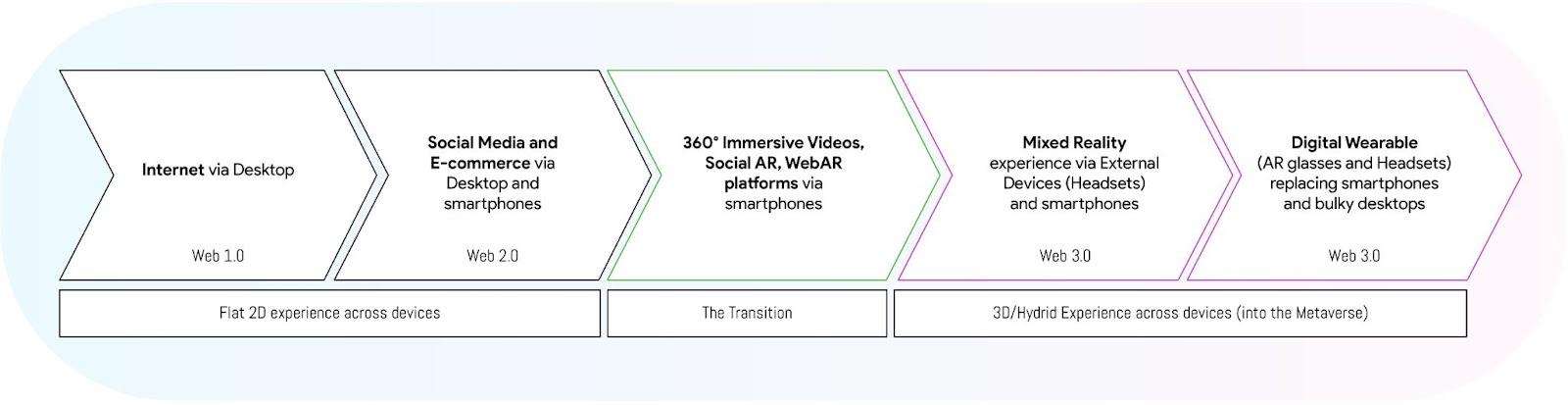
                                        Let us first start with telling you about Evolution of User Experience in the Digital space. 

                                        A picture containing diagram Description automatically generated

                                        Link to above image

                                        We are currently in the Transition phase and slowly moving towards AR VR Wearables & Mixed Reality devices as an everyday utility. While your customer base is moving towards the Web 3.0 it’s important for your brand to jump on the wagon.

                                        What it means is you change your communication and your content to something more engaging, a lot more immersive and definitely more interactive, allowing two way communication

                                        At retail level, we can explore Interactive store facades, Virtual try-on, In-store engagement games, Interactive Visual Merchandise and Immersive in-store experiences.

                                        What is Augmented Reality?

                                        Augmented reality (AR) is overlaying visual, auditory, or other sensory information onto the real world to enhance one’s experience. You don’t need fancy wearables like Heads sets or smart glasses to access it, rather it can be accessed through mobile apps or on your phone’s web browser. 

                                        Does AI come handy in building AR experiences?

                                        Yes, Use of Artificial Intelligence plugs computer intelligence into the entire user journey to make the experience seamless. Say, a chat bot or an AR bot to guide you through the entire journey will enhance the entire experience many fold.

                                        We integrate self-training AI modules into some experiences which understand Human behaviour and make the journey better.

                                        How Retail Businesses Are Using Augmented Reality?

                                        Augmented Reality allows brands to develop smart retail experiences that influence their customers’ perception or buying decisions.

                                        Retailers have traditionally relied on print advertising campaigns or other media to promote products. Being divided in the past, print, media and in-store marketing efforts are merged today into the comprehensive consumer experience via augmented reality.

                                        Retail AR spans from enhancing VM display windows to product Trial experience, from in-store engagement to Smart mirror installations and much more.

                                        Following the trend, augmented reality has emerged as an innovative tool that allows brands to interact with consumers on their mobile devices or on pre-installed set ups. Soon this experience will extend to smart glasses. 

                                        Below examples of AR speak for themselves:

                                        Nescafe Virtual Date

                                        Link to above images

                                        A fabulous AR portal for the youngsters, where they can walk-in, explore, interact, and also share with loved ones. From writing the name of their loved one on a virtual canvas to watching a shooting star, this Valentine’s Day specific immersive activation was a grandeur. 

                                        Interesting Insight: This pack lead experience increased pack purchase and communicated appropriate content for the right TG

                                        Ponds Influencer campaign amplified by AR

                                        Link to above images

                                        A gamified Social-AR campaign on Ponds’ new product launch, where users had to move around the Ponds Serum with their face and pop the bubbles containing elements harmful to skin. Bursting bubbles increases “Glow meter” above the user, which when filled gratifies the user with a sparkling glowing skin.

                                        Interesting Insight: User Generated content saw a big jump during this campaign building the much needed hype a brand wants in the initial phase.

                                        Mural in Manhattan

                                        A picture containing text Description automatically generated

                                        A picture containing text, outdoor, street Description automatically generated

                                        Link to above images

                                        This Mural on Road Safety in Manhattan comes to life in AR when passers-by scan it via a mobile App, enabling Artists to add another creative layer to their work and elevate the message within the Art and communicate with the world. 

                                        Additional features: Location sensing, mapping the nearby area and taking a selfie with the art are additional features of this experience. 

                                        1. Medical Team Internal Training for a pharmaceutical brand

                                        Link to above images

                                        This Micro-gastrointestinal simulation in AR has enabled a Pharma Brand to train their medical teams in research, product development and sales pitches. The Medical team could showcase the introduction of certain microbes and their effects in AR.

                                        What to expect in the coming years?

                                        With the mixed reality glasses recently launched in a big way in India, industries get more opportunities to share immersive & engaging content with its target customers

                                        By 2027 we will see a big jump in AR/VR/ MR/XR content floating around us in our day to day lives using our smartphones and other wearable devices.

                                        Impresario Tech build end-to-end brand campaigns focusing on Pre-purchase consideration or post purchase engagement, in store experience or on-pack brand communications with the use of Augmented Reality, Virtual Reality, Mixed reality, Artificial Intelligence & Machine Learning

                                        These immersive experiences can be built app-free (on web), deployed as special apps, rest on brands’ social media handles or installed physically in retail environments.

                                        Love to guide you through your brand’s transformation journey. 

                                        Write to us at Inquiry@impresariotech.io

                                        Most searched question

                                        What metaverse really means?

                                        How does the metaverse relate to the real world?

                                        Most searched queries

                                        Metaverse vs real life

                                        Metaverse technology

                                        Hello readers! Hope you liked what you read today. Click the like button at the bottom of this page and share insights with your colleagues and friends!

                                        For more such amazing content follow Digilah

                                        Categories
                                        Web 3.0 Tech Fin Tech

                                        A cashless society powered by blockchain technology

                                        Written by : Mosongo Jr on Digilah (Tech Thought Leadership)

                                        Introduction

                                        A cashless society is upon us; the question is simple: when will new technologies transform many industries, and payments are no exception? 

                                        Governments, fintech companies, banks, and merchants are actively looking for ways to improve the payment experience, meet the needs of the unbanked, and curb crime and corruption.

                                        In just a few years, we may see a world without cash. This isn’t some far-fetched idea; countries like Sweden, Finland, and China are already leading the way to a cashless society. And it’s not just small businesses that are making the switch; even major banks like HSBC are getting on board.

                                        So, what does this mean for you? Imagine a world where you can pay for anything with the click of a button. No more waiting in line to buy tickets or groceries. No more fumbling through your pockets for change.

                                        So what are you waiting for? Join the cashless revolution and experience the convenience and security.

                                        You’ve seen the signs. Businesses are refusing to accept cash, your friends are talking about going cashless, and the media is full of stories about the coming cashless revolution.

                                        So, what is the cashless revolution? 

                                        Put simply, it’s a movement towards a society where physical cash and coins are no longer used. Instead, all payments are made through digital means such as virtual currencies like bitcoin, credit cards, debit cards, and mobile payments.

                                        There are a number of reasons for this shift. 

                                        Firstly, businesses see going cashless as a way to reduce costs. Cash handling and security cost money, whereas digital payments are much cheaper and easier to manage.

                                        Secondly, many people are choosing to go cashless in order to avoid the hassle of carrying around coins and notes. 

                                        And thirdly, governments and central banks are increasingly seeing a cashless society as a way to improve financial security and reduce crime.

                                        The impact of the cashless economy on consumers and businesses is twofold. 

                                        Firstly, it is a more convenient and faster way to pay for things. You no longer have to fumble for change or fumble with card machines. Instead, you can just scan your phone or contactless card and be on your way.

                                        Secondly, it is more secure. With card fraud on the rise, businesses are increasingly looking for ways to reduce their liability. By moving to a cashless system, they can reduce the risk of fraud and protect their customers’ data.

                                        There’s no doubt that a cashless society is becoming more and more prevalent, and blockchain is playing a major role in powering this change. 

                                        Let’s explore some of the ways blockchain is being used to make a cashless society a reality. and why it could be the most used cashless payment method in the coming years.

                                        The blockchain system


                                        Blockchain-based payment systems are secure, efficient, and convenient.
                                        There is no need for third-party intermediaries such as banks, which means transactions can be completed more quickly and at a lower cost. 

                                        Blockchain has also helped more than 2 billion unbanked people by giving them access to digital financial services from which they are currently excluded. Similarly, look at how mobile phones have transformed communications and financial services.

                                        Blockchain and cryptocurrencies are expected to play a key role in enabling a cashless society. 

                                        While skeptics argue that CBDCs may limit the privacy of our day-to-day transactions, cryptocurrencies offer anonymity and censorship resistance that could help prevent prying eyes from prying into our day-to-day spending habits.

                                        Government agencies can easily add or remove CBDC from user accounts. However, public blockchain payments are immutable, meaning no one can change them or adjust your balance.

                                        Additionally, cryptocurrencies will become a viable alternative to government-issued currencies as cashless societies become a reality across the globe. Crypto assets like bitcoin act as a hedge against currency depreciation, allowing individuals to protect their wealth without relying on central banks or governments.

                                        Another key application of blockchain in a cashless society is in the area of fraud prevention. With traditional payment systems, there is always the risk of fraudulent activities such as identity theft and credit card fraud. 

                                        By using blockchain, businesses can reduce these risks by creating a secure and tamper-proof ledger of all transactions.

                                        Blockchain is playing a major role in powering the emerging cashless revolution. As more and more businesses adopt blockchain-based payment systems and fraud prevention measures, the cashless society will become more and more ubiquitous.


                                        Countries Leading the Cashless Revolution

                                        As the world continues to embrace a cashless future, certain countries are leading the charge by embracing blockchain-based cashless payments. El Salvador took the lead in accepting bitcoin as a legal tender, followed by the Central African Republic, and as of now, the Brazilian government is interested in making bitcoin a legal tender. 

                                        Although Sweden, Finland, and China are at the forefront of the cashless society movement, they aren’t yet using the blockchain to build their cashless payment systems. Most payment systems will move to the blockchain space. 

                                        JPMORGAN CHASE & CO., one of the world’s largest banks, is leading the way. thanks to their generous infrastructure and commitment to innovation.

                                        These developments prove that it’s not only possible but highly likely for our society to become completely cashless in the nearest future, with most payment systems built on the blockchain.

                                        Cultural Barriers to a Cashless World

                                        Despite its numerous advantages, the transition to a cashless society is met with several cultural barriers. It is no secret that some countries may have an inherent distrust of digital payments due to a lack of financial infrastructure or poor monetary policy decisions. 

                                        For example, in some African countries where cash is still used predominantly, people may not trust digital payments and prefer using physical cash instead.

                                        Furthermore, the risks that come with digital payments remain unrecognized by many people, such as fraud and cyber security threats. This lack of understanding of the safety measures also prevents them from transitioning to a cashless society.

                                        Ultimately, for us to move into a future where blockchain is at the forefront of payment technology, it is important to first overcome these cultural barriers by educating people and providing more secure payment systems.

                                        What does the future hold for a cashless society?

                                        As we move deeper into the 21st century, it is clear that the digital age is ushering in a new era of cashless transactions and financial freedom. The advent of blockchain technology is at the forefront of this revolution, allowing individuals to make payments quickly and securely with little risk of fraud or theft. 

                                        Moving to a cashless society has its advantages, from increasing efficiency to being more accessible for those without access to traditional banking services. But it also presents some unique challenges, from potential cybersecurity risks to a lack of privacy for consumers.

                                        Despite these possible drawbacks, experts agree that the advantages outweigh any potential pitfalls. As more countries adopt blockchain-based payment systems and move away from physical cash, we can expect to see increased convenience and security for consumers around the world. With the right infrastructure in place and necessary safeguards taken, the future looks incredibly bright for a cashless society powered by blockchain.

                                        Conclusion

                                        On the path to a cashless society, policymakers need to agree on a framework to drive the process forward. However, access to technology is one of the biggest factors in determining how quickly different parts of the world move away from cash. The transition from cash will only go smoothly if most people are familiar with digital payments. However, this is already a reality in many parts of the world.

                                        Society is going cashless, and cashless transfers will soon become the preferred option over time. There are many benefits to going cashless. Going cashless not only makes life easier but also helps to verify and standardize the transactions that are made.

                                        In a nutshell, a cashless society powered by blockchain technology is possible because of the features of blockchain, such as transparency, security, and immutability.

                                        Most searched question

                                        What is a blockchain technology?

                                        What are the 4 different types of blockchain technology?

                                        Most searched queries

                                        Blockchain technology with example

                                        Use of blockchain technology

                                        Hello readers! Hope you liked what you read today. Click the like button at the bottom of this page and share insights with your colleagues and friends!

                                        For more such amazing content follow Digilah

                                        Categories
                                        Law Tech Web 3.0 Tech

                                        “Law and technology produce, together, a kind of regulation of creativity”

                                        Lawrence Lessig

                                        Written by : Sophie N. Ngouakang on Digilah (Tech Thought Leadership)

                                        Sophie N. Ngouakang is the managing partner of Tchinsop Law Firm & founder of “Veritas Bitcoin”. My love for innovation has led me to combine interests in technology and law practicing in a tech-related area of law such as Blockchain which to me is very promising than other law specialties. (No offense to my law colleagues with different interests). That is what I decided to do and have been doing for quite some time.   

                                        When it comes to law and technology, one could ask several questions among which – if laws will ultimately have to change to keep up with modern tech or tech will have to adapt to keep in line with the law, considering for instance that many terms and conditions on apps are agreed to by minors?

                                        Minors agreeing to apps is another issue. Parents have an obligation to control what their minor children access. From time-to-time parents have gotten out of financial harm caused by their minor children spending money on apps, but it isn’t always a sure thing. There is a law about collecting information about children under the age of 13, but there isn’t much behind it since the children invariably check the boxes that say their parents have provided permission.

                                        Laws constantly change to keep up with technology. Unfortunately, they often change too slowly. A good example of that would be the failure of the many governments to enact meaningful reforms related to privacy as technology has become more invasive. Habitually, in the law, we adjust the language of things we write or our approaches to conflict resolutions based on changes in technology. 

                                        However, sometimes the law does not address underlying problems and without amendments to existing laws or new laws it is difficult to resolve problems, both criminal, commercial, and civil, within the legal system.

                                        Technology is only as good as the purpose for which we use and not necessarily for which it was intended. It’s essential to state that technology therefore, can’t be considered as a neutral tool since it all depends on how it is used.

                                        Humans abuse tools more often than the intended designer would prefer. Like screwdrivers being used as murder weapons, the technology is not neutral because human operators are not neutral.

                                        The most spoken about technology in recent times seems to be the Blockchain technology.

                                        Blockchain is a decentralized, peer to peer, immutable storage network which is censor free and regulator free because of the absence of one single controlling entity.

                                        Every transaction that is written is voted upon by a majority of nodes and changing something which was written before in the chain is computationally very difficult.   

                                        When blockchain matures to the point of being “the law”, the difference will be that “what happened when” will not take up as large a part of court hearings as today. Also, many disputes will not ever reach court because of more automatic settlements occurring before, as contracts automatically settle when parameters are breached.

                                        You will probably see many systems of law competing for adherents, they will all have to somehow interface with the legacy system until the legacy system either innovates to compete or is abandoned in favor of better regimes.

                                        Criminal, corporate and civil law firms will need to develop an understanding of how cryptocurrencies can be used to facilitate transfers of value worldwide, which will inevitably creep into cases of all kinds as it becomes clear that currencies like bitcoin are here to stay.

                                        As it becomes established case law, there will also be increasing numbers of things where the incorporation of information into a blockchain becomes proof that the information existed or that something happened at that point in time.

                                        Some countries have been much better about dealing with this technology than others as far as amending laws and/or passing new ones are concerned. El Salvador for example being the first country to legalize bitcoin as legal tender. 

                                        I think joining the tech-space with a legal background is always a plus and the inputs one can bring are countless. The first contribution that one can do is for “Smart Contracts”. 

                                        Smart Contracts are executable code that get executed upon the activation of an event in a contract.

                                        I always encourage persons with an interest in law and technology to get an understanding of “Smart contracts” as I see a great demand for people in the near future. We will always rely on human cooperation to uphold the law.

                                        As an illustration, if a person defaulted continuously on his rent payment for 3 months, a smart contract has the power to remotely lock the appartement.

                                        Taking the comparison in the real-world contracts, the Terms & Conditions for a lease agreement would have been drafted by the Attorney of the landlord that exists on paper. In case of default in the payment of rents, although the clause gets invoked, the landlord would still have to serve the tenant a notice to quit, before confiscating the keys to the appartement.

                                        With a “Smart Contract”, it is automated. Indeed, technology and law together produce a kind of creative regulation unprecedented in history, as Lawrence pointed out.

                                        In the end, laws change over time. We see that constantly. For example, we didn’t always have cars. Then we didn’t have cars that went very fast. Now look at all the laws related to building, owning, and operating cars. 

                                        Most searched question 

                                        What is Lawtech?

                                        What is law technology today?

                                        Most searched queries

                                        Legal tech Asia, Africa

                                        Legal tech industry


                                        Compliance and law

                                        Hello readers! Hope you liked what you read today. Click the like button at the bottom of this page and share insights with your colleagues and friends!

                                        For more such amazing content follow Digilah

                                        Categories
                                        Web 3.0 Tech

                                        Use of Cryptocurrencies : sites to avoid

                                        Written by : joel nzoda  on Digilah (Tech Thought Leadership)

                                        To compose this list of 8154 scams exploiting the reputation of Bitcoin and cryptocurrencies , I have crossed several sources, in particular the testimonials of our readers and the lists of the  HYPERLINK “https://www.amf-france.org/Epargne-Info-Service/Proteger-son-epargne/Listes-noires”AMF , CryptoFR , the House of Bitcoin , buy1bitcoin.fr , warning-trading.com , adcfrance.fr , cryptoscambuster , scambitcoin.com , investment-scam.com and badbitcoin.org  HYPERLINK “https://badbitcoin.org/thebadlist/index.php”.

                                        The list obtained by this merger is not exhaustive and may contain errors. If you would like to help me improve it by adding new sites or by alerting me to an abusive report, do not hesitate to contact me and/or leave your comments at the bottom of this article.

                                        Below are both pyramid schemes, fake “bitcoin faucets” and a large number of scams related to investing in cryptocurrencies (fake exchanges, fake brokers) or “ mining ”.

                                        Although it is obvious that some projects listed (for example) on Coinmarketcap are, to a greater or lesser degree, scams, I have chosen not to include cryptocurrencies in this list.

                                        On the same subject, see also the thread devoted to fake exchange platforms on cryptoFR , the Scam Accusations ” section of the Bitcointalk forum and our advice for buying  HYPERLINK “https://bitcoin.fr/comment-acheter-des-bitcoins-sans-se-faire-escroquer/”bitcoins  HYPERLINK “https://bitcoin.fr/comment-acheter-des-bitcoins-sans-se-faire-escroquer/”without being scammed .

                                        To search click cmd+F (on mac), or ctrl+F (on Windows) then type the name of the website in the search field.

                                        • 01crypto.com – 01crypto.net – 07ct.com – 0on.info – 0xbitcoincash.io
                                        • 1-9-90.com – 1-hash.com – 10×11.biz – 100-3x.com – 100-btc.com – 1000000satoshi.weebly.com – 1000eclats.c

                                        Find out more / Bitcoin / cryptocurrencies : sites to avoid – bitcoin.fr

                                        Most searched question

                                        What is cryptocurrency?

                                        What is bitcoin and how does it work?

                                        Most searched queries

                                        Ethereum price

                                        Bitcoin price


                                        Hello readers! Hope you liked what you read today. Click the like button at the bottom of this page and share insights with your colleagues and friends!

                                        For more such amazing content follow Digilah

                                        Categories
                                        Web 3.0 Tech

                                        How to buy cryptocurrencies?

                                        Written by : Joel nzoda on  Digilah (Tech Thought Leadership)

                                        You can buy via:

                                        stock exchanges that automate the market and maintain accounts in euros for their clients.

                                        In France, they must be backed by an institution with a payment service provider license (credit institution, electronic money institution or payment institution) issued by the ACPR.


                                        – over-the-counter platforms that connect buyers and sellers. To limit thefts and scams, these platforms sequester the bitcoins exchanged and offer a system for evaluating players. 


                                        DEXs (Decentralized Exchanges), over-the-counter platforms that replace the trusted third party with a smart contract.


                                        brokers who act as intermediaries between stock exchanges and buyers. 


                                        exchange counters: Brokers who sell bitcoins in a given physical space, often with support for novice customers.

                                        The exchange fees are given here for information only from the information displayed by the exchanges and most often based on a bank transfer.

                                        Afficher l’image source


                                        Please note:
                                        The fees only concern buyers and can be very different for sellers; – on the same platform, the overall cost can vary considerably depending on the volume traded, the trading mode (maker / taker ) and above all the means of payment , bank transfer being preferred for a lower cost. 


                                        – there may be hidden charges such as withdrawal fees; – the reference price may vary from broker to broker.

                                        Liquidity: For the largest exchanges I have added an indication (ranging from + to +++) on liquidity, this is an indication to take into consideration if you wish to trade large volumes at the best price.

                                         Learn more: Buy bitcoins – bitcoin.fr

                                        Most searched question

                                        What is cryptocurrency?

                                        What is bitcoin and how does it work?

                                        Most searched queries

                                        Ethereum price

                                        Bitcoin price


                                        Hello readers! Hope you liked what you read today. Click the like button at the bottom of this page and share insights with your colleagues and friends!

                                        For more such amazing content follow Digilah

                                        Categories
                                        Web 3.0 Tech

                                        What do Cryptocurrency miners calculate?

                                        Written by : joel nzoda on  Digilah (Tech Thought Leadership)

                                        Miners perform cryptographic hashes (two successive SHA256) on what is called a block header. For each new hash, the mining software uses a different random number called the nonce. The nonce is an integer value with 32 bits of memory allocated to it.

                                        This means that it is limited to only around 4 billion possibilities, which with the network’s current hashing power is largely insufficient. We therefore add in the hash timestamp of the block in Posix time , constantly updated. Another variable element on which minors can play: the arrangement of transactions.

                                        Including the block number, timestamp, nonce, block data and hash of the previous block, the hash produced will look like this:

                                        93ef6f358fbb998c60802496863052290d4c63735b7fe5bdaac821de96a53a9a

                                        This hash can be converted into a very long number. (It is a hexadecimal number, which means that the letters AF are the numbers 10-15). To make mining difficult, there is something called target difficulty.

                                        To create a valid block, a miner must find a hash that is below the target difficulty. For example, if the difficulty is:

                                        10000000000000000000000000000000000000000000000000000000000000

                                        any number that starts with a zero would be accepted and considered below target. Example:

                                        0787a6fd6e0782f7f8058fbef45f5c17fe89086ad4e78a1520d06505acb4522f

                                        If we decrease the target to:

                                        01000000000000000000000000000000000000000000000000000000000000

                                        we need a number starting with two zeros:

                                        00db27957bd0ba06a5af9e6c81226d74312a7028cf9a08fa125e49f15cae4979

                                        Because the target is a bulky number with many digits, a simpler number is usually used to express the current target. This number is called the mining difficulty. Mining difficulty is scaled to the first block created. Which means that a difficulty of 70,000 means 70,000 times more computing power than it took Satoshi Nakamoto to generate the first block, when he was the only miner and only using the CPU of a computer.Afficher l’image source

                                        When mining a block, miners include a timestamp in the block. Since 2016, this ” timestamp ” allows the network to adjust to the passage of time by calculating the median time spent (MTP), that is to say the median of the timestamps of the last 11 blocks. To be valid, a timestamp cannot be more than two hours in the future relative to the node’s subjective time.

                                        The difficulty changes every 2016 block. The network adjusts the difficulty so that the generation time of these 2016 blocks is 14 days, regardless of the computing power deployed.

                                        Therefore, the difficulty follows the power of the network. The adjustment algorithm is as follows: if the time measured in the period of 2016 blocks is less than 20,160 minutes (expected time), then the difficulty increases to comply with the assumed computing power; if it is higher, then the difficulty decreases. Retargeting is limited to a factor of 4 (multiplication as division) to avoid instabilities.

                                        Most searched question

                                        What is cryptocurrency?

                                        What is bitcoin and how does it work?

                                        Most searched queries

                                        Ethereum price

                                        Bitcoin price


                                        Hello readers! Hope you liked what you read today. Click the like button at the bottom of this page and share insights with your colleagues and friends!

                                        For more such amazing content follow Digilah

                                        Categories
                                        Web 3.0 Tech

                                        Here’s what you don’t know about cryptocurrency mining

                                        Written by : joel nzoda on Digilah (Tech Thought Leadership)

                                        Bitcoin transactions are secured. To this end, miners perform mathematical calculations for the Bitcoin network with their computer equipment.

                                        As a reward for their services, they collect the newly minted bitcoins along with the fees from the transactions they confirm. It is halved approximately every four years. On May 11, 2020, this reward increased to 6.25 bitcoins per block.

                                        Miners (or miners’ cooperatives ) are in competition and their income is proportional to the computing power deployed.

                                        “To describe mining, one could use the example of a gigantic sudoku contest where participants start a new grid as soon as someone finds a solution, and whose difficulty adjusts so that on average a grid is resolved every ten minutes. Imagine a giant sudoku grid, with several thousand rows and columns. It would be quite easy to verify that a completed grid is well filled. But […] it will take a lot of work to finish it! The difficulty of the grids can be adjusted by changing their sizes […], but they can still be checked easily even if they are very large. The puzzles to be solved in the bitcoin network are based on cryptographic hashes and have the same characteristics as these sudoku grids: they are very difficult to solve but it is very easy to verify that a solution is correct, and their difficulty can be adjusted. –Andreas M. Antonopoulos.

                                        Most searched question

                                        What is cryptocurrency?

                                        What is bitcoin and how does it work?

                                        Most searched queries

                                        Ethereum price

                                        Bitcoin price

                                        Hello readers! Hope you liked what you read today. Click the like button at the bottom of this page and share insights with your colleagues and friends!

                                        For more such amazing content follow Digilah

                                        Categories
                                        Web 3.0 Tech

                                        How to mine bitcoins? In Europe

                                        Written by : joel nzoda on Digilah (Tech Thought Leadership)

                                        Bitcoin mining is rarely a profitable business for individuals. Bitcoin ‘s popularity has generated huge competition which makes it inaccessible.

                                        Most often only industrial sites manage to profit from this activity. Before you venture into this adventure, I invite you to read the (already old) testimony of Greg Ryder and to visit the space dedicated to mining on the Bitcointalk forum .

                                        Note in passing the existence of companies that practice the “cloud mining and sell computing capacity to their customers who receive in exchange the fractions of mined bitcoins, after deduction of management fees. Be careful though, some services are often very disappointing, when it’s not just pure scams. In general, even if practiced seriously, cloud mining is rarely profitable.

                                        Practiced on French (or European) soil, cryptocurrency mining is only recommended for people who have, for domestic purposes, their own green electricity generator (solar, wind, geothermal, hydraulic) without having the possibility of reselling production surpluses on the public network.

                                        Another possibility to make mining rational in France is to use the heat produced to produce hot water, this is the proposal of the French startup WiseMining.

                                        Most searched question

                                        What is cryptocurrency?

                                        What is bitcoin and how does it work?

                                        Most searched queries

                                        Ethereum price

                                        Bitcoin price


                                        Hello readers! Hope you liked what you read today. Click the like button at the bottom of this page and share insights with your colleagues and friends!

                                        For more such amazing content follow Digilah