Digilah

Categories
Logistic & Travel Tech Web 3.0 Tech

What is virtual reality and why are aged care providers embracing it?

Written by : Colin Pudsey on Digilah (Tech Thought Leadership)

If you’ve been looking around at new ways to support your residents, chances are you’ve heard the words “virtual reality” being offered as a new idea. Maybe you’ve even seen pictures of people wearing headsets and waving their arms about.

But what is virtual reality, or VR, and why is it making such an impact in the aged care space?

Immersive beyond belief

Virtual reality is a simulated environment that looks and feels incredibly realistic. A key tool for using VR, is the headset, which allows you to explore this digital space by looking up, down and all around you. Unlike a computer or tablet which has a fixed field view, virtual reality adapts to your head movements to immerse you in a rich 360-degree, 3D environment.

This means that putting on a virtual reality headset feels like stepping into a completely different world. But the big question is, what can you do in this immersive virtual space?

The impossible becomes possible

Anything you can imagine! For the adrenaline seekers, how about skydiving, swimming with dolphins, or racing in an F1 car? For those looking for a calmer escape, maybe chilling out on the beach, exploring a tropical rainforest, or visiting a museum?

The technology is limitless, and it can even allow us to experience things that are impossible – a trip to mars perhaps? Or walking around the interior of the Titanic? VR can make that happen too.

That all sounds fun, but we’re talking about older adults here. Why would care providers be so keen to take their care recipients out of the four walls of a facility (virtually)?

Virtual experiences with clinical benefits

The answer lies in research, and whilst these experiences are certainly fun for all ages – they’re anything but frivolous. 

Virtual reality experiences have been shown to improve the quality of life in older adults. 

Participants in an American study were “less socially isolated… less likely to show signs of depression” and “feeling better about their overall wellbeing”. Another study from Taiwan revealed that VR “can provide older adults with the confidence to get involved in social activities”.

So, it’s clear that VR can have a range of positive impacts on care recipients. But the most exciting benefits of all, are linked to who we are as individuals.

A personal journey

Imagine being able to visit a childhood home, a church you were married in or a place you went on holidays with your family? For those of us born overseas, what about taking a journey back to experience familiar sights and sounds, and reconnect with your culture? Maybe a faith-based pilgrimage or personal spiritual practice?

VR is at its best when it’s partnered with a deep understanding of the individual and what’s important to them and that’s how innovative care providers are getting the most out of VR.

By building upon their strong connections with the individual, carers can deliver meaningful personalized experiences that leverage the power of VR to connect to identity.

For all walks of life

No matter what stage of life an individual is at, virtual reality may provide engagement, excitement, and an opportunity for connection.

Particularly for those of us supporting a loved one with dementia, as VR has been shown to “positively affect the cognitive and physical functioning of those with mild cognitive impairment or dementia”.

And what could be more important for someone living with dementia, than to reconnect them to their true self, their culture, and their loved ones. Now we’re really pushing the dial with “joy”!

Sometimes what’s important isn’t a clinical benefit…

Going beyond the clinical

What is immediately apparent when you try on a VR headset is that it’s like magic. Whilst there may be benefits in wellbeing and cognitive function, it’s an experience to bring wonder, enjoyment, and positive emotions and this can be supercharged when sharing the same experience in a group VR setting.

Any tool that can help bring significant and measurable joy, happiness, and excitement to the life of care recipients is one that’s worth exploring.

Ultimately, that might be the driving factor in the growing use of VR in the aged care space, a growth that’s led by innovative companies.

Changing Lives through Virtual Reality

Melbourne based virtual reality startup, SilVR Adventures, has been taking care of recipients on shared virtual reality experiences since 2019. 

Providing a turnkey VR solution to care providers across Australia and New Zealand, they enable care team members to take people with a variety of needs on immersive, group VR experiences.

Our content focuses on storytelling, emotional journeys and reminiscence therapy. We want to build engaging and inspiring experiences for older adults, no matter what stage of life they’re at.

With the largest library of world tours, spiritual journeys, and bucket list events, we’re experimenting with new ways to engage care recipients. But the real magic happens when the headset comes off.

Creating meaningful connections

The most powerful moments in working with VR are the social connections it stimulates.

“We’ve found that the winning formula is taking people on adventures together. They’ll have an amazing time travelling the world or experiencing something brand new, then the headsets come off and they’re chatting about where they went, where they want to go to next and sharing memories and stories from the past. It’s incredible to watch!”

And it’s clear that aged care providers agree too, with some around Australia establishing weekly ‘Travel Clubs’ to build camaraderie and friendship through shared experience across multiple sites.

We’re super excited to be able to connect up to 40 participants around the world in a shared virtual reality experience, then have them meet in a digital space afterwards like our virtual café and chat about it.

The ability to link people couldn’t have come at a better time with restrictions and lockdowns significantly increasing feelings of isolation, loneliness, and depression among our elders.

The future of the technology

Virtual reality has made great strides in the past few years, but it still has an exciting journey ahead. With companies like Facebook and Google making big investments in the space, it’s clear that the technology will continue to grow and develop.

There’s room to grow in the personal care space too, with VR companies pivoting away from residential facilities and beginning to offer services to be used in home care too.

“So far there’s nothing on offer for people in the home, that’s why SilVR Adventures is thrilled to be launching our home care solution in 2021. We’ll be able to support older adults aging in place with enhanced connections and deliver meaningful virtual adventures, in their own home – and that’s something to get excited about.

A rich and incredible virtual world

As we head towards 2023, there is still a lot of uncertainty, but whatever happens it’s clear that we need to find new ways to stay connected and engaged, and that couldn’t be truer for those of us receiving care.

Leading aged care providers around Australia are increasingly turning to the immersive power of VR as a potential tool for reducing isolation, improving wellbeing, and strengthening connections. 

Very soon personal carers in the home will be taking this technology for a spin too.

Watch a video to see how our seniors are enjoying themselves with the new found Virtual reality – https://www.youtube.com/watch?v=XYDr9PAQLMw

MOST SEARCHED QUESTION

What is virtual reality and why is it important?

How does VR help the elderly?

What are the positive effects of VR?


MOST SEARCHED QUERIES

Virtual reality health

Metaverse for seniors


Hello readers! Hope you liked what you read today. Click the like button at the bottom of this page and share insights with your colleagues and friends!

For more such amazing content follow Digilah

Categories
Web 3.0 Tech

INTRODUCTION TO BLOCKCHAIN AND METAVERSE

Written by : joel nzoda on Digilah (Tech Thought Leadership)

GOALS

      • Define blockchain
      • Characterize a blockchain
      • Usefulness of blockchains
      • Web 3.0 and the Metaverse
      • NFT or non-fungible tokens and their usefulness

    BLOCKCHAIN 

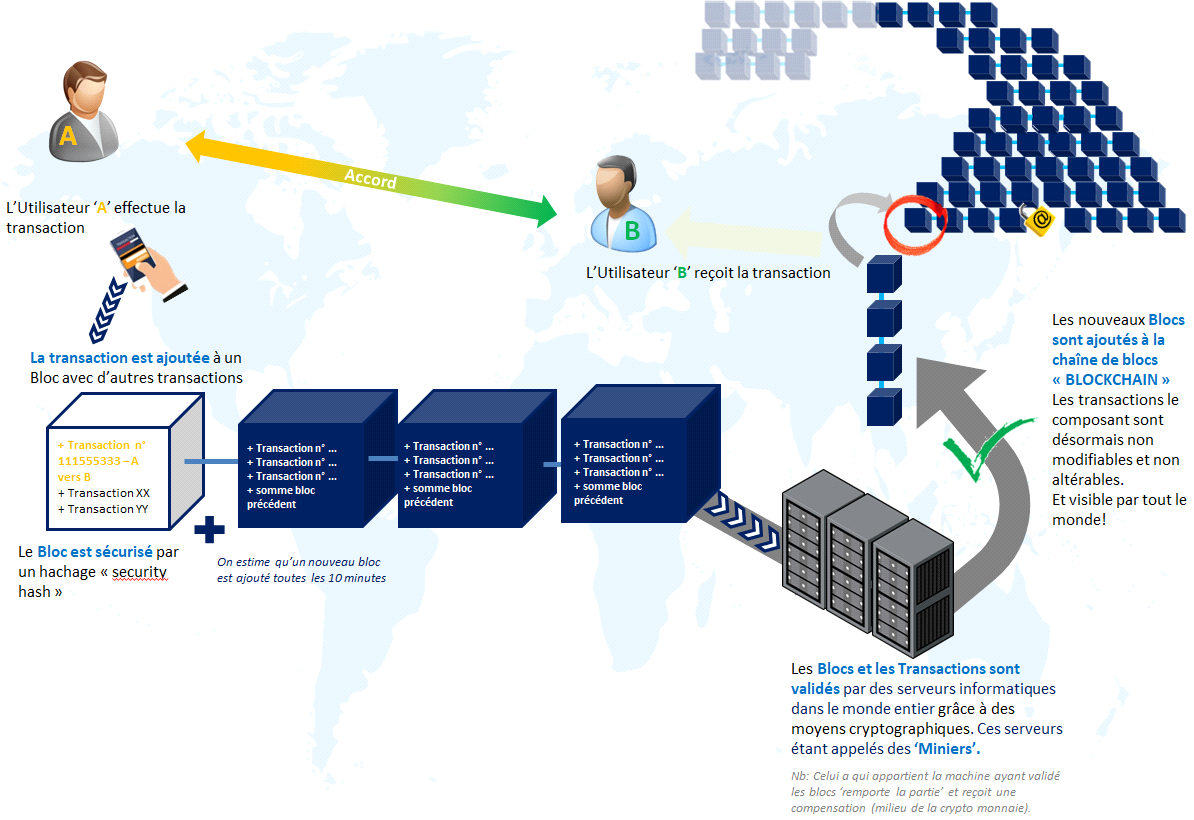
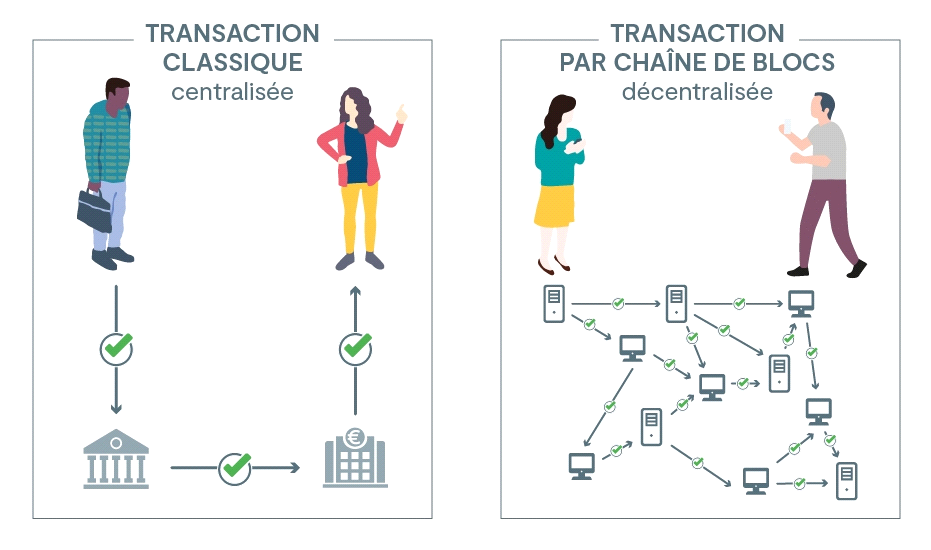
    Developed from 2008, blockchain is, first and foremost, a technology for storing and transmitting information. This technology offers high standards of transparency and security because it works without a central control body. More concretely, the blockchain allows its networked users to share data without an intermediary.

    Source : https://www.jlconsulting.fr/media/BS_20190614_BlockChain.png

    CHARACTERIZE A BLOCKCHAIN

    In practice, a blockchain is a database that contains the history of all exchanges made between its users since its creation. Its main characteristics are:

        • The identification of each part is carried out by a cryptographic process

        • The transaction is sent to a network (or storage “node”) of computers located around the world.

          • Each “node” hosts a copy of the database in which the history of the transactions carried out is recorded. All stakeholders can access it simultaneously

          • The security system is based on a consensus mechanism of all the “nodes” each time information is added. Data is encrypted and authenticated by “data centers” or “miners”. The transaction thus validated is added to the database in the form of a block of encrypted data (this is the “block” in blockchain)

          • Decentralized security management prevents transaction tampering. Each new block added to the blockchain is linked to the previous one and a copy is transmitted to all the “nodes” of the network. The integration is chronological, indelible, and tamper-proof.

        Source : https://www.economie.gouv.fr/files/files/2019/infog-block-chain.jpg

        USEFULNESS OF BLOCKCHAINS

        The blockchain represents a major innovation that is used in particular in the banking sector. Indeed, historically, blockchain technology was developed to support transactions carried out via cryptocurrencies/crypto-assets (including bitcoins which are the most well-known form) and which have the main characteristic of not depending on an organization centralizer (like a central bank) and to be international.

        But its use is not limited to cryptocurrencies. Many fields and sectors of activity, commercial or non-commercial, public or private, already use the blockchain or plan to do so in the years to come. The uses of blockchains and other technologies include:

            • In the banking sector, technology opens up the possibility of validating transactions without the intermediary of a clearing house, which should make it possible to certify transactions in much shorter timeframes. The blockchain can also promote the sharing of information between competing players in a financial centre while respecting the secrecy of their commercial data and, in doing so, facilitate the management of common structures or instruments by reducing contact costs and administration fees.

              • In the insurance sector, the contribution of the blockchain is due, for example, to the automation of reimbursement procedures and the alleviation of certain formalities at the expense of companies and their customers, provided that the assumptions and conditions of compensation and damage are clearly established.

                • In the logistics sector, the blockchain has two interests:

                • ensure product traceability, as well as the memory of the various interventions on a production and distribution chain.

                • reduce formalities and create the conditions for cooperation between actors in a sector, particularly in terms of information exchange. This use could also find an application in the agri-food sector for food traceability, particularly interesting in the event of a health crisis.

                  • In the energy sector, by authorizing the exchange of services and values outside a central management body, the blockchain potentially creates the conditions for implementation on a more or less large scale depending on the technical capacities of local networks. production, exchange and resale of energy to balance supply and demand at all times, which is a major constraint for electricity networks in particular.

                But many sectors are potentially affected by the use of blockchain technology: health, real estate, luxury, aeronautics, etc.

                Using blockchain has many benefits, including:

                    • The speed of transactions thanks to the fact that the validation of a block takes only a few seconds to a few minutes.
                    • Security of the system, which is ensured by the fact that the validation is carried out by a set of different users, who do not know each other. This protects against the risk of malicious intent or hijacking, since the nodes monitor the system and check each other
                    • The productivity and efficiency gains generated by the fact that the blockchain entrusts the organization of exchanges to a computer protocol. This mechanically reduces the transaction or centralization costs existing in traditional systems (financial costs, control or certification, use of intermediaries who are remunerated for their service; automation of certain services, etc.).

                  WEB 3.0 AND THE METAVERSE

                  As conversations began to shift from Bitcoin (BTC) to other larger crypto projects such as Ethereum network upgrades and central bank digital currencies, or CBDCs, media coverage would suggest that widespread adoption of crypto is already well advanced. But it is clear that the majority of people do not know what it is.

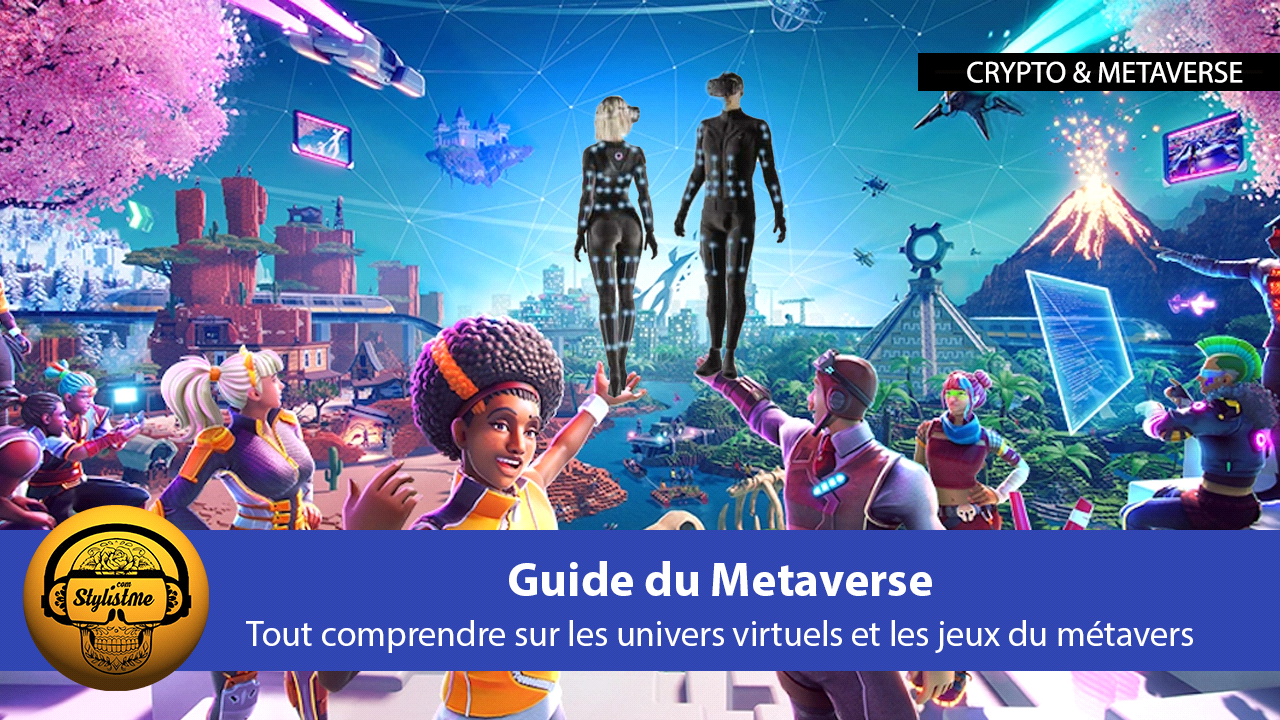
                  The Metaverse (in English) or Métavers (in French) is a generic term for technologies that make it possible to create an entire (virtual) digital universe like our real universe. This universe can be extremely detailed and include a wide variety of different worlds, often also called virtual environments. People can join this Metaverse using different technologies and interact with each other. However, instead of being present in person, the user creates an avatar which is their representation in the Metaverse.

                  Source : https://i0.wp.com/stylistme.com/wp-content/uploads/2022/02/Metaverse-guide-tuto.png?w=1280 HYPERLINK “https://i0.wp.com/stylistme.com/wp-content/uploads/2022/02/Metaverse-guide-tuto.png?w=1280&ssl=1″& HYPERLINK “https://i0.wp.com/stylistme.com/wp-content/uploads/2022/02/Metaverse-guide-tuto.png?w=1280&ssl=1″ssl=1

                  However, the Metaverse doesn’t just want to be a massively multiplayer open-world gaming platform (RPG MMO). It is already beginning to be a virtual space where people work, earn money (by spending it), meet people, and invest in real estate. In short, where you can live another life.

                  Technologies like Augmented Reality (AR) and Virtual Reality (VR) are important levers for the Metaverse, as they will help create an incredible sense of immersion in another’s skin and in another universe. However, there is one project that may well facilitate mainstream adoption of crypto: Web3.

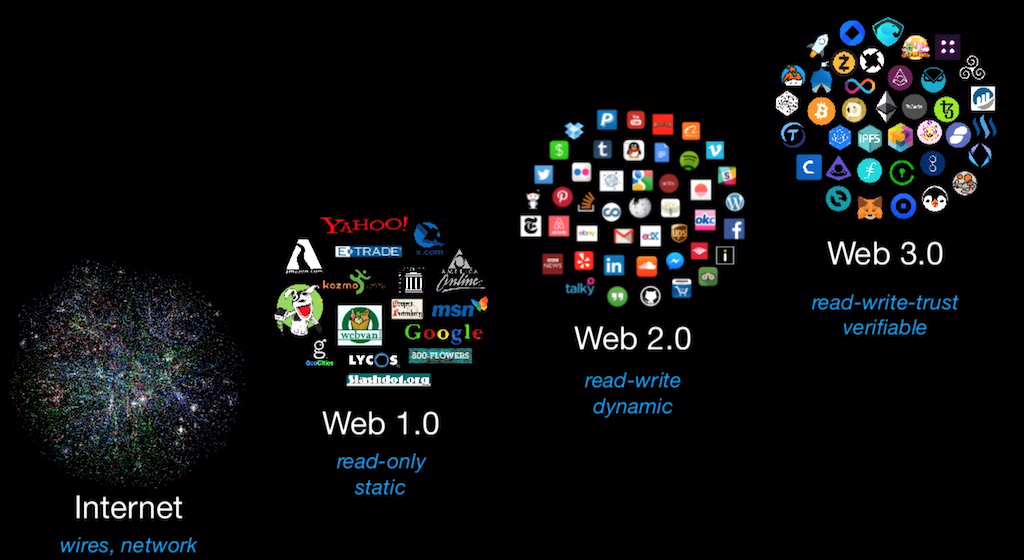
                  To better understand the evolution of these two technologies, an illustration between Web2 and Web3 as support for the Metaverse.

                  Source: https://i0.wp.com/stylistme.com/wp-content/uploads/2022/02/Web-3.0-evolution-Internet.jpg?w=1024 HYPERLINK “https://i0.wp.com/stylistme.com/wp-content/uploads/2022/02/Web-3.0-evolution-Internet.jpg?w=1024&ssl=1″& HYPERLINK “https://i0.wp.com/stylistme.com/wp-content/uploads/2022/02/Web-3.0-evolution-Internet.jpg?w=1024&ssl=1″ssl=1

                  NFTs (NON FUNGIBLE TOKENS ) AND THEIR USES 

                  NFT are the three initials of Non-Fungible Token, which translates to non-fungible token. That doesn’t necessarily make things any clearer. Therefore we must detail the notion of “non-fungible”.

                  For example, bitcoins or €100 bills are fungible. Even though each note is unique, it will have exactly the same value as another €100 note. The first mined bitcoin, no matter what platform it is on or who owns it, is the same value as a recently mined bitcoin stored in another wallet.

                  Conversely, works of art or concert tickets are non-fungible. Something that is not fungible cannot be replaced or divided. It’s unique. They are objects of the same nature, but which have their own characteristics and their own usefulness.

                  We talk about “tokens” when they are digital units, which are exchanged with blockchain technology: 3D visuals, objects in a video game, or even a piece of land in a fictional universe.

                  The NFT can therefore be defined as follows: it is the digital title of ownership of a non-fungible token. NFTs can be classified into different categories according to their nature and usefulness:

                      • collectibles: a collection of digital objects, or a work of art for example.
                      • metaverses: virtual worlds.
                      • online gaming tokens.
                      • utilities: they provide a service to their owner.

                    Some NTFs may belong to more than one category. They are traded on online marketplaces dedicated to NFTs, connected to the blockchain.

                                                                                                                               The value criteria of an NFT: This young technology has a future ahead of it, but it could lead to some abuses. Many investors seek to speculate on this trend which, although it is a resounding success, is still very volatile and full of scams. The vast majority of sold works and NFT projects will never have value, simply because no one wants them.

                    Some NFTs have artistic value: They are works valued independently of the fact that they are digital, in the same way as a painting in a museum. The blockchain does not have a preponderant role in the evaluation of their price, it is simply the art market. Overall, price is defined by what an artist’s fan is willing to invest.

                    The value of an NFT can also depend on its usefulness: Becoming a member of a club, meeting other holders or the artist himself, being more powerful in a video game, acquiring and showing a certain social status, etc. .

                    BIBLIOGRAPHY

                    My name is Joel Nzoda Consultant in Digital Marketing, Junior Blockchain Developer, Junior cyber Security Consultant and Expert in blockchain technologies. I hope I have been able to bring value to each other, I remain attentive. Discover my activities on social networks.

                    Twitter: https://twitter.com/boschdigital I Linkedin: https://linkedin.com/in/nzodax

                    Instagram: https://instagram.com/nzodax I Facebook: https://facebook.com/nzodax

                    Medium: https://medium.com/agencedigitalenzodax I Tiktok: https://tiktok.com/nzodax

                    Tumbr: https://tumbr.com/superexpertdigital I Email joelnzoda@gamail.com I Whatsapp: +237693241257

                    Most searched question

                    What Is Web 3.0 the evolution of the internet?

                    When did Web 3.0 start?

                    Why Web 3.0 is the future?

                    Most searched  queries

                    Web 3.0 blockchain

                    Web 3.0 technologies

                    Web 3.0 metaverse

                    Hello readers! Hope you liked what you read today. Click the like button at the bottom of this page and share insights with your colleagues and friends!

                    For more such amazing content follow Digilah
                    Categories
                    Edu Tech Web 3.0 Tech

                    Education via Gamification using the Metaverse

                    Written by Rick Woo on Digilah (Tech Thought Leadership)

                    My name is Rick Woo, born in Hong Kong and graduated from Australia. To me, I did experience the journey from Web 1.0, Web 2.0 and now Web 3.0. What I see is we must embrace technology. Also, I pretty much tend to use the buzzword “gamification”, here is the reason.

                    I started up LOST in 2013, a real-life escape game that gives gamers an all-rounded experience (www.losthk.com).  

                    Introduction

                    LOST will launch a play-to-earn and play-to-learn mechanism, which has been made viable by blockchain economics.  Play-to-earn model enables players to be rewarded by playing LOST games; and the play-to-learn model enhances players to attain knowledge throughout LOST games.  Together with our existing stores and future stores, this revolutionary model will disrupt the market and create a different income stream by the OMO (online merge offline) concept, plus LOST Token and NFT assets, the ultimate GameFi & SocialFi world is born.

                    Escape in Metaverse

                    Now, LOST officially announced its entry into the Metaverse, creating the world’s first Metaverse escape room. Founded in 2013 and headquartered in Hong Kong, LOST (www.losthk.com) currently has 14 branches around the world, together with its sub-brand LOST Junior, offering players an unique game experience throughout different story themes and self-developed auto-gadgets.  From children to adults, individual to corporate, shopping malls to schools, indoor to outdoor, and now offline to online to create an OMO (online merge offline) Metaverse game experience. 

                    The 4E business model

                    The entire business model is a combination of virtual and reality, via our ESCAPE game, connecting the physical store and the virtual store, which enhance the user experience on ENTERTAINMENT.  For instance, players can continue to challenge the rest of the escape game after they did the online / offline one.  Every time when they cracked the riddles or unlocked the chests may receive a limited NFT, this will be an integration for online / offline customers to have a greater user experience.  Besides, any kind of brands / products can also be promoted through this experiential EVENT, such as sports brands, can issue NFT or Tokens of limited edition sneakers and store them in the treasure box, allowing challengers to win it by unlocking, as a result to to increase the sales and strengthen brand effect.  Furthermore, together with our sub-brand LOST Junior, we will create an experiential EDUCATION, let the child learn while playing, like story-telling, science explanation, strengthen social skill through our escape game, a comprehensive play-based learning experience.

                    NFT in the escape game

                    LOST will have different themed rooms in Metaverse, and various virtual props / tools / gadgets will be used to unlock each mission level. These unique props are exactly NFTs, which can upgrade the player’s level for cracking the harder levels; on the other hand, those NFT items will have a potential market value.  Digital assets in Metaverse could be a painting, a key, weapons or equipment. It is also your certificate of passing the escape game level, as you need it to reach the higher level with these items, as a result the value of these NFT items is created.  Moreover, the crypto currency “LOST Token” will be hidden in different places randomly, players can collect them and redeem it at LOST physical stores as tickets. This crypto currency can also be used for purchasing equipments, items to equip your avatar in Metaverse and convert them into digital assets. In the future, players can create their own escape game rooms in Metaverse and build their own revenue stream.

                    The future of LOST Island

                    The whole concept of LOST is to create play-to-learn and play-to-earn.  Throughout the escape game experience not only the players will attain the knowledge, but also gaining the NFT / Token.  Moreover, brands’ joint promotion can also be benefited by riding on this OMO (online merge offline) business model, creating brand awareness and increasing market value.  In the future, LOST looks forward to building a virtual world based on Web 3.0 and will be named as LOST Island.  

                    An Edutainment world with education and entertainment, a gaming ecosystem with infinite possibility.

                    MOST SEARCHED QUESTION

                    How is metaverse used in education?

                    How is gamification used in education?

                    MOST SEARCHED QUERIES

                    Metaverse in education PDF

                    Edtech metaverse

                    Metaverse gamification


                    Hello readers! Hope you liked what you read today. Click the like button at the bottom of this page and share insights with your colleagues and friends!

                    For more such amazing content follow Digilah
                    Categories
                    Web 3.0 Tech

                    UNDERSTANDING THE MERGE

                    Written by : Makongue Tobbo Gilles Camille on Digilah (Tech Thought Leadership)

                    To understand the term Merge, it is important to master certain operating mechanisms of the Blockchain, such as the proof of work (Proof of work) and the proof of stake (proof of stake) algorithm consensus.

                    The proof of work: is a mechanism by which the different machines (represented by miners) on a blockchain network validate transactions on that network, through a consensus algorithm in this case the proof of work consensus algorithm. Proof of work is done using a set of machines (computers, CPUs, GPUs, Asics etc.) driven by humans called miners. A miner’s role is to secure the network by validating transactions as they appear on the blockchain.

                    Basically, each transaction corresponds to a mathematical equation whose solution is unknown, when a transaction is carried out on the Bitcoin network for example, the miner whose machine will have the greatest computational capacity will succeed in solving the mathematical equation hidden behind the transaction initiated, will be rewarded with an amount of crypto (Bitcoin) into his wallet. This process is called mining. 

                    Once the transaction has been validated by the winner (miner having validated the transaction) all the other machines (nodes) must validate and approve the transaction as well so that a copy of this transaction will be shared on all the machines involved in the mining process.

                    This mechanism makes it difficult or even impossible for a hacker to modify the content of the transaction. The hacker will have to modify the copy of that transaction at the same time on more that 50% of the miner’s machine that constitutes the whole network. 

                    Generally, several entities or people join forces and create what are called mining pools in order to have an important computing power in order to validate a large number of transactions faster. The proof of work remains one of the most secure computer systems in the world. although it has certain limitations such as high energy consumption, low transaction speed, and high transaction costs to name a few. 

                    It is important to recall that the Blockchain Ethereum has also been operating under proof of work since its creation in 2015 and wanted to change the consensus mechanism for ecological and scalability reasons. Several alternatives have been proposed to overcome this problem, but one of the most important ones remains the Proof of Stake consensus algorithm.

                    Proof of stake: validates transactions on the network using money staked in wallets. Here to validate transactions on the network, unlike having a machine (GPUs, ASICs) whose computing capacity must be huge, validators must store a require amount of crypto (money) in their wallet defined by the developers of the blockchain in question, so they can participate in securing the network by validating transactions. The higher the amount, the more likely the validator is to validate a transaction, and in return earn some reward (money in the form of crypto).

                    In order to prepare for the transition from proof of work to proof of stake, the developers of the Ethereum blockchain set up in December 2020 a network called Beacon Chain (Consensus Layer) which is a separate blockchain from the Ethereum mainnet, running in parallel but never having processed any transaction on the main network. The Beacon chain uses the proof of stake consensus algorithm.

                    The MERGE is simply the fuse of the main Ethereum network (main net) which works under the proof of work with the Beacon Chain which works under the proof of stake consensus. 

                    One of the objectives of MERGE is to reduce the significant energy consumption generated by proof work consensus algorithm. It is important to remember that The Merge is only the first step for a total migration from proof of work to proof of stake for the Ethereum Blockchain. There are several others steps such as:

                    Ø The Surge: whose objective will be to increase the number of transactions per second commonly called scalability so that the Ethereum network can reach the up to hundred thousand transactions per second. To carry out this step, the developers will use a network partitioning technique called sharding, which consists of dividing the network into several parts called shards, so that the transaction processing calculation will be shared among the network, therefore more digestible and faster.

                    Ø The verge: which will make it possible to set up the Verkle tree (an improvement of the Merkle tree) which will allow network participants to be validators without having to store a large amount of data on their machines (computers).

                    Ø The Purge: which will be a continuation and improvement of the previous step “the Verge”

                    Ø The Splurge: which will constitute a series of updates to the Protocol.

                    What we must remember from this important step (The Merge), the transaction costs will not be reduced, the transaction speed will not change either, since all these improvements will be integrated into the future steps listed above. On the other hand, what will change, will be the reduction in Energy consumption of nearly 99%, the issuance of tokens which will be reduced by 90% (the quantity of tokens in circulation will reduce), and the reward system as well.

                    I am a freelance Blockchain consultant, reach out to me and I would love to help you more on this future technology. 

                    Most searched question 

                    What does the Ethereum MERGE mean?

                    What happens if the MERGE fails?

                    Most searched queries

                    What is the Merge, Ethereum

                    Merge into oracle


                    Hello readers! Hope you liked what you read today. Click the like button at the bottom of this page and share insights with your colleagues and friends!

                    For more such amazing content follow Digilah
                    Categories
                    Web 3.0 Tech

                    Solving Complex 21st Century Challenges through Disruption

                    Written by Khoi Koin Crypto on Digilah (Tech Thought Leadership)

                    It took me a while to synthesise my thoughts on how to introduce this new market entrant in a short piece like this. I have finally resorted to a schematic in my head that will bring the entire white paper to the readership, thought leaders and generally all consumers of this type of information. Mpowa is a start-up that punches way above its waist, and with good cause too, since it is the mission of the rookie company to disrupt various aspects of the global geo-political landscape.

                     Some of these include the blockchain based economy and Web3, renewable energy and resource sovereignty (at a household level), and healing (I know, broad concept, but that is my intention here) at the social, economic and physiological (mental, psychological, emotional) layers of life.

                    Now that is already a mouthful, right? And so, let me jump right in and give you our cursory remarks contained in the white paper:

                    “This blockchain-based interactive SaaS platform, is contrived to stimulate society to collectively ensure global resource sufficiency and accessibility for sustainable healthy living. Aiming to serve humanity as a whole, on the increasingly more turbulent and polluted planet earth.

                    Averting unnecessary illness and death is the most important reason for Mpowa’s existence, as every human being should ideally be able to live in a healthy way. By continually increasing the Energy Flux Density, resource abundance is within reach. Mpowa does not agree to the general consensus of mandatory vaccination and consumption control in order to reduce emissions.

                    By also empowering externally organised SDG-oriented clean-tech projects to present themselves on the platform, Mpowa facilitates the industry with a high-standard GTM opportunity, while also permitting low-cap / high value projects to raise the necessary funding to succeed. 

                    Transparency and auditability are key features of blockchain technology, which provide traceability of funds (resource allocation can be tracked from start to finish) and verifiable Proof of Impact.

                    Constant transparency and credibility also differentiates the SaaS platform from established competitors and well known large-scale foundations that utilise traditional banking technology.

                    Mpowa’s data-driven approach is in line with the UN’s DSDs to match the United Nations National Quality Assurance Frameworks Manual (UNNQAFM) for Official Statistics.

                    By utilising blockchain technology, Mpowa provides an additional credibility layer to ensure data quality, transparency of set definitions and important terms and project methodology towards contributors and auditors.”

                    There you have it, in a nutshell. As a teaser I am hoping to continually bring more puzzle pieces to this audience in order to shape the full picture, as well as, spark genuine interest among specialists to cultivate an irrepressible desire to join forces with Mpowa’s mission to:

                    • cover the world in disruptive IoT technologies
                    • cutting-edge renewable energy and resource technologies (as opposed to mature cleantech like solar or wind energy generation modalities
                    • the latest (some in post-clinical trial stage and others in early commercialisation stage) medical (healing is my preferred word though) technologies
                    • bring opportunities for carbon sequestration, carbon credits/finance, accurate carbon footprint reduction and data measurement to an individual, household, community or large-scale (angel and conventional) investors within a single Web3 Decarboniser App

                    These constitute a simplified synopsis of the intricate ecosystem that is Mpowa.

                    How did I get to become the Managing Director: Mpowa Africa (as part of Mpowa Global)? What appealed to me was that it convinced me to largely abandon the daily slog for the chance to be associated with this kind of unique and disruptive platform, one may ask? Especially since I have been doing my stint of just over a year and a half at risk. Well, I guess there are no short answers to fairly interesting questions, right?

                    The CEO of Mpowa Global, Ryan Lavelle, based in the UK and the Netherlands, and I spoke at a global blockchain event and connected shortly afterwards. I am in no way any sort of technical  expert of any of the value propositions mentioned above. But I am passionate about the blockchain based economy as the antithesis of the conventional, broken FIAT economy.

                    I am basically a lifelong activist and have moved on from politics to life 11 years ago. Apart from taking activism to the blockchain, I view real practical caring for the planet and sentient life with the same lens. Activism around nutrition, wellness (as apart from health) and exploring human capabilities since 2008.

                    Needless to say, after warning Ryan that I was not interested in being recruited via social media (LinkedIn in this case), I was indeed prepared to listen to him. When he was done talking I changed my tune to “recruit away, please”, started volunteering and set important networks up for Mpowa’s first footprint where I live, South Africa. 

                    The complexity of the web that is the Mpowa ecosystem is the direct result of Ryan’s brilliant mind, as a systems thinker, his many failed attempts (an important criterion in my book) on similar projects and his desire and passion to effect change at a tangible, real person level. These are ambitious aspirations, to use a euphemism. And it takes indefatigable energy, dedication and teeth gritting to stay the course. 

                    Somehow, Ryan has managed to bring into the fold a remarkable collection of individuals who all have highly technical skills, experience and networks in the various fields in which Mpowa plays.

                    Having been inducted, I had to hear and watch many presentations to various prospective clients, partners, beneficiary community members and so on. After all of these I had two things to say.

                    “Make it relevant to the lowest common denominators in all societies (people who sleep under cardboard boxes, bridges and in streets) otherwise it is not worth my while.”

                    “I am here for Africa first. So my involvement is towards Africa and beyond!

                    As a social scientist, politics and international relations specifically, I have become somewhat adept at problematising the world we live in. By way of illustration, I have no use case for the word “democracy” given the barrage of empirical evidence, extensive knowledge-base and universal lived experience of 97% of all people everywhere. Neither does Mpowa. For one, democracy is a top down practice, in spite of its name.

                    We use the concept of “really democratising” the fields we operate in. We have operations in a number of African countries where we are employing (through bootstrap personal funds) heroes and heroines who engage, mobilise, organise and conceptualise community-specific projects in any and all of the fields we find ourselves in.

                    These projects are then submitted to the Mpowa DAO for funding. This is a simple showcase of what “bottom up” means.

                    It means that people decide what they need and therefore want, an autonomous body considers the merits/demerits and local partners (NGOs) become implementing agents. At this point it becomes necessary to mention that the technology, the campaigns, the projects all are simultaneously tokenized, as NFTs.

                    Therefore the impact, even at household levels would be, for example, sanitation (potable water) and economic (tradable NFTs). We are agitating for more innovation for the latter impact, which will in all likelihood be realised through the Decarboniser  app.

                    I would be cheating the reader if I didn’t mention that we also drive major social campaigns on either continental or global scale. Our current campaign, Stop the Abuse (including gender-based, infanticide, crimes against children and so on), is in the final, pre-launch phase.

                    We are currently morphing out of the pre-seed phase into the funding phase. If you are at least a little intrigued by this, and looking forward to the next instalment, please connect with us for in-depth discussions around the platform, the funding requirements and the epochal odyssey ahead of us. Here is another short teaser to complete an initial picture:

                    https://www.youtube.com/watch?v=1cL99PDxERs&feature=youtu.be

                    Most searched queries

                    The Stages of Disruption

                    Disruption examples

                    Types of disruption

                    Most searched question

                    What is disruption risk?

                    What do we mean by disruption?

                    What is disruption in technology?


                    Hello readers! Hope you liked what you read today. Click the like button at the bottom of this page and share insights with your colleagues and friends!

                    For more such amazing content follow Digilah
                    Categories
                    Wellness/Beauty Tech Web 3.0 Tech

                    Aromatically Yours!

                    Written by Candice Midde on Digilah (Tech Thought Leadership)

                    Aromas can play a significant role in our daily lives and the virtual world is highly influencing us more to take the leap of faith and create magic with our senses.

                    We were taught about the five senses in our childhood and the sense of ‘smell’ is the one of those that triggers our subconscious memory and it’s intuitive to the events around us. This goes back to the classic Annie’s song, “You fill up my senses like a night in the forest…” and so on, John Denver describes the scent of his woman. Smell is a chemical language that is most of the time taken for granted. It is so natural to us and reminds us of memories, that we do not have to put in a lot of thought and effort. However, the pandemic has changed our lifestyles a lot.

                    Senses that travel

                    While digitization has taken place and our screen time has increased enormously, all the other senses are very much active and put into conscious use. Smell is critical and how one link to the digital world is challenging. In the past, a lot of experimentation has been done capturing scents from nature and mimicking them in the lab to re-create the same magic as one would experience. From the smell of coffee in coffee bars to the aroma of popcorn in movie theaters. Virtual electronic noses were invented to analytically deep dive into fragrance specifications to be ahead of competition.

                    Captivating 

                    “Odors have a power of persuasion stronger than that of words, appearances, emotions, or will.” quoted Patrick Suskind in his 1985 novel, Perfume: The Story of a Murderer. Tricks of the trade have been creating this fantasy of smells not so familiar, packaging them with colors, concepts, ingredient stories, enhanced mood music playlists have persuaded us to stay at stores for longer, shop more and control our thoughts through neuroscience technology.

                    Driven to act

                    Smell can help us make choices and decisions to try and buy products. Many perfume, cosmetic and beverage companies are engaging consumers through social media with their fragrance and flavor wheels to opt for their preferences on how the product would smell or smell and taste like. Visuals play a key role in helping consumers pick their brand. It is all about the perception created of what we are exposed to: What you see, is what you believe!

                    Borrowing neighbors

                    These days edible fruity flavors are found in lip care, beverages are inspired by lavender flowers, candles come in aromas of bacon and thus, cross category fertilization is a trend that is picking up. And the involvement of Millennial and Gen-Zs has been tremendous returning to nostalgic memories when it comes to aromas. 

                    The DIY (Do-It-Yourself) techniques going viral on Instagram and TikTok during lockdowns have boosted the rise of influencers and bloggers that review products and spread the word. Today it is not the celebrity endorsement that works but ordinary users that leave more credibility especially the usage ideas of innovative formats that are popular on YouTube.

                    More is yet to come!

                    This is just the beginning, and the world is yet to witness a huge revolution of metaverse calling. Chatting with virtual bots and artificial intelligence devices, virtual gaming and role-playing avatars are no less than an alien arriving on our planet and creating a ‘world within a world.’

                    Every conversation and movement are captured to extract data, thereby closely monitoring day-to-day activities, from our actions to what is going on in our minds. There are pros and cons to every sci-fi made real, but eventually using these to the best of our advantage is co-creating a world of instant, faster and agile consumerism. The question is are we ready to trust this new world? 

                    Aromatically Yours!

                    Candice Midde

                    Aromas & Sensory Expert working in an MNC

                    Most searched queries

                    Research paper on perfume

                    Study of perfume making

                    Most searched question

                    What is the strongest smell?

                    Which smell is good for health?

                    What is an example of aroma?


                    Hello readers! Hope you liked what you read today. Click the like button at the bottom of this page and share insights with your colleagues and friends!

                    For more such amazing content follow Digilah

                    Categories
                    Web 3.0 Tech Art Tech

                    How Web3 could help Local Artisans retain the heritage of their Art  

                    Written by : Ajit Padmanabh on Digilah (Tech Thought Leadership)

                    Introduction

                    There is a palpable sense of skepticism in many with regards to the promise of inclusivity in Web3. Many believe that all talk of decentralization is a mere hype and is not implementable.

                    When one looks at the Metaverse players across various layers and that the metaverse market is projected to be worth $12Tn by 2030, the values of pay-parity, equity and inclusivity need to be lived in and by the Metaverse players. 

                    Are there companies working on inclusivity and equity in places like Africa and economically backward countries?

                    Are there real possibilities to generate revenue and employment for the deprived or underprivileged classes of our society, with Web3 technologies? 

                    The internet had made similar promises in the beginning and the utopian dream died within years of its inception. If we look at the internet today, there are pockets of improvement in revenue generation in rural and tribal populations but largely, it has skewed more, making the privileged a little more privileged.

                     Hence, considering the promise of Web3 in decentralization and self-sufficiency in revenues, this article attempts to provide scenarios across various layers of Metaverse as depicted below, to make this utopian ideal a reality. 

                    The Artisan Community and Indian Craft

                    As an ancient civilization that has birthed many cultures and has seen numerous migrations and invasions, India has a rich heritage in the field of arts.

                    Craft as a term was historically limited to “goods worked by hand” but now includes a broader canvas – all things art, like Music, Dance, Painting, Sculptures, Textiles etc. Even if we limit Indian craft to “Handicrafts” across states, the variety in art form and media is unparalleled. 

                    The Export Promotion Council for Handicrafts (EPCH) is a nodal agency for promoting exports of handicrafts from India to various destinations of the world and projecting India’s image abroad as a reliable supplier of high-quality handicrafts goods & services. 

                    The Handicrafts exports during the year 2021-22 was Rs.33253.00 Crores (US$4459.76 Million) registering a growth of 29.49% in rupee terms & 28.90% in dollar terms over previous year1. While the growth is promising especially from a tourism perspective, this may have a miniscule impact on the overall rating of India as the Vishwaguru

                    Revenue Generation for Artisans, while preserving the Art Heritage 

                    The fast-paced Digital Age is only going to get faster with Industry 4.0. With technologies like VR/AR, 3D-Scanning and 3D-Modeling, 3D-Printing as well as Web 3.0 constructs (and buzzwords) like the NFT, Metaverse and Blockchain, the craft Industry has all the components aligned for that leapfrog moment. 

                    A lot of artisan communities and tribal art communities in India are now extinct and some on the verge of extinction – this is a challenge that uniquely presents itself to us as an opportunity if we leverage the technologies mentioned above. 

                    Industry 4.0 terms Technology as a driver of change, and not merely an enabler. We should look to harness this driver for Indian Craft and the numerous communities associated with it.

                    There is a need to look at Indian Craft holistically, including all forms of fine art and performing arts, compounded by technology and tourism. We Illustrate these possibilities by taking the famous Channapatna Toys from Karnataka, as an example. They are protected as a Geographical Indication (GI) under the World Trade Organisation administered by the Government of Karnataka. 

                    Channapatna Toys could be put up on an artisan marketplace in the Metaverse. The artisan would be able to directly engage in selling goods in 3D and voice-interact with consumers worldwide. With technologies like 3D-scanning and 3D-printing, consumers worldwide would be able to see, touch and feel these products via Haptic technologies and also view the story of the artisan behind it.

                    Such multi-sensory experiences are disruptive and could help consumers in accelerating their buying decisions, something the Internet has not been able to achieve. 

                    Consumers will not only get to pick up local artisans’ produce but also engage with them and know more about our culture, traditions and heritage from their standpoint. The same product, once digitized, could be converted to limited edition NFTs during special seasons. The underlying financial technology could be powered by Digital Ledger Technology (DLT) or Blockchain, keeping the transaction decentralized, bereft of middle-men. 

                    Imagine the access for the artisans to the entire Indian Diaspora across the world and imagine the ease of access and purchase for the consumers, at large. This will also help the Artisans transfer knowledge to the next generation, a large number of who are looking for better economic opportunities in cities. 

                    As mentioned earlier, this is the main reason why India has lost a lot of tribal and native art. With metaverse and ancillary technologies, the hope is that we will be able to reverse this trend and preserve art heritage for posterity while making it economically viable for the artisans at scale, something that is unknown and unprecedented in today’s times.

                    Early traction in such technology-driven soft power can certainly propel India onto the world stage and make traditional Indian artisans global celebrities, giving them the much needed recognition and respect.    

                    Conclusion 

                    Indian Heritage and Culture is multi-layered, with each layer having the capability to catapult India’s soft-power quotient. One could experience it through ancient monuments, scriptures, textiles, crafts, music, dance, food, sports, folktales and many more. 

                    There is a need to look at each of these layers from a Technology and Tourism standpoint, the intent being to preserve and propagate Heritage and Cultures of the world, including the most backward communities.

                    If deployed across other art-forms like paintings, pottery, sculptures, textiles, and even artists like musicians and dancers, Artisans worldwide have tremendous potential to earn from a global market without boundaries. 

                    References:

                    1. https://indiaeducationdiary.in/piyush-goyal-union-minister-of-commerce-industry-consumer-affairs-food-public-distribution-and-textiles-govt-of-india-graces-handicrafts-export-award-function-as-chief-guest-and-gives-away/ 

                    Most searched question 

                    Why do we need Web3?

                    Is Web3 virtual reality?

                    Are Web 3.0 and the metaverse the same thing?

                    Most searched queries

                    Web3 social impact

                    Web3 blockchain


                    Hello readers! Hope you liked what you read today. Click the like button at the bottom of this page and share insights with your colleagues and friends!

                     For more such amazing content follow Digilah

                    Categories
                    Web 3.0 Tech Med/Health Tech

                    Thoughts On How India Can Leapfrog In Web3 


                    Written by : Ajit Padmanabh on Digilah (Tech Thought Leadership)

                    Introduction

                    For an entrepreneur and a technologist like myself, the potential of Web3 bringing in a Hardware manufacturing and R&D revolution in India, feels like music to the ears. India has long been viewed as a cheaper alternative for software services, an industry largely responsible for creating millionaires and scores of ambitious tech entrepreneurs.

                    Now, with the Hitech Manufacturing facilities being set up in various states, including Mysore and Bangalore, it’s time the world takes notice of India for their high-end hardware needs.

                    India – The Potential

                    India is the fastest-growing trillion-dollar economy in the world and the fifth-largest overall, with a nominal GDP of $2.94 trillion. India became the fifth-largest economy in 2019, overtaking the United Kingdom and France.

                    India is expected to overtake Germany to become fourth-largest economy in 2026 and Japan to become third largest in 2034, according to a recent report by the UK-based Center for Economics and Business Research (CEBR).

                    The Indian Software services industry contributes 8% to the overall GDP currently (from 1.2% in 1998), and is among its largest contributors. 

                    India is blessed with a demographic dividend – 60% of the 1.3Bn population being under 35 years of age. Compared to other Asian giants like China and Japan, India is in an extremely favorable position to chart out a growth trajectory for the 21st century, especially in tech sectors like Hitech Manufacturing, Semiconductors, Device Hardware etc.India has been striving to attract foreign investment across sectors and is steadily climbing up the ladder as far as ease of doing business is concerned, worldwide. 

                    India is also the second largest mobile phone market in the world, next only to China. 

                    The government is taking steps to boost local manufacturing through initiatives such as the Production Linked Incentive (PLI) scheme for large-scale electronics manufacturing, Scheme for Promotion of Manufacturing of Electronic Components and Semiconductors (SPECS), and the scheme for modified Electronics Manufacturing Clusters (EMC 2.0). Recently, the announcement of India’s first semiconductor plant to be setup in Mysore at a cost of ₹22,900 crore ($3 billion), has ushered-in a new wave of focus on hardware across the nation. 

                    The semiconductor plant is expected to generate 1,500 high-tech and high-caliber jobs, and about 10,000 ancillary jobs, according to K.S. Sudheer, General Manager, Karnataka Digital Economy Mission (KDEM), Mysore Cluster. 

                    Opportunities in Hardware Development with Web3

                    As far as systems’ topology for Web3 is concerned, the visualization landscape is driven by VR/AR. For decades, VR has seemed like a futuristic dream that is just around the corner, but never reaches its full potential. 

                    This time, however, might really be different. Recent advances in the power of VR hardware, notably the headsets and processors used to produce realistic VR experiences, suggest that VR is finally powerful enough and cheap enough to go mainstream.1 It, however, remains clunky and heavy leading to a cognitive loss of immersion for the user. 

                    To add to it, multi-sensory experiences demand peripheral wearables like Haptic Gloves and suits, among others, further depleting the embodied cognition necessary for Web3 immersive experiences. In fact, one of the reasons for VR not being adopted mainstream is the weight and discomfort with the present HMDs (Head-Mounted Devices).

                    R&D Opportunities with Head-Mounted Devices

                    This is a great opportunity for India to shine with indigenous R&D that could not only look to reduce the size and increase the comfort of these HMDs but also price them so as to disrupt the global market. 

                    In terms of XR devices, a beginning has been made with JioGlass (Tesseract) and AjnaLens but complete indigenous technology across the supply-chain is still undeveloped. Some of the areas for R&D include assessment of the underlying optics technology in HMDs. For example, a technique called polarization-based optical folding is a way to design lenses so light bounces in the right way to the human eye so on-screen images are displayed properly—but the light doesn’t need to physically travel as far as it does in traditional optics. That makes the space needed for VR optics smaller. 

                    The other technique under consideration is holographic optics, an optics technology that “bends light like a lens but looks like a thin, transparent sticker”. Holographic optics replace glass or plastic lenses, making the resulting VR headset much lighter. In fact, these advances could make the VR headsets of tomorrow, with proposed designs less than 10mm in thickness. Meta is at the forefront of this research with large investments.2

                    Clearly, the stakes are high and so is the investment. It’s definitely a bus India cannot afford to miss. Timely interventions have already been initiated by the Govt.

                    Our innovative minds need to be brought together from multiple domains like Physics, Material Sciences, Nanotechnology, Neurosciences etc. across research institutes like IITs, IISc to help crack the pilot-prototype-fabrication-commercialization cycle. 

                    R&D Opportunities with Multi-sensory Peripheral Devices

                    Today, research into multi-sensory experiences yields peripheral devices for each sensory experience – Gloves and Suits for Haptics (touch), scent-based devices (smell) and gustatory (taste) devices

                    A person who wants to be immersed in the virtual world should have no cognition of the real world. In this case, however, the user is well aware of these devices clinging to him, thanks to their weight and design, thereby hampering the experience and the power of Web3, for the user.

                    The opportunity, therefore, is to look at an integrated multi-sensory device as well as BCI (Brain-Computer Interface) capabilities that can be leveraged to create a seamless, immersive experience for the user. It is noteworthy to mention that initial steps in this regard have been undertaken at various IITs, especially IIT Chennai (Haptics), IIT Jodhpur (Sensory Devices) and IIT Bhubaneswar. 

                    A Defense-Academia-Industry collaborative setup would help accelerate targeted research into design and usage of such devices. 

                    This has huge potential for India in terms of IP ownership, Manufacturing and Commercialization, on a global scale. The aesthetics and function of these devices are equally important. These devices should be disruptive and act as lifestyle products which could yield greater market access globally.

                    Conclusion

                    Some of you reading this article may have your own ideas/concepts. The need of the hour is to institutionalize hardware R&D for Web3 and execute it on mission-mode much like what India did with institutions like ISRO and BARC.

                    It’s time for the world to take note of India as a viable and necessary market and destination for hardware launches and cutting-edge research & development in hardware manufacturing and testing. India needs to set itself up and be laser-focused on the path of R&D, Aesthetics and Commercialization of indigenous hardware for Web3, to realize that leapfrog moment.

                    References

                    1. https://cacm.acm.org/magazines/2021/2/250071-the-state-of-virtual-reality-hardware/fulltext
                    2. https://cacm.acm.org/magazines/2021/2/250071-the-state-of-virtual-reality-hardware/fulltext 


                    Most searched question

                    Does Web3 have a future?

                    What are the benefits of Web3?

                    What are the possibilities of Web3?

                    Most searched queries

                    Web3 crypto

                    How to invest in Web3

                    What is Web3


                    Hello readers! Hope you liked what you read today. Click the like button at the bottom of this page and share insights with your colleagues and friends!

                     For more such amazing content follow Digilah


                    Categories
                    Food Tech Web 3.0 Tech

                    A Paradigm Shift is Possible in the Metaverse Experience

                    Written by : Ajit Padmanabh on Digilah (Tech Thought Leadership)

                    Only if these 2 technologies become a reality!

                    There is no doubt about it – Metaverse is the next Internet and is here to stay for a couple of generations, if not more. It is also a natural evolution from today’s 2D Internet to be able to experience the Digital Universe in 3D! With today’s technology advancements and research, if we can plug 2 technologies into the Metaverse, it would be a limitless opportunity. 

                    What are these 2 technologies, you ask? Sensory technologies involving Olfactory and Gustatory systems. In simpler terms, Smell and Taste, respectively. With the pandemic having affected many people with the loss of sense and taste and they having reported a loss of interest in life owing to the sensory loss, it makes sense to build these technologies for the Metaverse.  

                    Why Sensory Technologies

                    You may be familiar with the reductionist philosophy. It’s the practice of analyzing and describing a complex phenomenon in terms of its simple or fundamental constituents, especially when this is said to provide a sufficient explanation. 

                    Quoting few examples from Britannica1, the ideas that physical bodies are collections of atoms or that a given mental state (e.g., one person’s belief that snow is white) is identical to a particular physical state (the firing of certain neurons in that person’s brain) are examples of reductionism.

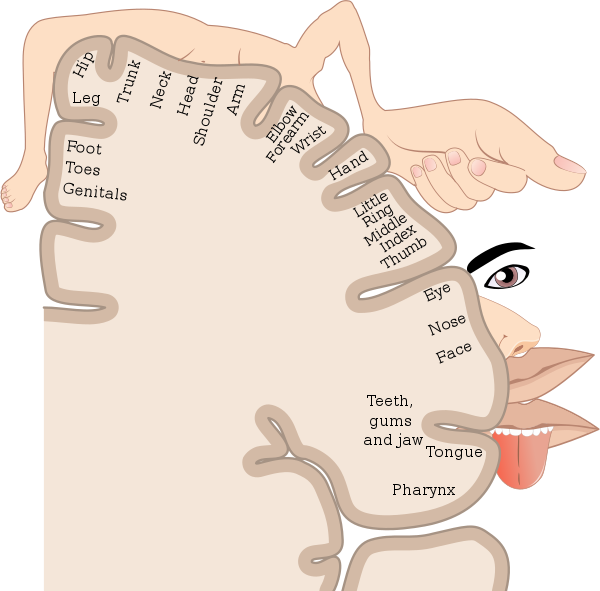
                    With advances in neuroscientific research in the last century, there is an existence of what is known as Cortical Homunculus. A cortical homunculus is a distorted representation of the human body, based on a neurological “map” of the areas and proportions of the human brain dedicated to processing motor functions, or sensory functions, for different parts of the body. A 2D representation of the sensory homunculus is shown below. 

                    Fig.1 A 2D Cortical Sensory homunculus

                    All signals are received by the primary sensory cortex in the brain. The amount of cortex devoted to any given body region is not proportional to that body region’s surface area or volume, but rather to how richly innervated that region is.

                    Areas of the body with more complex and/or more numerous sensory or motor connections are represented as larger in the homunculus, while those with less complex and/or less numerous connections are represented as smaller.2 You’d notice that the significant amount of brain-processing is accorded to sensory functions, including those of taste and smell. 

                    If we are to look at the proposition of Metaverse being an alternate universe and where you are expected to spend considerable amount of time, it has to be capable of attracting your attention not only visually or aurally (as is the case with the 2D internet of today) but as a multi-sensory experience involving haptics (touch), olfactory (smell) and gustatory (taste) technologies as well.

                    Hence, it is critical to understand and invest in these sensory technologies and ensure that the promise of Metaverse is realized in entirety.

                    A Sneak Peek into Multi-sensory Prototypes and Ongoing Research 

                    A lot of research and development has gone into haptic (touch) technologies with many commercially available solutions as well. Since the solutions are fairly established, we will focus on research into olfactory and gustatory technology.

                    Olfactory Prototypes and Research

                    As far as olfactory technologies are concerned, considerable research is being performed on classification and extraction of scents so as to define the exact sense stimulus in the brain which then can be simulated using ergonomic hardware. 

                    According to Judith Amores, a research fellow at Massachusetts General Hospital and Harvard Medical School, whose work is focused on scent and virtual reality – “People don’t really appreciate the sense of smell,” she said. “It’s actually so important, it’s so unexplored, and it’s so powerful.”3

                    OVR Technologies, a Burlington, Vermont-based startup, is one of the few companies developing this technology for Virtual Reality. While reproducing real-world odors with chemicals is challenging, it opens up new possibilities in nostalgic experiences as odor is associated with memories. With earlier 5D systems, scent technology had certain issues, namely the mixing up and lingering of scents long after the experience. This is being fixed with AI-driven algorithms that trigger various odors and control their intensity, duration among other parameters. 

                     Lastly, there is research on olfactory-powered deaddiction programs in Virtual Reality, which could prove to be a panacea in the Metaverse. Closer home, research into olfactory is ongoing at various institutes including IIT, Jodhpur.

                    Gustatory Prototypes and Research

                    Research into gustatory prototypes is in its early days. The idea is to simulate taste in the physical world first and then look to replicate it in the virtual world. The “lickable screen,” called the “Norimaki Synthesizer,” uses five different gels, each corresponding to the five tastes the human tongue can distinguish between — salty, acidic, bitter, sweet, and umami. 

                    By weakening and strengthening these five different tastes through the use of electrical currents, the device can reproduce any “arbitrary taste,” according to the research.4 “Like an optical display that uses lights of three basic colors to produce arbitrary colors, this display can synthesize and distribute arbitrary tastes together with the data acquired by taste sensors,” said Homei Miyashita, researcher at Meiji University, Japan. 

                    In a recent development, A team at the Carnegie Mellon University, a private institution in Pittsburgh, US, have made it possible for users to feel the virtual world in and on their mouth, without making physical contact. What the user can feel are tactile sensations such as drinking from a water fountain, wind on the face.5 Project Nourished, a VR food start-up, has been experimenting with technology to trick taste buds and promote sustainability.6

                    Conclusion

                    Metaverse is here to stay and become an integral part of who we are. Multi-sensory metaverse, in its complete form, will not only make it real and immersive but will also open up new industry verticals hitherto unknown as of today. A paradigm shift is also possible in Hospitality, Travel & Tourism and Entertainment industries with such technologies.

                    There is huge potential to be at the forefront of research and commercialization of such technologies in India – Tasty food for thought for investors and research institutes across the country!

                    References:

                    1. https://www.britannica.com/topic/reductionism
                    2. https://en.wikipedia.org/wiki/Cortical_homunculus 
                    3. https://www.wbur.org/news/2022/03/14/virtual-reality-smell-ovr-technology
                    4. https://futurism.com/the-byte/device-simulate-any-flavor  
                    5. https://www.cnbctv18.com/technology/ultrasound-vr-device-lets-users-touch-and-feel-in-mouths-vr-kiss-13378502.htm

                    Most searched question

                    What is metaverse experience?

                    What are the possibilities in metaverse?

                    Will the metaverse change our lives?

                    Most searched queries

                    Metaverse companies

                    Top 10 metaverse companies

                    Metaverse in education research paper


                    Hello readers! Hope you liked what you read today. Click the like button at the bottom of this page and share insights with your colleagues and friends!

                     For more such amazing content follow Digilah

                    Categories
                    Med/Health Tech Web 3.0 Tech

                    Digitalizing the Healthcare Industry with Blockchain Technology

                    Written by : Divinegift (soetan) Afolabi on Digilah (Tech Thought Leadership)

                    The healthcare industry is not yet ready for digitalization, but blockchain technology has the potential to transform how healthcare is delivered.

                    There are numerous potential blockchain applications in the healthcare industry, and it is critical to investigate all of them in order to fully realize the technology’s potential. However, let us discuss the TELEMEDICINE technology that has so far been used in the healthcare industry.

                    With the rise of telemedicine technology, more revolutionaries are turning to health tech to improve global health and well-being. Users can consult doctors and other medical professionals from the comfort of their own homes, thanks to telemedicine (be it in rural, remote, or urban areas). It has grown so quickly that everyone wants to have access to high-quality services.

                    Telemedicine has numerous advantages, including convenience, improved access to healthcare, quick response time, reduced workload on local medical personnel, and lower cost.

                    Benefits of Telemedicine 

                    Convenience is one of telemedicine’s biggest advantages. Patients are no longer required to miss work or travel long distances to see a doctor. They can simply log into a telemedicine platform and have a doctor consult with them from the comfort of their own homes at a lower cost. This is advantageous to everyone, especially those living in rural areas where it is difficult to obtain quality healthcare at an affordable cost.

                    Patients can consult doctors and other medical professionals via telemedicine from anywhere in the world, at any time. This means that patients in rural areas will be able to access high-quality healthcare without having to travel long distances.

                    Telemedicine also saves time, money, travel expenses, and time away from work. Furthermore, telemedicine is frequently less expensive than in-person care. This is due to the fact that telemedicine platforms frequently have lower overhead costs than traditional healthcare practices.

                    In light of all of this, it is clear that telemedicine is a game-changing way to improve healthcare access and achieve global goal 3 for all. It is convenient and inexpensive, and it allows patients to consult qualified medical professionals from any location and at any time using their devices. Telemedicine is transforming the healthcare industry worldwide. Consider what blockchain and telemedicine can accomplish together.  It would change how we get quality healthcare, keep health records, authenticate medications, and more.

                    Blockchain technology can be used to create a secure, decentralized platform for storing and sharing patient data. Streamline clinical trials, research initiatives, and the authenticity of pharmaceutical and medical supplies.

                    One potential application for blockchain is the secure storage and sharing of patient data. In the past, there has been news of patient data being stolen within individual healthcare organizations, making it difficult to share information between providers.

                    This has resulted in inefficiency in healthcare delivery and has put patients at risk when records are not properly handled and updated. Most developing countries now lack centralized, up-to-date, paperless medical information about their patients. This has made it difficult for organized bodies to obtain concise data or information about the state of health in some countries. 

                    To achieve the United Nations Sustainable Development Goals by 2030, it is critical to find solutions that can help to address this issue, such as the use of blockchain as a means to save and protect users’ medical data.

                    Blockchain technology provides a decentralized system for storing and sharing patient data. This would enable the healthcare provider to obtain any information required at any time and from any location. It would also protect users’ data, which would only be accessible with the patient’s permission.

                    Furthermore, blockchain can aid in ensuring the authenticity of data collected during clinical trials and research. Clinical research data must be used to determine the efficacy of a new treatment.

                    Clinical trials are often complex and time-consuming to coordinate, but blockchain can help to streamline processes by providing a secure, decentralized platform where clinical trial data can be stored and shared.

                    The part that most leaders haven’t noticed is that blockchain can also help with medical supply chain authentication. Many counterfeit drugs have been sold on the black market, posing a serious threat to the public. Blockchain can aid in ensuring the authenticity of medical records. 

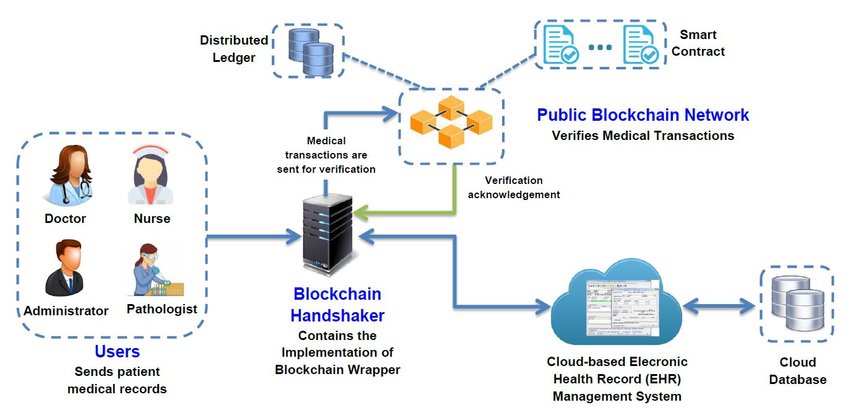
                    By providing tracking technologies powered by smart contracts and nodes, blockchain can help to ensure the authenticity of medical products.

                    This would ensure that patients receive safe and effective medications while also assisting in the fight against the sale of counterfeit medications.

                    Building a solution that lasts longer is what inspired the creation of HellthGO, a healthcare adherence provider with the goal of providing quality healthcare services to all individuals at all levels.

                    HellthGO would be able to reach all parts of Africa with services such as telemedicine, where notable and qualified medical professionals would provide the best healthcare services to all. 

                    HellthGO, in addition to telemedicine, is a social commerce platform where individuals and corporations can learn more about health care, first aid, cures, and healthcare adherence from renowned tutors, raising awareness about maintaining a healthy lifestyle and creating a safe and healthy world.

                    To make it easier for everyone to afford and access quality healthcare, HellthGO has decided to use blockchain technology to finance our users’ daily expenses and savings through a decentralized wallet that gives users total control over their funds while rewarding them for adhering to a health adherence plan. 

                    This allows our users to transact in both fiat and cryptocurrency and connects them to the HellthGO transchain, where their data is secure and shared in a blockchain-powered decentralized ledger, also assess a comfortable lifestyle where HellthGO provide home delivery of medical product and services through our dispatch partners.

                    Speaking of other strategies, HellthGO, a health technology startup leveraging blockchain, has developed solutions that work and provide accessible healthcare through telemedicine and more technology built to reward patients for being healthcare compliant.

                    At least 400 million people have no basic healthcare and more than 1.6 billion people live in fragile settings where protracted crises, combined with a weak national capacity to deliver basic health services, present a significant challenge to global health (UNDP). 

                    By digitalizing the healthcare industry using telemedicine and blockchain, we will be able to achieve good health and well-being for all by the year 2030.

                    This is the driving force behind HellthGo, the leading decentralized healthcare adherence solution working to achieve universal health coverage by 2030. That is, everyone has access to quality healthcare services, allowing for a reduction in mortality and morbidity rates in most African countries and improving access to healthcare for everyone, regardless of gender, age, religion, political affiliation, or geographical location, thereby increasing life expectancy.

                    MOST SEARCHED QUESTION 

                    What is the future of medical technology?

                    How blockchain technology is transforming the healthcare industry?

                    Which type of blockchain is used in healthcare?

                    MOST SEARCHED QUERIES

                    Web 3.0 healthcare

                    Blockchain in healthcare use cases

                    blockchain in healthcare research paper


                    Hello readers! Hope you liked what you read today. Click the like button at the bottom of this page and share insights with your colleagues and friends!

                    For more such amazing content follow Digilah

                    Categories
                    AI Tech Web 3.0 Tech

                    Web3.0:The Real decentralized Internet 

                    Written by Femi Omoshona on Digilah (Tech Thought Leadership)

                    Decentralized technology is the present and the early we start investing our time, energy and resources trying to understand what future DApp looks like the better for us. 

                    Blockchain, AI, AR and IOT are amazing technologies we should be wrapping our brain around in this 21st century.

                    In this article, I lay out how the web has evolved, where it’s going next, and how Africa as a continent can position itself for the future.

                    Think about how the internet affects your life on a daily basis since it was discovered in early 1990. Internet, a system architecture that has revolutionized communications and methods of commerce by allowing various computer networks around the world to interconnect. Sometimes referred to as a network of networks, the Internet emerged in the United States in the 1970s but did not become visible to the general public until the early 1990s.

                    By 2020, approximately 4.5 billion people, or more than half of the world’s population, were estimated to have access to the Internet.

                    The Evolution of the Web

                    The evolution of the web can be classified into three separate stages: Web 1.0, Web 2.0, and Web 3.0.

                    Web 1.0  are static web sites and personal sites, the term used for the earliest version of the Internet as it emerged from its origins with Defense Advanced Research Projects Agency (DARPA) and became, for the first time, a global network representing the future of digital communications. Web 1.0  offered little information and was accessible to users across the world; these pages had little or no functionality, flexibility, or user-generated content.

                    Web 2.0 is called the “read/write” web, which seems to indicate an updated version of the current World Wide Web, which is known as Web 1.0. It’s more accurate to think of Web 2.0 as a shift in thinking and focus on web design. Instead of static HTML pages with little or no interaction between users, Web 2.0 represents a shift to interactive functionality and compatibility through some of the following features: User-generated content, Transparency in data and integrations.

                    Web 3.0 (…Loading)

                    Web 3.0 is the next stage of the web evolution that would make the internet more intelligent or process information with near-human-like intelligence through the power of AI systems that could run smart programs to assist users.

                    Tim Berners-Lee had said that the Semantic Web is meant to “automatically” interface with systems, people and home devices. As such, content creation and decision-making processes will involve both humans and machines. This would enable the intelligent creation and distribution of highly-tailored content straight to every internet consumer.

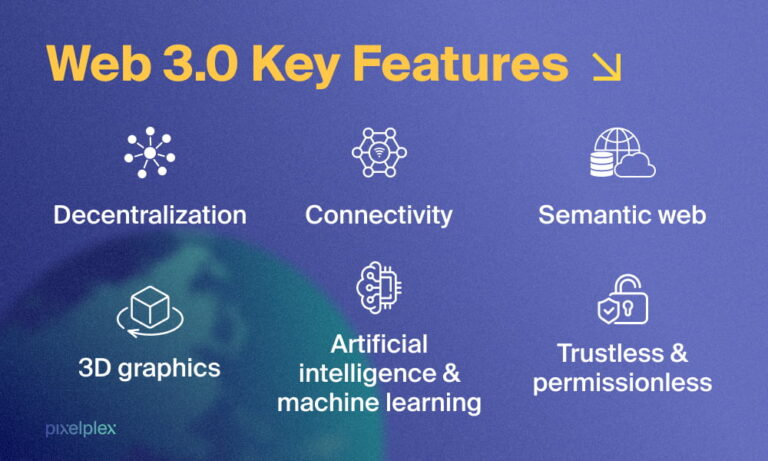
                    Key Features of Web 3.0

                    To really understand the next stage of the internet, we need to take a look at the four key features of Web 3.0:

                    Semantic Web

                    Semantic(s) is the study of the relationship between words. Therefore, the Semantic Web, according to Berners-Lee, enables computers to analyze loads of data from the Web, which includes content, transactions and links between persons.

                    Artificial Intelligence

                    Web 3.0 machines can read and decipher the meaning and emotions conveyed by a set of data, it brings forth intelligent machines. Although Web 2.0 presents similar capabilities, it is still predominantly human-based, which opens up room for corrupt behaviors such as biased product reviews, rigged ratings, etc.

                    For instance, online review platforms like Trustpilot provide a way for consumers to review any product or service. Unfortunately, a company can simply gather a large group of people and pay them to create positive reviews for its undeserving products. Therefore, the internet needs AI to learn how to distinguish the genuine from the fake in order to provide reliable data.

                    Web3.0 future for Africa

                    Across the world, the new Web3 economy is giving birth to myriad opportunities and the implications for the African continent are massive. Code 247 Foundation is on a mission to raised the next generation of Africa talent who will leverage the latest blockchain technologies to provide real value to billions of unbanked, underbanked and underserved individuals across Africa and other emerging markets, and we’re excited to see various blockchain protocols, startups, investors, grant funders and governments interested in doing the same.

                    Web3 can open up an intra-African exchange economy, it can be used for purchases and transportation between African nations. It will assist Africans to generate more economic value in a wider market.

                    In Africa, the evolution of blockchain technology has interested many governments across the Africa countries  to explore blockchain-based solutions, creating Central Bank Digital Currencies (CBDCs) that are likely to develop a more informed approach to the Web3 economy along with policy frameworks in line with the needs of everyday users.

                    Web 3 can be used to solve some of the challenges in Africa, issues of land ownership:

                    It is no secret the messy land management in most African countries has made it harder for citizens to acquire genuine land. This has meant that most communities are left poor due to lack of access to manage and develop their lands. Other challenges include faulk drugs, financial transactions and management of traffic etc.

                    Conclusion

                    We believe in Africa 100%. Africa can be great, will be great and must be great. Blockchain and Web3 technologies will be revolutionary in Africa. There are a lot of problems with currency and corruption in Africa.

                    Most searched question

                    What Is Web 3.0 the evolution of the internet?

                    When did Web 3.0 start?

                    Why Web 3.0 is the future?

                    Most searched  queries

                    Web 3.0 blockchain

                    Web 3.0 technologies

                    Web 3.0 metaverse


                    📣 Hello readers: Do you like what you read today? Click the 💟 “Like” button at the bottom of this page and share insights with your colleagues and friends and do follow Digilah for more amazing articles.

                    Categories
                    Web 3.0 Tech

                    My Tech Journey – is a wave

                    Written by Bolarinwa Odupe on Digilah (Tech Thought Leadership)

                    Matt Mullenweg a social media entrepreneur once quoted “Technology is best when it brings people together.” 

                    The evolution of digital technology is such that even if we wanted to, we can’t stop the impact, especially in a community like ours. The average man today has better medical care, unlimited access to information and education. Better options to travel in and communicate with one another across long distances more than the wealthy monarchs in time past.

                    A few years ago, I was just an average individual who loved tech. I was so enthusiastic about tech that I regularly kept up with the latest trends by learning new technologies. Now, I have clients whom I communicate with virtually most of the time. As a matter of fact, I have never met most of them physically, why? This is because of the rapid revolution of digital and technology that the global pandemic brought. The world has now become a global village where there is a dramatic increase in the standard of living due to labor productivity.

                    From the industrial age to modern age, it is quite obvious that digital and tech has greatly improved working conditions.

                    The impact has covered long working hours and has replaced tedious work conditions with efficient tools that speed up work processes and make you achieve  more in record time.

                    The digital and tech sector is a competitive industry and it requires new strategies and practices. Most brands have grown to recognize how much of an impact digital technology holds for their businesses. Through technology, we have seen the growth of emails, virtual meeting places, work tools which we have increasingly grown to depend on because they help to give more efficiency and visibility to your startup.

                    One thing about my thought leadership is the fact that I’m not just content with my basic knowledge of tech. Tech and digital is a sector that keeps evolving over the years and to keep updated on trends, one must be willing to learn new technologies. I had the knowledge of coding, digital marketing and a whole of other technical know-hows before I created my startup. Now I use Google sheet, Google drive, Google docs, Google meet for my meetings and canva for my product designs. I had to learn more than the basic knowledge of product and web design.  I have learnt quite a lot from tech between 2020 and till now, and I have not stopped learning.

                    It should also be observed that the global pandemic was a major propeller for the growth of digital technology all over the world. The pandemic caused most brands and startups to create temporary solutions to meet any demand brought upon them suddenly much more quickly than they had thought possible before the global crisis. 

                    The reliance on digital and technology also became much more profound as they began to recognize the importance of technology and how far its reach was.

                    It also helped because many consumers naturally leaned more onto technological channels and platforms they’ve been using over the course of the pandemic.

                    The pandemic helped me create a tech startup which sped up in a space of a few years due to the world’s new outlook on tech and digital. My tech brand Centiiv is founded on a community of blockchain enthusiasts like myself who are curious to learn all they can about blockchain. The growth of technology is a wave that cannot be stopped. 

                    Every day more people discover new inventions that make life simpler and work more efficient. My workplace productivity has grown by a huge margin and the numbers keep rising because thanks to online communication tools, technology enables us to work more closely in some ways even while working remotely. Teamwork is now simpler to achieve even when workers are not in the same place. 

                    Most searched  question

                    What is a Web 3.0 website?

                    What programming language does Web 3.0 use?

                    What skills are needed for Web3?

                    Most searched queries

                    Web 3.0 crypto

                    Web 3.0 blockchain

                    Web 3.0 applications

                     
                    Hello readers! Hope you liked what you read today. Click the like button at the bottom of this page and share insights with your colleagues and friends!

                     For more such amazing content follow Digilah
                    Categories
                    Web 3.0 Tech

                    Understanding Stablecoins

                    Written by Ganesh Kompella on Digilah (Tech Thought Leadership)

                    In the wake of recent crypto events, I feel it necessary to write an opinion piece on what stablecoins are, why they exist and what separates them from being good or bad. 

                    What is a stablecoin?

                    A stablecoin is a crypto asset pegged to a real-world asset’s value. 

                    Example: 1 USDT is always intended to be worth 1 US dollar. They hold their value relative to traditional currencies but, unlike the money in your bank account, they can be used freely on the blockchain. 

                    Similar to traditional currencies, these stablecoins can be used for buying, selling, sending, and lending within the crypto markets. 

                    In terms of timeline – USDT was the very first crypto stablecoin, then Circle introduced USDC, Binance introduced BUSD, Luna introduced the failed algo stablecoin UST and there are a bunch of others.  

                    How are they different from regular currency? 

                    Stablecoins are more cost- & time-efficient than the decades-old payment rails that the financial system relies on.

                    They are transferable 24/7/365 & are faster & cheaper to transact with than fiat. That’s why they continue to rise in popularity through bull and bear markets.

                     In 2021 alone the total value settled with stablecoins was $6T, up 600% from its 2022 high of $1T. This graph from CoinMetrics sheds a light on how popular these are becoming.

                    Different types of Stablecoins

                    There are essentially three types of stablecoin designs:

                    1. Fiat-collateralized 
                    2. Crypto-collateralized
                    3. Algorithmic 

                    The mechanics of each are different from one another as the names suggest, some are asset backed while some are code backed. They work very differently from one another and have distinctive pros and cons amongst themselves. 

                    Fiat-collateralized

                    Fiat backed stablecoins work very much like regular money market funds. You deposit your dollar with a stablecoin entity and get an equivalent amount of stablecoins in return.

                    Let’s take USDT (Tether) as an example.

                    A $100 deposit will get you $100USDT. You get the stablecoin and you are free to use it anyway you choose onto any of the blockchain networks that support tether. And the issuer puts your deposit to use and earns interest. With a crucial promise that you can always go back to the issuer, redeem your USDT for U.S.Dollars.

                    Diving into Specifics, this is how Tether manages their deposit reserves (Last reported on March 31, 2022). Your deposits turned reserves are mostly into Cash & Cash equivalent with some allocations into other asset classes like secured loans, corporate bonds, and digital tokens. These entities get audited from time to time. 

                    As an investor you must take notice of these audits, review them, and make an assessment on the issuer’s reserves. Strong reserves indicate they wouldn’t have any liquidity concerns in the event of a market crash or bank run.

                    Crypto-collatarized

                    Crypto-backed stablecoins operate more like traditional home equity loans. Investors deposit crypto with a decentralized issuer (usually a DeFi protocol), which issues stablecoins in exchange.

                     The investor must repay the stablecoins (plus a fee) to redeem their crypto assets. The critical promise is that every crypto-backed stablecoin in circulation is directly backed by excess collateral.

                     From a transparency perspective, the reserves can be audited & monitored by anyone in real time (including regulators). They just need to look on-chain. $DAI is an example of such stablecoin. It’s trusted by a huge community of crypto investors and developers

                    Algorithmic stablecoins

                    They are typically minted & issued by a DeFi protocol and are commonly under-collateralized (meaning they aren’t backed by an equivalent or excess amount of collateral). Instead, they mostly rely on an algorithm that aims to maintain a stable price by expanding & contracting the stablecoin’s supply. 

                    The intent is to influence interest rates and market behavior, which, in theory, ultimately return the stablecoin to its target price. The key promise is that the algorithm & incentive mechanisms work as promised, & the stablecoin maintains its peg through the issuance & removal of its supply.

                    The downside: The non-collateralized, algorithmic model keeps failing. Luna UST is one such example. 

                    Historically, the adoption of Fiat-collaraterized stablecoin has dominated this segment, with over 95% of the market share, some economists even call it “Smart Money”. 

                    What does the future hold? 

                    Stablecoins definitely have the potential to play a pivotal role in the global economy and the future of digital finance. 

                    Once we see central banks, regulators and the traditional financial sector starting taking notice which they already have. They could bring a host of benefits into this sector.
                    The pros of stablecoins are obvious: Low-cost, safe, real-time and more intuitive and competitive with what the consumers and businesses need today. 

                    They could rapidly change and make it cheaper for businesses to accept payment, for governments to run cash intensive programs and connecting the unbanked population.

                    MOST SEARCHED QUESTION 

                    What is the point of stablecoins?

                    Can you make money on stablecoins?

                    How many stablecoin are there?

                    MOST SEARCHED QUERIES

                    Stablecoins list

                    Best stablecoin

                    Is Bitcoin a stablecoin


                    Hello readers! Hope you liked what you read today. Click the like button at the bottom of this page and share insights with your colleagues and friends!

                    For more such amazing content like and follow Digilah
                    Categories
                    Art Tech Web 3.0 Tech

                    NFT Can Be A Force For Positive Social Impact

                    Witten by Darren Tan on Digilah (Tech Thought Leadership)

                    With all the ongoing debate about the inherent value of NFT, for myself, as the founder of Digital Arts For Social Impact (DASI) , I believe that NFT can be an effective channel for positive social impact. 

                    NFT started in the year of 2012, backed by the basis of bitcoin then, since Etherium hadn’t started before then – and since that point, there have been many ongoing conversations as well as trades that have happened on the digital space.

                    Some see it as an opportunity to get rich quick, given the number of rug pulls that has happened due to insider traders making a quick run after a successful fund raise, while others see it as an opportunity to express their art – and letting keen buyers own an original authentic piece of their work without any potential risk of inauthentic duplication

                    NFT Art-tech

                    For myself, my exposure to NFT, blockchain as well as Web 3.0 definitely changed the way he viewed work as well as the digital space, and it definitely pivoted me from being a typical salaryman to someone who can also create positive social impact with the help of NFTs

                    Afterall, the basis behind the creation of an NFT can be condensed into 7 simple steps:

                    1) Create/pick your artwork/ unique creation

                    2) Choose your choice of blockchain tech

                    3) Setting up your digital wallet for          transaction

                    4) Shortlist & Select your NFT marketplace.

                    5) Upload your NFTs

                    6) Develop a robust sales & marketing plan for your NFTS

                    7) Fund-raising and channeling it to an effective cause

                    In fact, it was with this knowledge that I have also invested heavily into ethereum as well as developed a robust team made up of industry veterans as well as artists across the globe, to serve the impoverished community around the world – one of which being Cambodia.

                    For DASI’s very 1st upcoming project, Darren & his team made up of industry veterans as well as artists across the globe, they have ambitiously set their sights to help impoverished Cambodian kids to fund raise for their very own school – with hopes that this will be
                    a beacon for future NFT projects that will lead to support more social causes.

                    Most searched question

                    What is an NFT and how does it work?

                    Is NFT the same as Bitcoin?

                    Are NFTs a good investment?

                    Is Ethereum an NFT?

                    Is NFT goof for digital artists?

                    Most searched queries

                    NFT Token cost

                    NFT examples

                    NFT market place

                    Most expensive NFT

                    Digital art


                    For more such amazing content follow: Digilah

                    Categories
                    Web 3.0 Tech

                    Blockchain for Good

                    Written by Raj A. Kapoor on Digilah (Tech Thought Leadership)

                    Today, blockchain is that “red string”

                    I often speak about the ancient tale of the “red string”. To refresh your memory, let me tell you once again.. According to an ancient East Asian legend, an invisible red string of fate binds us to people we are destined to meet. It says that fate connects us to people around the world we wouldn’t’t otherwise meet. Today, blockchain is that “red string” – a virtual thread, removing anonymity throughout the global supply chain and connecting us all. This inspiring technology can root out corruption and empower more people to participate in an ethics economy.

                    And what’s more the string is working its way every day of our lives as our lives intertwine technology, in this case blockchain, in our daily lives, gravitating us towards not just trust and efficiencies, but also meaningful social impact.

                    Blockchain has been heralded by thought leaders of Silicon Valley and PhD mathematicians alike as the greatest confluence of technology since the invention of the internet itself.  It allows a multitude of applications, such as peer-to-peer “smart contracts”, the creation of digital assets and data collection. It may also be the missing piece of the puzzle for the “Internet of Things” (IOT).

                    Let me share how blockchain is unleashing social impact by highlighting some critical use case.

                    A great initiative is the Meta Bank Defi.  They are developing a mixed reality metaverse business district by combining Virtual reality with the decentralization of blockchain technology to provide users with means to monetize their online experiences. They empower all, no matter race, sex, wealth, political views, and religion. Creating a district where individuals can earn, learn, teach, live, buy, sell, educate, play and have the opportunity to build generational wealth. They are creating a platform where individuals can donate time and teach someone a skillset and earn rewards. Metabank Defi is going to impact all by providing opportunities to educate or teach skillsets so individuals can earn in a digital world, to break the cycle of poverty. They have also developed a digital identity in developing countries.

                    Another innovative use of the technology shines bright with “Digital Arts for Social Impact” (DASI). Many poor families rely heavily on begging to feed their families. It is extremely uncertain and demeaning for a person to live hand-to-mouth on a day- to-day basis. The goal of the DASI initiative is to show them that there’s an alternative. One that will allow them to learn and develop in a way that will enable them to support themselves and their children into the future. The initiative is an innovative collection of NFTs minted on the blockchain collaborating with artists around the world. Proceeds of the sale of these NFT’s go towards the future education of these underprivileged children and improve the living conditions of kids in the rural communities around the world. The mission started in Cambodia is now moving rapidly to India, Thailand, Brazil, Nigeria, and several countries.

                    A program close to my heart is the SEA project. I do not know if most are aware that we have ONLY 10 years to save our oceans as they get impacted by pollution, warming, overfishing and habitat destruction. Like the oceans, virtually every natural ecosystem on earth is an equally urgent state of crisis. There is still time to save our planet and the time is NOW!  To mitigate this impending concern, a climate impact project – SEA – is revolutionising the way data will be collected to monitor environmental variables and stored on the blockchain. The data fragmentation of today does not allow for accuracy of prediction and has resulted in the deterioration of proper modelling for predicting accurate environmental models. SEA is setting up a global network of millions of sensors, monitoring and measuring our environment, and building an open, immutable data resource on the blockchain

                    The Afoma Project is another project connecting the artisan community globally by leveraging blockchain. The project serves as a driver behind creating a decentralized ecosystem that offers incentives, a crypto wallet, a marketplace, NFTs, and a humanitarian coalition. It leverages a utility token designed and built to drive social impact through an ecosystem that promotes marginalized artists and artisans across the globe and enable artists and artisans to scale beyond their local economy for developing regions such as Africa, India, Bangladesh and more through a social impact ecosystem that includes the world’s first blockchain integrated multi-vendor artisanal marketplace, NFT factory and Metaverse. In addition, contributing towards the sustainable development goals that includes poverty alleviation for people and communities we are engaged with.

                    There are so many more. But the bottom line ….technologies like blockchain are opening a world of opportunity for positive social impact. We are inspired every day by our collaborations with enterprises, governments and NGOs that make this a more inclusive, fair, and a sustainable world. Because when the world is a stakeholder, how you grow matters.

                    Metabank Defi: https://metabankdefi.com/

                    DASI: https://dasiglobal.com/

                    SEA: https://sea.earth/

                    Afoma : https://www.afoma.io/