Digilah

Categories
Mar Tech

Opportunities with O2O Commerce (Online-to-Offline)

Written by Gunalan R on Digilah (Tech Thought Leadership)

Many brick and mortar businesses have put new retail and omnichannel strategies on their agenda. The pandemic has pushed many consumers, like us, online. But yet, different sets of consumers still long for the in-store experiences. 

On another note, companies, now, have to battle with a mix of high inflation, consumer behaviour and changing trends. With big brands like Walmart and Shopify laying off their workforce, there is a significant uncertainty in the retail industry.

That said, all sectors of the retail industry had embraced technology solutions to accelerate the pace of digital transformation. 

For the many of our beloved retails brands, offline-to-online commerce (O2O) is the solution. 

O2O integration is where retailers use online and offline to provide improved customer experiences. It’s a strategy to convert traffic from ecommerce into offline sales. 

A report by Forrester notes that while online shopping is projected to grow to 27% of overall retail sales by 2023, consumers are rethinking the in-store experience – with 40% of adults in the US saying they enjoy shopping in stores less than before the pandemic.

A hybrid O2O retail model bridges the two channels with a single strategy – elevating in-store shopping with digitally-enhanced experiences, while providing enticing virtual environments online. As customers become more experience-driven, the gap between ecommerce and physical stores is further reduced, with completely re-imagined customer journeys.

Virtual shopping with live digital support

Online shoppers can be instantly connected to skilled in-store staff to explore products. Customisable web widgets for live chat, audio and video calls can be leveraged for instant customer service or virtual shopping experiences. These widgets can also be activated by clicking web links – which many businesses design in their branding as buttons or images on their websites, inviting shoppers to enjoy tailored shopping experiences.

Digital platforms connect customers to staff best suited to their needs, while delivering rich customer insights. 

They can even follow up with the customer over their preferred instant messaging and social media channels for better relationship building – even sending special offers and deals exclusive to that customer.

Many of us know QR codes where customers can scan them for shopping, provide product information and make payments

Another way is to bridge the divide between in-person and virtual environments through QR codes. This blends the O2O shopping experience. For example, sharing of QR codes in marketing campaigns and advertisements, or sending a message on your Facebook Pages can transform them into a powerful communication platform. Strong retail relationships can be built through live chat, instant message platforms, virtual number or video calls and more. A QR code linked to a cloud-based omnichannel solution can help you to build a 360° customer profile with minimal effort.

Humanising your brand to nurture customer relationships

Modern customers have come to expect almost immediate responses to their queries. If you keep them waiting, or force them to navigate through a complicated procedure to answer their question, you will miss opportunities and risk losing customers to the competition. Another key differentiator is quality of service – which the right technology platform can help with, through the power of data.

By building close relationships through on-demand communication, staff can give guidance to customers based on their unique preferences, habits and order history, ensuring a fully personalised journey. This is vital, given that 86% of customers cite an emotional connection with staff as a reason to continue doing business with a brand.

Inspire loyalty from existing and new customers by building a brand that they love through a total customer engagement platform

Most searched question 

Why is O2O important?

What does O2O mean in marketing?

What are the four types of e-commerce?

Most searched queries

O2O strategy
O2O process
O2O benefits

Hello readers! Hope you liked what you read today. Click the like button at the bottom of this page and share insights with your colleagues and friends!

For more such amazing content follow Digilah

Categories
Logistic & Travel Tech

Happy employees are key to achieving goals


Written by Kiran Sidhu on Digilah (Tech Thought Leadership)

Great top-down leadership doesn’t end at laying down the groundwork. A good business leader knows that a people-first mindset is key to a company’s growth. It is a fact that staff satisfaction tends to reflect on their productivity and loyalty. And who better to represent your company than a loyal and happy employee?

Business travel today is one aspect of work that is very much changed from how it was pre-2020. It is an area that business leaders must acknowledge has a direct impact on employee happiness. Travel risk and trip preparations call for more energy and closer attention to detail in order to achieve quality business trips. 

But it is not just “how” business travel is done that has changed. Companies are also assessing the “why” and assessing the rationale behind each trip. Business travel is often pitted against video calls though the former is proven unrivaled in forging connections and winning deals. However, paying more attention to the purpose of travel is worth doing to achieve greater employee happiness, less risk and save costs.

Are employees happy to travel for business? 

The novelty of jet setting for work can wane over time – no one likes long layovers, delays and crowded airports. But the bleisure trend shows no sign of slowing. On top of that, people want to deliver their best work and excel in their careers. And research shows that face-to-face meetings and business trips yield better business results. Whether employees like to travel for business comes down to a matter of preference and support. 

This is where business travel management makes all the difference, not just to those traveling but also to employees in human resources, finance, managers, and other roles. Modern travel management empowers employees to choose how they travel within the parameters of the company travel policy. Travel management done right lets employees know they are well protected, trusted and valued. The culture of a company is determined by how people feel at work.

Here’s how modern, technology-driven business travel management keeps employees happy.

Peace of mind with risk & safety tools

Safety is not just about having a policy in place but communicating it well to ensure employees know how they are covered. Employees having peace of mind is invaluable, especially when in a new and unfamiliar environment. Feeling safe during business trips positively impacts confidence and unwittingly equips them to do better work.

 Your company travel policy may cover how employees are taken care of if something goes wrong but using a modern travel management tool ensures you stay proactive in preventing untoward incidents. 

Global disease outbreak? TruTrip’s integration with Riskline, for example, alerts you ahead of time so you can choose your next course of action – whether repatriation, treatment or other support. 

Employees achieve more when admin tasks are fewer

Business travel requires careful planning, budgeting and reporting. When done manually, one business trip creates spillover tasks for human resources, finance, team managers, travel managers, administrative staff and the traveler itself. That’s a lot of time that can be saved through streamlining and automation.

Using a travel management platform frees up your employees’ time, letting them do more of the work they take pride in. No more booking and comparing flights and hotels on different platforms; researching travel requirements; reimbursements and reporting; lengthy back and forth travel approvals and requests, and arcane company travel policy. 

Overall, it sets your company up to do more and better meet your goals.

Empowering employees to make travel choices 

Company travel policies inform employees of budgets and other rules to comply with. But despite the best of intentions, business trip bookings and expenses may sometimes fall outside the confines of travel policy. Using a travel management platform takes away the challenge of implementation. Set up your company travel policy and bookings are automatically compliant. 

Instead of restricting employees to booking with certain hotels and star ratings, smart policy implementation lets them choose travel based on their needs and preferences – whether that is direct or connecting flights, unique accommodation types and other trip extras. Select a travel management partner that gives you extensive travel choices. These minor customisations can go a long way to ensuring business traveler satisfaction. 

Support and service at every stage of your business trip 

A dedicated support team that’s one call, chat, or email away at all times can take the edge off traveling in a high-stress environment. Quality travel management gives you easy, self-service options to make planning business trips a breeze. And at any point, if you need help, having someone to talk to makes for a better overall experience. 

But it is not just pre-trip that support is useful. Employees having access to the right support while on business trips are critical. Things can go wrong when traveling – missing travel documents, injuries, bad hotel experiences and more. Your travel management partner is your dedicated point of contact to help resolve issues for you. 

TruTrip makes business travel enjoyable and safeWith our modern technology and tools, employees can better dedicate their time to organizational growth. There is no better time than now to get started on impactful business travel. To learn more about TruTrip, schedule a demo or sign up for a free trial.

Most searched question 

Why are happy employees essential for a successful business?

What are 10 ways to motivate employees?


Most searched queries

Benefits of happy employees

Happy employees are productive employees


Hello readers! Hope you liked what you read today. Click the like button at the bottom of this page and share insights with your colleagues and friends!

For more such amazing content follow Digilah
 

Categories
Wellness/Beauty Tech Web 3.0 Tech

Aromatically Yours!

Written by Candice Midde on Digilah (Tech Thought Leadership)

Aromas can play a significant role in our daily lives and the virtual world is highly influencing us more to take the leap of faith and create magic with our senses.

We were taught about the five senses in our childhood and the sense of ‘smell’ is the one of those that triggers our subconscious memory and it’s intuitive to the events around us. This goes back to the classic Annie’s song, “You fill up my senses like a night in the forest…” and so on, John Denver describes the scent of his woman. Smell is a chemical language that is most of the time taken for granted. It is so natural to us and reminds us of memories, that we do not have to put in a lot of thought and effort. However, the pandemic has changed our lifestyles a lot.

Senses that travel

While digitization has taken place and our screen time has increased enormously, all the other senses are very much active and put into conscious use. Smell is critical and how one link to the digital world is challenging. In the past, a lot of experimentation has been done capturing scents from nature and mimicking them in the lab to re-create the same magic as one would experience. From the smell of coffee in coffee bars to the aroma of popcorn in movie theaters. Virtual electronic noses were invented to analytically deep dive into fragrance specifications to be ahead of competition.

Captivating 

“Odors have a power of persuasion stronger than that of words, appearances, emotions, or will.” quoted Patrick Suskind in his 1985 novel, Perfume: The Story of a Murderer. Tricks of the trade have been creating this fantasy of smells not so familiar, packaging them with colors, concepts, ingredient stories, enhanced mood music playlists have persuaded us to stay at stores for longer, shop more and control our thoughts through neuroscience technology.

Driven to act

Smell can help us make choices and decisions to try and buy products. Many perfume, cosmetic and beverage companies are engaging consumers through social media with their fragrance and flavor wheels to opt for their preferences on how the product would smell or smell and taste like. Visuals play a key role in helping consumers pick their brand. It is all about the perception created of what we are exposed to: What you see, is what you believe!

Borrowing neighbors

These days edible fruity flavors are found in lip care, beverages are inspired by lavender flowers, candles come in aromas of bacon and thus, cross category fertilization is a trend that is picking up. And the involvement of Millennial and Gen-Zs has been tremendous returning to nostalgic memories when it comes to aromas. 

The DIY (Do-It-Yourself) techniques going viral on Instagram and TikTok during lockdowns have boosted the rise of influencers and bloggers that review products and spread the word. Today it is not the celebrity endorsement that works but ordinary users that leave more credibility especially the usage ideas of innovative formats that are popular on YouTube.

More is yet to come!

This is just the beginning, and the world is yet to witness a huge revolution of metaverse calling. Chatting with virtual bots and artificial intelligence devices, virtual gaming and role-playing avatars are no less than an alien arriving on our planet and creating a ‘world within a world.’

Every conversation and movement are captured to extract data, thereby closely monitoring day-to-day activities, from our actions to what is going on in our minds. There are pros and cons to every sci-fi made real, but eventually using these to the best of our advantage is co-creating a world of instant, faster and agile consumerism. The question is are we ready to trust this new world? 

Aromatically Yours!

Candice Midde

Aromas & Sensory Expert working in an MNC

Most searched queries

Research paper on perfume

Study of perfume making

Most searched question

What is the strongest smell?

Which smell is good for health?

What is an example of aroma?


Hello readers! Hope you liked what you read today. Click the like button at the bottom of this page and share insights with your colleagues and friends!

For more such amazing content follow Digilah

Categories
Food Tech Web 3.0 Tech

A Paradigm Shift is Possible in the Metaverse Experience

Written by : Ajit Padmanabh on Digilah (Tech Thought Leadership)

Only if these 2 technologies become a reality!

There is no doubt about it – Metaverse is the next Internet and is here to stay for a couple of generations, if not more. It is also a natural evolution from today’s 2D Internet to be able to experience the Digital Universe in 3D! With today’s technology advancements and research, if we can plug 2 technologies into the Metaverse, it would be a limitless opportunity. 

What are these 2 technologies, you ask? Sensory technologies involving Olfactory and Gustatory systems. In simpler terms, Smell and Taste, respectively. With the pandemic having affected many people with the loss of sense and taste and they having reported a loss of interest in life owing to the sensory loss, it makes sense to build these technologies for the Metaverse.  

Why Sensory Technologies

You may be familiar with the reductionist philosophy. It’s the practice of analyzing and describing a complex phenomenon in terms of its simple or fundamental constituents, especially when this is said to provide a sufficient explanation. 

Quoting few examples from Britannica1, the ideas that physical bodies are collections of atoms or that a given mental state (e.g., one person’s belief that snow is white) is identical to a particular physical state (the firing of certain neurons in that person’s brain) are examples of reductionism.

With advances in neuroscientific research in the last century, there is an existence of what is known as Cortical Homunculus. A cortical homunculus is a distorted representation of the human body, based on a neurological “map” of the areas and proportions of the human brain dedicated to processing motor functions, or sensory functions, for different parts of the body. A 2D representation of the sensory homunculus is shown below. 

Fig.1 A 2D Cortical Sensory homunculus

All signals are received by the primary sensory cortex in the brain. The amount of cortex devoted to any given body region is not proportional to that body region’s surface area or volume, but rather to how richly innervated that region is.

Areas of the body with more complex and/or more numerous sensory or motor connections are represented as larger in the homunculus, while those with less complex and/or less numerous connections are represented as smaller.2 You’d notice that the significant amount of brain-processing is accorded to sensory functions, including those of taste and smell. 

If we are to look at the proposition of Metaverse being an alternate universe and where you are expected to spend considerable amount of time, it has to be capable of attracting your attention not only visually or aurally (as is the case with the 2D internet of today) but as a multi-sensory experience involving haptics (touch), olfactory (smell) and gustatory (taste) technologies as well.

Hence, it is critical to understand and invest in these sensory technologies and ensure that the promise of Metaverse is realized in entirety.

A Sneak Peek into Multi-sensory Prototypes and Ongoing Research 

A lot of research and development has gone into haptic (touch) technologies with many commercially available solutions as well. Since the solutions are fairly established, we will focus on research into olfactory and gustatory technology.

Olfactory Prototypes and Research

As far as olfactory technologies are concerned, considerable research is being performed on classification and extraction of scents so as to define the exact sense stimulus in the brain which then can be simulated using ergonomic hardware. 

According to Judith Amores, a research fellow at Massachusetts General Hospital and Harvard Medical School, whose work is focused on scent and virtual reality – “People don’t really appreciate the sense of smell,” she said. “It’s actually so important, it’s so unexplored, and it’s so powerful.”3

OVR Technologies, a Burlington, Vermont-based startup, is one of the few companies developing this technology for Virtual Reality. While reproducing real-world odors with chemicals is challenging, it opens up new possibilities in nostalgic experiences as odor is associated with memories. With earlier 5D systems, scent technology had certain issues, namely the mixing up and lingering of scents long after the experience. This is being fixed with AI-driven algorithms that trigger various odors and control their intensity, duration among other parameters. 

 Lastly, there is research on olfactory-powered deaddiction programs in Virtual Reality, which could prove to be a panacea in the Metaverse. Closer home, research into olfactory is ongoing at various institutes including IIT, Jodhpur.

Gustatory Prototypes and Research

Research into gustatory prototypes is in its early days. The idea is to simulate taste in the physical world first and then look to replicate it in the virtual world. The “lickable screen,” called the “Norimaki Synthesizer,” uses five different gels, each corresponding to the five tastes the human tongue can distinguish between — salty, acidic, bitter, sweet, and umami. 

By weakening and strengthening these five different tastes through the use of electrical currents, the device can reproduce any “arbitrary taste,” according to the research.4 “Like an optical display that uses lights of three basic colors to produce arbitrary colors, this display can synthesize and distribute arbitrary tastes together with the data acquired by taste sensors,” said Homei Miyashita, researcher at Meiji University, Japan. 

In a recent development, A team at the Carnegie Mellon University, a private institution in Pittsburgh, US, have made it possible for users to feel the virtual world in and on their mouth, without making physical contact. What the user can feel are tactile sensations such as drinking from a water fountain, wind on the face.5 Project Nourished, a VR food start-up, has been experimenting with technology to trick taste buds and promote sustainability.6

Conclusion

Metaverse is here to stay and become an integral part of who we are. Multi-sensory metaverse, in its complete form, will not only make it real and immersive but will also open up new industry verticals hitherto unknown as of today. A paradigm shift is also possible in Hospitality, Travel & Tourism and Entertainment industries with such technologies.

There is huge potential to be at the forefront of research and commercialization of such technologies in India – Tasty food for thought for investors and research institutes across the country!

References:

  1. https://www.britannica.com/topic/reductionism
  2. https://en.wikipedia.org/wiki/Cortical_homunculus 
  3. https://www.wbur.org/news/2022/03/14/virtual-reality-smell-ovr-technology
  4. https://futurism.com/the-byte/device-simulate-any-flavor  
  5. https://www.cnbctv18.com/technology/ultrasound-vr-device-lets-users-touch-and-feel-in-mouths-vr-kiss-13378502.htm

Most searched question

What is metaverse experience?

What are the possibilities in metaverse?

Will the metaverse change our lives?

Most searched queries

Metaverse companies

Top 10 metaverse companies

Metaverse in education research paper


Hello readers! Hope you liked what you read today. Click the like button at the bottom of this page and share insights with your colleagues and friends!

 For more such amazing content follow Digilah

Categories
AI Tech

5 Levels of Autonomy in Vehicles

Witten by Oliver-Werner K. on Digilah (Tech Thought Leadership)

Levels 0 to 5

Level 0 – No Automation. The human at the wheel steers, brakes, accelerates, and negotiates traffic.

Level 1 – Driver Assistance. …

Level 2 – Partial Automation. …

Level 3 – Conditional Automation. …

Level 4 – High Automation. …

Level 5 – Full Automation.

Researchers forecast that by 2025 we’ll see approximately 8 million autonomous or semi-autonomous vehicles on the road. Before merging onto roadways, self-driving cars will first have to progress through 6 levels of driver assistance technology advancements.

What exactly are these levels? And where are we now? 

The Society of Automotive Engineers (SAE) defines 6 levels of driving automation ranging from 0 (fully manual) to 5 (fully autonomous). These levels have been adopted by the U.S. Department of Transportation. 

Level 0 (No Driving Automation)

Most vehicles on the road today are Level 0: manually controlled. The human provides the dynamic driving task although there may be systems in place to help the driver. An example would be the emergency braking system―since it technically doesn’t “drive” the vehicle, it does not qualify as automation. 

Level 1 (Driver Assistance)

This is the lowest level of automation. The vehicle features a single automated system for driver assistance, such as steering or accelerating (cruise control). Adaptive cruise control, where the vehicle can be kept at a safe distance behind the next car, qualifies as Level 1 because the human driver monitors the other aspects of driving such as steering and braking. 

Level 2 (Partial Driving Automation)

This means advanced driver assistance systems or ADAS. The vehicle can control both steering and accelerating/decelerating. Here the automation falls short of self-driving because a human sits in the driver’s seat and can take control of the car at any time. Tesla Autopilot and Cadillac (General Motors) Super Cruise systems both qualify as Level 2.

Level 3 (Conditional Driving Automation)

The jump from Level 2 to Level 3 is substantial from a technological perspective, but subtle if not negligible from a human perspective.

Level 3 vehicles have “environmental detection” capabilities and can make informed decisions for themselves, such as accelerating past a slow-moving vehicle. But―they still require human override. The driver must remain alert and ready to take control if the system is unable to execute the task.

Almost two years ago, Audi (Volkswagen) announced that the next generation of the A8―their flagship sedan―would be the world’s first production Level 3 vehicle. And they delivered. The 2019 Audi A8L arrives in commercial dealerships this Fall. It features Traffic Jam Pilot, which combines a lidar scanner with advanced sensor fusion and processing power (plus built-in redundancies should a component fail).

However, while Audi was developing their marvel of engineering, the regulatory process in the U.S. shifted from federal guidance to state-by-state mandates for autonomous vehicles. So for the time being, the A8L is still classified as a Level 2 vehicle in the United States and will ship without key hardware and software required to achieve Level 3 functionality. In Europe, however, Audi will roll out the full Level 3 A8L with Traffic Jam Pilot (in Germany first). 

artificial intelligence

Level 4 (High Driving Automation)

The key difference between Level 3 and Level 4 automation is that Level 4 vehicles can intervene if things go wrong or there is a system failure. In this sense, these cars do not require human interaction in most circumstances. However, a human still has the option to manually override.

Level 4 vehicles can operate in self-driving mode. But until legislation and infrastructure evolves, they can only do so within a limited area (usually an urban environment where top speeds reach an average of 30mph). This is known as geofencing. As such, most Level 4 vehicles in existence are geared toward ridesharing. For example:

NAVYA, a French company, is already building and selling Level 4 shuttles and cabs in the U.S. that run fully on electric power and can reach a top speed of 55 mph.

Alphabet’s Waymo recently unveiled a Level 4 self-driving taxi service in Arizona, where they had been testing driverless cars―without a safety driver in the seat―for more than a year and over 10 million miles.

Canadian automotive supplier Magna has developed technology (MAX4) to enable Level 4 capabilities in both urban and highway environments. 

They are working with Lyft to supply high-tech kits that turn vehicles into self-driving cars.Just a few months ago, Volvo and Baidu announced a strategic partnership to jointly develop Level 4 electric vehicles that will serve the robotaxi market in China.

Level 5 (Full Driving Automation)

Level 5 vehicles do not require human attention―the “dynamic driving task” is eliminated. Level 5 cars won’t even have steering wheels or acceleration/braking pedals. They will be free from geofencing, able to go anywhere and do anything that an experienced human driver can do. Fully autonomous cars are undergoing testing in several pockets of the world, but none are yet available to the general public!


(Source1: https://www.synopsys.com/automotive/autonomous-driving-levels.html)

(Source2: https://newsroom.intel.com/news/autonomous-driving-hands-wheel-no-wheel-all/)

Most searched questions

What are the levels of vehicle autonomy?

What level of autonomy is Tesla?

What are SAE levels?

Most searched queries

Levels of autonomous driving

5 levels of automation

level 2 autonomous cars list

Hello readers! Hope you liked what you read today. Click the like button at the bottom of this page and share insights with your colleagues and friends!

For more such amazing content follow Digilah

Categories
Med/Health Tech Web 3.0 Tech

Digitalizing the Healthcare Industry with Blockchain Technology

Written by : Divinegift (soetan) Afolabi on Digilah (Tech Thought Leadership)

The healthcare industry is not yet ready for digitalization, but blockchain technology has the potential to transform how healthcare is delivered.

There are numerous potential blockchain applications in the healthcare industry, and it is critical to investigate all of them in order to fully realize the technology’s potential. However, let us discuss the TELEMEDICINE technology that has so far been used in the healthcare industry.

With the rise of telemedicine technology, more revolutionaries are turning to health tech to improve global health and well-being. Users can consult doctors and other medical professionals from the comfort of their own homes, thanks to telemedicine (be it in rural, remote, or urban areas). It has grown so quickly that everyone wants to have access to high-quality services.

Telemedicine has numerous advantages, including convenience, improved access to healthcare, quick response time, reduced workload on local medical personnel, and lower cost.

Benefits of Telemedicine 

Convenience is one of telemedicine’s biggest advantages. Patients are no longer required to miss work or travel long distances to see a doctor. They can simply log into a telemedicine platform and have a doctor consult with them from the comfort of their own homes at a lower cost. This is advantageous to everyone, especially those living in rural areas where it is difficult to obtain quality healthcare at an affordable cost.

Patients can consult doctors and other medical professionals via telemedicine from anywhere in the world, at any time. This means that patients in rural areas will be able to access high-quality healthcare without having to travel long distances.

Telemedicine also saves time, money, travel expenses, and time away from work. Furthermore, telemedicine is frequently less expensive than in-person care. This is due to the fact that telemedicine platforms frequently have lower overhead costs than traditional healthcare practices.

In light of all of this, it is clear that telemedicine is a game-changing way to improve healthcare access and achieve global goal 3 for all. It is convenient and inexpensive, and it allows patients to consult qualified medical professionals from any location and at any time using their devices. Telemedicine is transforming the healthcare industry worldwide. Consider what blockchain and telemedicine can accomplish together.  It would change how we get quality healthcare, keep health records, authenticate medications, and more.

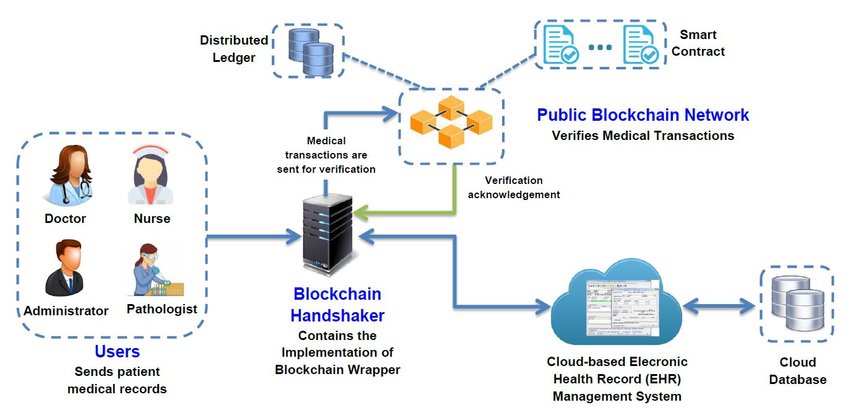
Blockchain technology can be used to create a secure, decentralized platform for storing and sharing patient data. Streamline clinical trials, research initiatives, and the authenticity of pharmaceutical and medical supplies.

One potential application for blockchain is the secure storage and sharing of patient data. In the past, there has been news of patient data being stolen within individual healthcare organizations, making it difficult to share information between providers.

This has resulted in inefficiency in healthcare delivery and has put patients at risk when records are not properly handled and updated. Most developing countries now lack centralized, up-to-date, paperless medical information about their patients. This has made it difficult for organized bodies to obtain concise data or information about the state of health in some countries. 

To achieve the United Nations Sustainable Development Goals by 2030, it is critical to find solutions that can help to address this issue, such as the use of blockchain as a means to save and protect users’ medical data.

Blockchain technology provides a decentralized system for storing and sharing patient data. This would enable the healthcare provider to obtain any information required at any time and from any location. It would also protect users’ data, which would only be accessible with the patient’s permission.

Furthermore, blockchain can aid in ensuring the authenticity of data collected during clinical trials and research. Clinical research data must be used to determine the efficacy of a new treatment.

Clinical trials are often complex and time-consuming to coordinate, but blockchain can help to streamline processes by providing a secure, decentralized platform where clinical trial data can be stored and shared.

The part that most leaders haven’t noticed is that blockchain can also help with medical supply chain authentication. Many counterfeit drugs have been sold on the black market, posing a serious threat to the public. Blockchain can aid in ensuring the authenticity of medical records. 

By providing tracking technologies powered by smart contracts and nodes, blockchain can help to ensure the authenticity of medical products.

This would ensure that patients receive safe and effective medications while also assisting in the fight against the sale of counterfeit medications.

Building a solution that lasts longer is what inspired the creation of HellthGO, a healthcare adherence provider with the goal of providing quality healthcare services to all individuals at all levels.

HellthGO would be able to reach all parts of Africa with services such as telemedicine, where notable and qualified medical professionals would provide the best healthcare services to all. 

HellthGO, in addition to telemedicine, is a social commerce platform where individuals and corporations can learn more about health care, first aid, cures, and healthcare adherence from renowned tutors, raising awareness about maintaining a healthy lifestyle and creating a safe and healthy world.

To make it easier for everyone to afford and access quality healthcare, HellthGO has decided to use blockchain technology to finance our users’ daily expenses and savings through a decentralized wallet that gives users total control over their funds while rewarding them for adhering to a health adherence plan. 

This allows our users to transact in both fiat and cryptocurrency and connects them to the HellthGO transchain, where their data is secure and shared in a blockchain-powered decentralized ledger, also assess a comfortable lifestyle where HellthGO provide home delivery of medical product and services through our dispatch partners.

Speaking of other strategies, HellthGO, a health technology startup leveraging blockchain, has developed solutions that work and provide accessible healthcare through telemedicine and more technology built to reward patients for being healthcare compliant.

At least 400 million people have no basic healthcare and more than 1.6 billion people live in fragile settings where protracted crises, combined with a weak national capacity to deliver basic health services, present a significant challenge to global health (UNDP). 

By digitalizing the healthcare industry using telemedicine and blockchain, we will be able to achieve good health and well-being for all by the year 2030.

This is the driving force behind HellthGo, the leading decentralized healthcare adherence solution working to achieve universal health coverage by 2030. That is, everyone has access to quality healthcare services, allowing for a reduction in mortality and morbidity rates in most African countries and improving access to healthcare for everyone, regardless of gender, age, religion, political affiliation, or geographical location, thereby increasing life expectancy.

MOST SEARCHED QUESTION 

What is the future of medical technology?

How blockchain technology is transforming the healthcare industry?

Which type of blockchain is used in healthcare?

MOST SEARCHED QUERIES

Web 3.0 healthcare

Blockchain in healthcare use cases

blockchain in healthcare research paper


Hello readers! Hope you liked what you read today. Click the like button at the bottom of this page and share insights with your colleagues and friends!

For more such amazing content follow Digilah

Categories
Web 3.0 Tech

Understanding Stablecoins

Written by Ganesh Kompella on Digilah (Tech Thought Leadership)

In the wake of recent crypto events, I feel it necessary to write an opinion piece on what stablecoins are, why they exist and what separates them from being good or bad. 

What is a stablecoin?

A stablecoin is a crypto asset pegged to a real-world asset’s value. 

Example: 1 USDT is always intended to be worth 1 US dollar. They hold their value relative to traditional currencies but, unlike the money in your bank account, they can be used freely on the blockchain. 

Similar to traditional currencies, these stablecoins can be used for buying, selling, sending, and lending within the crypto markets. 

In terms of timeline – USDT was the very first crypto stablecoin, then Circle introduced USDC, Binance introduced BUSD, Luna introduced the failed algo stablecoin UST and there are a bunch of others.  

How are they different from regular currency? 

Stablecoins are more cost- & time-efficient than the decades-old payment rails that the financial system relies on.

They are transferable 24/7/365 & are faster & cheaper to transact with than fiat. That’s why they continue to rise in popularity through bull and bear markets.

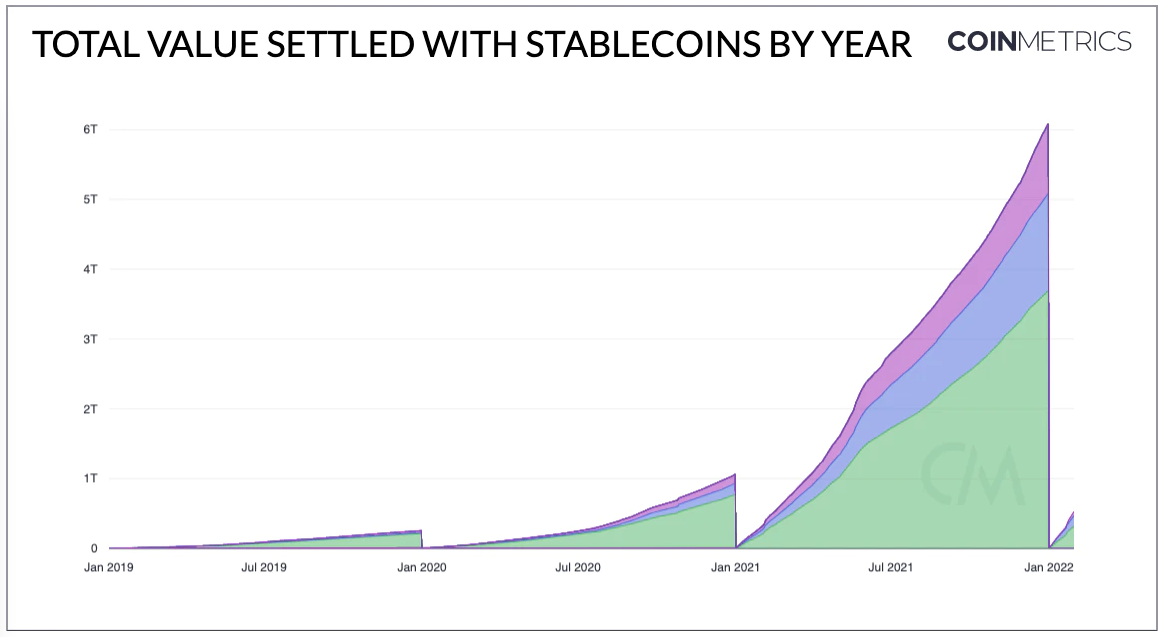
 In 2021 alone the total value settled with stablecoins was $6T, up 600% from its 2022 high of $1T. This graph from CoinMetrics sheds a light on how popular these are becoming.

Different types of Stablecoins

There are essentially three types of stablecoin designs:

  1. Fiat-collateralized 
  2. Crypto-collateralized
  3. Algorithmic 

The mechanics of each are different from one another as the names suggest, some are asset backed while some are code backed. They work very differently from one another and have distinctive pros and cons amongst themselves. 

Fiat-collateralized

Fiat backed stablecoins work very much like regular money market funds. You deposit your dollar with a stablecoin entity and get an equivalent amount of stablecoins in return.

Let’s take USDT (Tether) as an example.

A $100 deposit will get you $100USDT. You get the stablecoin and you are free to use it anyway you choose onto any of the blockchain networks that support tether. And the issuer puts your deposit to use and earns interest. With a crucial promise that you can always go back to the issuer, redeem your USDT for U.S.Dollars.

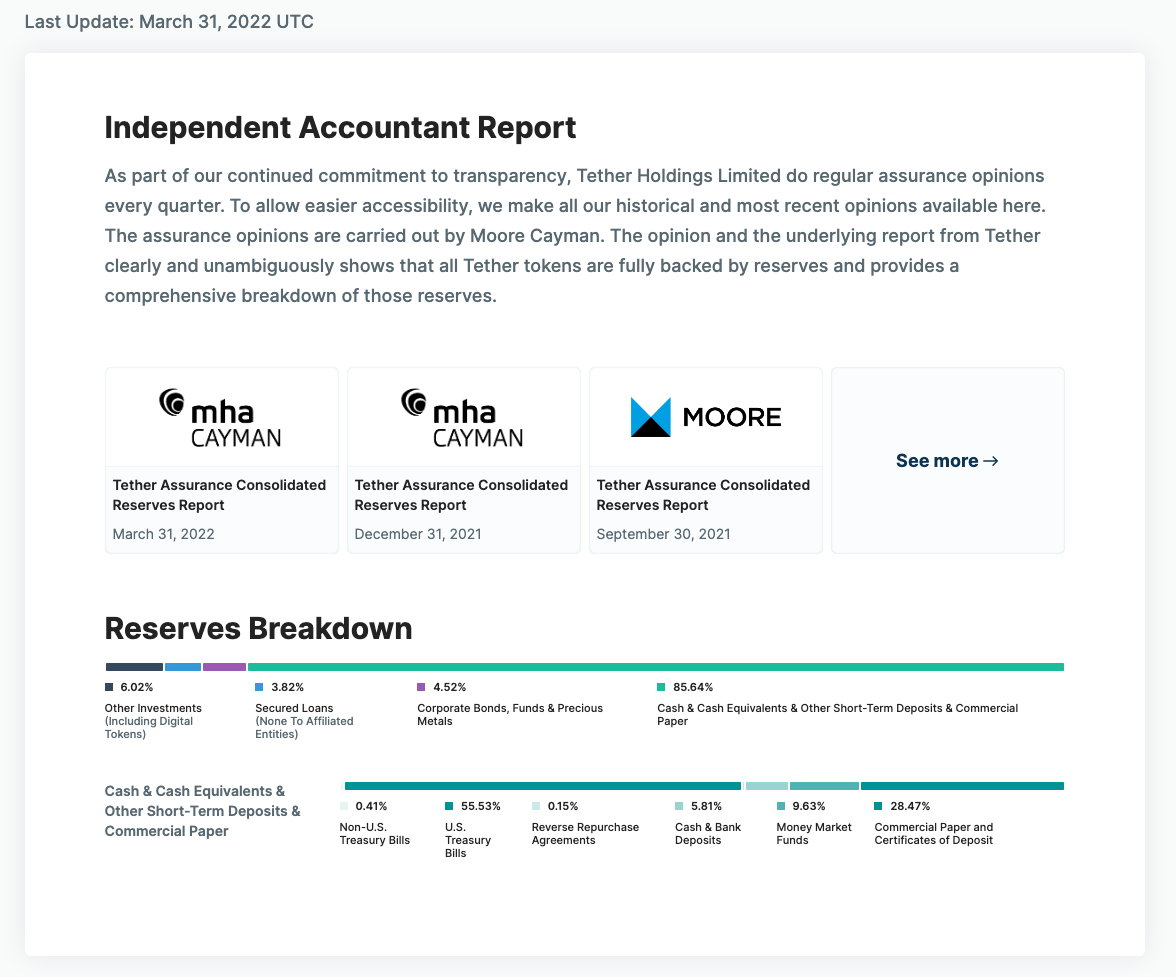
Diving into Specifics, this is how Tether manages their deposit reserves (Last reported on March 31, 2022). Your deposits turned reserves are mostly into Cash & Cash equivalent with some allocations into other asset classes like secured loans, corporate bonds, and digital tokens. These entities get audited from time to time. 

As an investor you must take notice of these audits, review them, and make an assessment on the issuer’s reserves. Strong reserves indicate they wouldn’t have any liquidity concerns in the event of a market crash or bank run.

Crypto-collatarized

Crypto-backed stablecoins operate more like traditional home equity loans. Investors deposit crypto with a decentralized issuer (usually a DeFi protocol), which issues stablecoins in exchange.

 The investor must repay the stablecoins (plus a fee) to redeem their crypto assets. The critical promise is that every crypto-backed stablecoin in circulation is directly backed by excess collateral.

 From a transparency perspective, the reserves can be audited & monitored by anyone in real time (including regulators). They just need to look on-chain. $DAI is an example of such stablecoin. It’s trusted by a huge community of crypto investors and developers

Algorithmic stablecoins

They are typically minted & issued by a DeFi protocol and are commonly under-collateralized (meaning they aren’t backed by an equivalent or excess amount of collateral). Instead, they mostly rely on an algorithm that aims to maintain a stable price by expanding & contracting the stablecoin’s supply. 

The intent is to influence interest rates and market behavior, which, in theory, ultimately return the stablecoin to its target price. The key promise is that the algorithm & incentive mechanisms work as promised, & the stablecoin maintains its peg through the issuance & removal of its supply.

The downside: The non-collateralized, algorithmic model keeps failing. Luna UST is one such example. 

Historically, the adoption of Fiat-collaraterized stablecoin has dominated this segment, with over 95% of the market share, some economists even call it “Smart Money”. 

What does the future hold? 

Stablecoins definitely have the potential to play a pivotal role in the global economy and the future of digital finance. 

Once we see central banks, regulators and the traditional financial sector starting taking notice which they already have. They could bring a host of benefits into this sector.
The pros of stablecoins are obvious: Low-cost, safe, real-time and more intuitive and competitive with what the consumers and businesses need today. 

They could rapidly change and make it cheaper for businesses to accept payment, for governments to run cash intensive programs and connecting the unbanked population.

MOST SEARCHED QUESTION 

What is the point of stablecoins?

Can you make money on stablecoins?

How many stablecoin are there?

MOST SEARCHED QUERIES

Stablecoins list

Best stablecoin

Is Bitcoin a stablecoin


Hello readers! Hope you liked what you read today. Click the like button at the bottom of this page and share insights with your colleagues and friends!

For more such amazing content like and follow Digilah

Categories
Edu Tech

Edumoms

Written by – Mona Sutrave on Digilah (Tech Thought Leadership)

Technology has been re-shaping and re-organising the economic dynamics of the world. The Internet brought about the revolution at the turn of the century.

Today, Technological advancement in almost all fields is NORMAL. Technology drives daily life. From a simple purchase of vegetables to complex algorithm driven activities. Technology has crept into our lives like we have never realised before.

Consumerism has shifted gears from a sellers’ market to a buyers’ market. While marketplaces created demand for products. Today, demand for a marketplace of convenience has brought the market place virtually to the customer. Making customers’ access products from different regions. Without having to travel the distance.

Education has its fair share in this technological revolution. The information available to the world at a click of a ‘mouse’ has been astounding. Just that one needs to access their relevant information with care.  

Online videos are in millions which speak about various topics. But little do they teach in a way a mother or a teacher would teach.  Content companies show content as they have understood a concept while in their college days.

The real challenge is how a young mind is wired? Does that young mind fire connections like a 25 year old? Does someone doing so make a school teacher obsolete? The Answer is a simple ‘NO’.

The growing years are so important in framing a personality. What one is at 10 is not the same as 14 and 16 and definitely not the same as while one is 25.  This goes on to prove that ‘ONE SIZE DOES NOT FIT ALL’. 

Each child is unique and each of their needs are certainly unique.  One needs to step into the mindset of the student and help them nurture their learning skills to adapt to the challenges. That One person, is the Teacher

A Teacher is not just educated, they are “QUALIFIED”. They understand every child in their class. They understand their abilities and Capabilities. They do not treat the child as a robot to max marks sheets.  They treat the child as a human being and help them with the abilities to form the very basis of LIFE SKILLS. The choice to PICK n CHOOSE.

DHII came into existence for the very fact that there were so many contents, videos, pdfs of chapters, but the whole personal touch was missing.  Kids are kids, they need to be nurtured, spoken to, cared and loved while teaching, which technology still hasn’t achieved.  It’s just not the topic which the kid is learning, but the whole universe around that particular topic, which only a teacher sitting across can bring it down.  

We at DHII believe in this very concept of teaching.  Help the students realise their true potential and enable them to experience the HIGH POINTS. We are available to the student through-out the duration of the course, in person. We proudly say, we just don’t teach subjects, but we BUILD CONFIDENCE.

We call ourselves, the new era EDU MOMS, simply because the first guru for any human being is a MOM. The affection which MOMs can give, can be compared to none! 

The onslaught of content companies camouflaged as edtechs are widening the gap by denying reasonable opportunities to the lower end of pool.  

We propose to take our ONLINE Teaching to Tier II and Lower areas, make quality education affordable to the aspiring students to cross the hurdle first.  Break the barriers of the regional languages and enable them to realise their dreams.

Technology is indeed making this possible. We have started this journey of providing customised education to the far and beyond corners of India with an initial investment. We now hope to achieve our mission with right investment opportunities sooner than we imagined!

most searched question?

Why education is the key to success?

What are 3 types of education?

What is the role of education in society?

most searched queries

Education importance

Education Department

Education Portal


Hello readers! Hope you liked what you read today. Click the like button at the bottom of this page and share insights with your colleagues and friends!

For more such amazing content follow Digilah

Categories
Sustainability Tech

IoT For Sustainability

Written by – Agrim Nagrani on Digilah (Tech Thought Leadership)

The current fast paced world is creating new opportunities for growth every day. With emerging technology and an interconnected world via IoT, there is always room to create a new market and provide solutions for growth of older ones to create a more technologically advanced society. 

The fourth industrial revolution, more commonly referred to as Industry 4.0, is characterised by the use of smart technology developed by a combination of Machine Learning, Artificial Intelligence, Cloud Computing and Internet of Things, to analyse data in order to increase efficiency and user satisfaction.

The creation of smart factories and machines, opens up a realm of possibilities, providing for solutions in Manufacturing, supply chain management, modernising enterprise applications, edge computing, smart systems, 5G and many more. 

What exactly is Industry 4.0?

In a most generic way, Industry 4.0 describes a rapid shift to the use of automation and data exchange in technology and manufacturing processes, creating a system where machines rely on wireless connectivity and data analysis to monitor and process statistics and data to make autonomous decisions.

With the availability of affordable edge infrastructure and advanced connectivity technologies, Industry 4.0 has become increasingly mainstream, taking hold of the traditional manufacturing system and   completely revolutionising it.  

Heavily dependent on IoT, ML and AI, it has paved a way for the next revolution, one guided by robotic automation.

Why is IoT important?

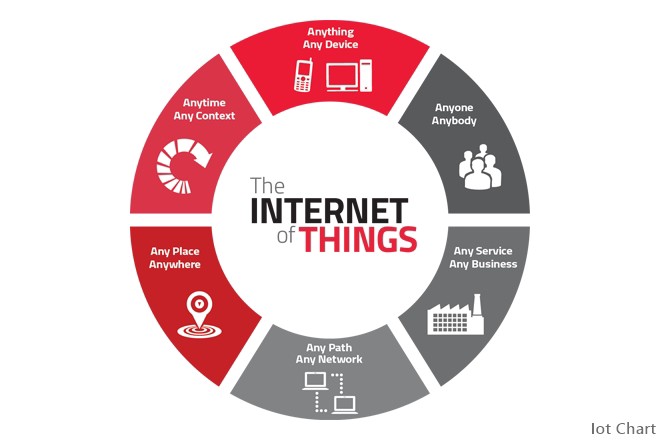
The internet of things (IoT) is a computing concept that describes the idea of the network of physical objects embedded with sensors, software, and other technologies being connected to the internet and being able to identify themselves to other devices.

The data from IoT is important as it creates an improved customer experience, with greater efficiency in production and optimised monitoring and data analyses to further industrial growth.

With the changing world, the need for novel solutions is now greater, with more focus being put on the future, especially a self-sustainable one. 

Businesses need to rebrand themselves, or prove themselves to be at the head of the change as reliable information providers in order to keep up with the flow of the tides.

IoT entrepreneurs need a wide range of vision to cater to the needs of the market, both the current and future, and as such the IoT businesses can be generally categorised as core, adjacent or transformational depending on the type of services it provides.

IIOT and Industry 4.0

Industrial IoT or IIoT takes the concept of IoT and applies it on large scale industrial settings with focus on instrumentation and control of devices using cloud computing.

Use of Machine-to-Machine communication to achieve wireless control was a pre-existing working concept, however, with use of cloud computing and machine learning, a new level of automation can be achieved, thus leading to unprecedented growth in revenue and creation of new business models. 

Some of the more common uses of IIoT are: 

  • Smart manufacturing
  • Smart power grids 
  • Smart cities
  • Smart digital supply chains

While IIoT and Industry 4.0 are separate concepts, they do benefit each other and are considered as a set piece when working to increase efficiency in operation via automation.

Industry 4.0 itself is non-existent without IIoT while the concept of IIoT is inefficient without the concept of Industry 4.0 and as such, they share several common agendas.

  • Focus on results and efficiency to streamline production process and make manufacturing viable and cost efficient
  • Both categories heavily depend on high speed wireless communication between smart machines and constant real time monitoring and data analysis.
  • People Driven and requiring constant development and implementation with people capable of interpreting data to further innovate on faster efficient processes

Benefits of IIoT

Maximising revenue – By eliminating unplanned downtime and getting to market faster, improve revenue growth

Lower operational costs – Interconnected machines and industrial data boosts productivity while lowering cost of production

Improved Quality – Market analysis and monitoring via an interconnected system improves efficiency and quality of service/product

Creating a Brand

With the vast domain that is IoT, it is difficult to find a niche to hold onto and create a business model surrounding it.

In order to keep up with the booming growth, there is a need for constant influx of novel ideas and sharing information in order to create a brand image that is credible and also due to the recent nature of all developments and a lack of general awareness, it may be difficult to provide both efficiency and sustainability.

This is where IoTAGI comes in, enabling access to technology and partnering with Industry 4.0 based service providers to curate customised IIoT solutions and help usher in a new era of digitization.

Most searched question 

How IoT can help sustainability?

How will IoT impact sustainability of environment or business?

What impact will IoT have on sustainability?

What is industrial IoT?

Most searched queries

IoT sustainability PDF

Internet of Things environmental impact

IoT for environment

Hello readers! Hope you liked what you read today. Click the like button at the bottom of this page and share insights with your colleagues and friends!

For more such amazing content follow Digilah

Categories
Security Tech

Protecting your personal data in times of uncertainty

Written by – Kiran Kari on Digilah (Tech Thought Leadership)

It has been couple of years since COVID-19 brought the world to a standstill. While countries are opening their borders for business and tourism, it wasn’t long ago that the world shut itself up in a cocoon. The pandemic brought a lot of good when the going was bad. The good was brewing in the human mind – innovation! Businesses and large enterprises have found new ways to engage, employees have found ways to be efficient and productive, and consumers have found creative ways to purchase and consume. 

In the pandemic, the consumer was wary about touching soiled currency notes, the interactive screen at the ATM, or share their credit/debit cards to make that necessary purchase. These are all high touch points in a daily life. The only way to overcome these challenges was through usage of mobile apps. Mobile apps provided us with the convenience of booking a taxi, ordering food or make payments without making physical contact with a third person. 

Like it is in any business, with every advantage comes the corresponding disadvantage. The use of banking and financial mobile apps was always certain to grow but, in the pandemic, it grew much faster than anticipated. No one expected the number of users accessing digital services would grow so fast, so soon and so exponentially high. With such high usage in digital payments also came the threat in the form of malicious actors or more commonly known as, hackers

Banks, wallet payments firms or any enterprise with a consumer facing mobile app need to protect their apps from the threat vectors emanating from their consumers devices. Similarly, the consumer must be equally responsible for their own data and privacy. The hackers are looking for ways and means to steal credentials, data, create fraud, take over accounts, change the behaviors of the apps, etc., all of which amount to huge losses to the business and the consumer alike. Hackers have access to very sophisticated tools to ‘mix and match’ their attacks. A lot of compromises to the consumer devices happen through sophisticated malware, screen overlay attacks, advanced jail break or rooting techniques, root enablers and reverse engineering.

There have been many instances of hacks and compromises across the world in the recent past and it will continue to make headlines. Most recently, the OCBC bank SMS scam in Singapore lead to huge losses to account holders and the bank was penalized heavily by the regulators. So, what can we do as consumers to keep ourselves safe?

It is a healthy practice to not only keep your mobile devices clean and safe but also be cautious about your surroundings. Some of the basic hygiene that you can follow is as below:   

Some of the basic hygiene that you can follow is as below:

  • To begin, don’t click on the links that come as text messages (or email) on any of your messaging platforms, especially when it is from an unknown source. This is the biggest reason for phishing attacks. Phishing scams look so real that you end up thinking its genuine.
  • Similarly, be wary of vishing attacks, wherein someone calls you, pretends to be from your bank or a government agency and have you share your critical data, OTP, et al. 
  • When in doubt, call your bank or the agency to verify the information. When you know it’s not true, register your complaint on the fake call you received. Be a good Samaritan. 
  • Never share your personal information with any unauthorized person. No legal entity will ask you to part with your personal data. 
  • There are many frauds happening on social media platforms including your messaging apps. Don’t fall prey for anything that looks too good to be true.
  • Always download apps from the authorized app or play store.
  • Do not jail break or root your mobile devices. 
  • Ensure that you have a well-known anti-virus installed on your phone that also checks for phishing attacks.
  • Never store critical info like passwords, bank account information, etc. on your mobile devices.
  • Spend some time educating yourself on cybercrimes.

In the current climate of uncertainty, it is impossible to predict what is going to happen next. But we know that the malicious actors are going to be a lot more active than ever before.

It is time for consumers to be data proactive and strengthen the security on their mobile devices. 

Most searched queries

Data protection methods

Data protection examples

Data security

Most searched question

What is data protection and why is it important?

What are 5 ways to secure data?

What measures should you take to keep data secure?

How are privacy and data protection related to each other?


For more such amazing content follow Digilah

Categories
Digi Tech

How Email Marketing Can Empower Your Business

Written by Sheenah Lozada  on Digilah (Tech Thought Leadership)

Let’s go back to memory lane. Imagine the day when there was no email. Most of the marketers rely heavy on traditional mail for advertising. These are in the forms of flyers, catalogues, promotional letters sent via snail mail and delivered by your favorite postman.

When I was growing up and now, my mom an avid fan of Readers Digest, and we always looked forward in the mail on a monthly basis for it to arrive. She has cooking book subscriptions as well that we are eager to receive and try out some of the recipes. 

The agony of waiting……… 

Thankfully today, it is very convenient in just few clicks you can subscribe to your favorite brands, cookbook, etc.  No more waiting… 

Email has tremendously transformed how many businesses can reach through their customers immediately and establish a rapport where they have the option to choose the content they want to receive.

Let’s dive in to know the History for Email Marketing 

1971 Ray Tomlinson sent the first email message which either said “Test 123” or the top row keys, “QWERTYUIOP”

1972 Larry Roberts created an email management database that let users list, select, forward and respond to email messages.

1978Gary Thuerk, a marketing manager at Digital Equipment Corporation, sent the first email blast to 400 Arpanet advertising machines. This generated $13 million in sales.

1982 Electronic mail message becomes the “EMAIL”.

1988Spam was introduced.  Inspired by those who are angry receiving email blast the word spam is added to the Oxford English dictionally. 

1989Lotus Notes 1.0, was launched as the first widely use email software service.

1991 – The internet was born. Everyone was using it. 

Late 1990s – Email service was introduced. Microsoft released Internet Mail (now Outlook) and Hotmail launched in 1998. The same time HTML was introduced to add characters to emails using custom fonts, colors, graphics and formatting.

2003 CAN-SPAM was introduced in the U.S, it was signed by President George W. Bush. This prompts businesses to reduce sending unsolicited emails and include sender details and unsubscribe link in every message.

2009 – The introduction of Responsive Emails which enables readers to use their desktop, smartphones, or tablet to access and read emails.

TodayEmail marketing is an integral part of the any digital marketing strategies that marketers are using to nurture their customer communication in the most cost effective way.

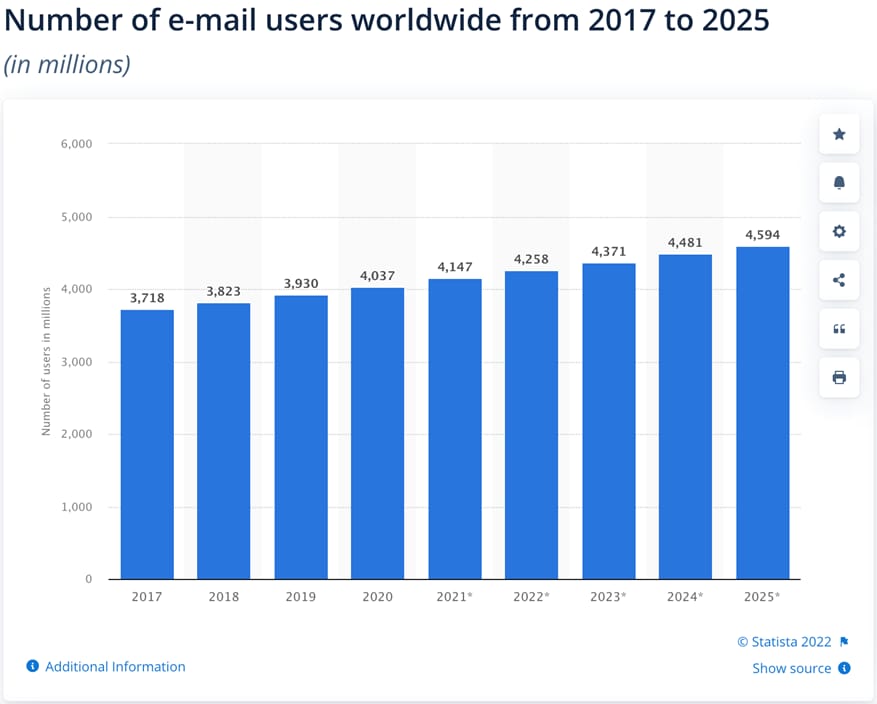
Source: https://www.statista.com/statistics/255080/number-of-e-mail-users-worldwide/

Despite the growth and prominence of mobile messengers and chat apps, email global users amounted to 4 billion and is set to grow to 4.6 billion users in 2025.

The global emails received and sent worldwide was approximately 306 billion in 2020. It is projected to increase to over 376 billion emails on 2025. This data shows that the trend towards mobile also is true for email.

As we know that the consumers interaction is multi-event and multichannel

These are some of the marketing strategies that you can invest with.

  • Inbound marketing
  • Content marketing
  • Email marketing
  • Search Engine Optimization(SEO)
  • Social Media
  • Paid Advertising
  • Mobile Marketing

One thing for sure is that email for marketing isn’t going anywhere. It will continue to be a staple part of any marketing strategy for all types of businesses.

COMMON SEARCHES:

Email marketing tools

Email marketing meaning 

Email marketing example 

Email marketing service

Email marketing examples 

Types of email marketing

Email marketing ideas

Email marketing benefits

WHAT PEOPLE GENERALLY ASK

What is email marketing and example?

How do businesses marketing?

What is an email marketing strategy?

What is email marketing and its benefits?

Categories
Mar Tech

Brands Digital Success

Written by Harshit Srivastava on Digilah (Tech Thought Leadership)

With the rapid increase of users on digital platforms has been a great opportunity for brands and organizations to get hold of their customers, interact with them, acquire new customers, take feedback, make improvements and the biggest benefit has been measurable results of marketing campaigns.

Starting from the beginning of the journey to the end goal of a brand, one can easily make a high converting funnel with expert guidance.

The most effective generic funnel has always been Brand Awareness —> Consideration/ Engagement —> Conversion

With the help of social platforms, we can reach out to people who are found mostly on digital platforms. According to a recent study, on an avg. the user spends around 147 minutes daily on social media. Now the best part has been that audiences on these platforms are scattered which gives us the advantage to target users on basis of their demography and behavior. Example: Young generation up to the age of 27 are more active on Instagram while the elder generation still prefers Facebook. This number isn’t a universal constant but keeps on changing depending on the country, geography, literacy, income, and various factors.

With the help of targeting options available for advertisers, we can target the right audience with the right content at the right time to achieve the brand goals.

With the help of remarketing campaigns, we can target the customers who have already been our buyers or shown interest in our ad in any form. It might be a scroll to the bottom of the page, Clicks, search on the website, add to cart, checkout, add a payment method, etc.

Differentiating all these audiences with different events, we can create and feed content accordingly. Thus, increasing the conversion rate.

There’s an ongoing debate if paid media is beneficial or organic –

To achieve the best results, both approaches should be followed simultaneously. Though all the platforms are somehow decreasing the organic reach and visibility of content. It’s advised that paid media should not be neglected at any cost.

While Organic media gives long-lasting results if carried out constantly for a never-ending time, Paid Media gives instant results at any point in time.

Some of the biggest mistakes that brands should avoid-

  • Irregularity in maintaining a digital presence
  • Not having a brand identity
  • Not following brand guidelines
  • Ignoring Content
  • Ignoring Paid Distribution of ads
  • Being Impatient

Concluding this article, marketing is all about creating a perception. The best is to create the right one. Maintain distance from unethical marketing tactics. It might give short-term results but in long run, you will end up losing the trust of your customers and among competitors.

You can contact me here – https://www.digitallyanalytical.com/contact-us

Categories
Digi Tech

Top 10 Secrets For A Good Website

Written by Paul Lim on Digilah (Tech Thought Leadership)

Today, we live in the world of the Web. It is common for companies to have websites and about 80% of consumers use the Internet to research on a business, product or service before making a purchase. But what if you do not exist on the Internet?

Establishing a web presence can prevent competitor from poaching your customers and simply setting up an appropriate company website can reel your target audience right in.

Websites can also improve customer service. As there is no downtime on the Internet, customers can be updated 24/7 and have their queries answered almost immediately. And what better way to provide them with value-added service than to share handy information on your website? Knowledge sharing is one method to connect with potential customers and eventually convert them into sales.

What is crucial is to build a website with the fundamental capabilities that garner and drive targeted traffic.  Here are 10 website to creating an ideal website to attract visitors and generate revenue.

1. Know Your Target Market 

The first step towards recognizing your target market is to have a proper understanding of the problems that your business tackle. Thereafter, identify the groups of people will be affected by these problems, these individuals will make up your target audience.

Make a list of your target audiences and group them accordingly to categories sure as profession, age, education levels, and gender. Find out how these groups of people may benefit from your products and services by questioning what they lack in their lives and meeting their needs where possible.

2. A Clear Navigation Bar

A clear navigation bar is a plus to any website. Choose simple names for the tabs on the navigation bar and the web pages – logical naming of both tabs and web pages should guide and direct visitors to a specific call-to-action.

3. About Us

The primary purpose of an About Us page is to inform the user about your company and what you do. The page should furnish visitors with the basic background information they need such as the company’s history, awards and achievements as well as social proof and authentic statements that can give your company image a boost.

4. Strong Headlines

There are millions of websites in the cyberspace competing for several keywords trying to be recognized as the first hit on search engines – but how exactly do you get people to read what you write?

Although good content and aesthetics are of great value to a website, a strong headline could give your website an edge over others. Pay special attention in crafting catchy and compelling titles for your headline and think out of the box to appeal to consumers and obtain the click-through.

Useful key words that trigger consumer action include Free, Discount, Guaranteed, Incredible Offer, 1-for-1 promotion etc. To truly persuade a visitor to constantly return to your website, use question words such as What, Why, When or How as visitors are often looking for answers to their various queries.

Take the subject “Driving A Car” for instance. 3 effective examples are:

  • “How to drive a car?”
  • “Why I Love Driving A Car?”
  • “10 Ways to drive a Car safety”

5. Integrate Social Media & Videos

Using Social Media and embedding videos in your content can direct traffic to your website on a regular basis. The inbound links to your website from high-profile social media platforms such as Facebook, You Tube, Twitter, Tik Tok and others will increase your search engine results page ranking.

Consider creating the following social media profiles:

  • Linkedin – A professional site to showcase expertise and reach out to potential clients based on skills set
  • Twitter – A social sharing platform where you can post relevant tips and information with links to corresponding articles on your website
  • You Tube – Upload short yet succinct videos to demonstrate useful tutorials and give advice to

Always include a link back to an appropriate landing page on your own website and ensure you include a call-to-action on the page, for instance “Retweet” or “Share this video”

6. Power Pictures and Graphics

Simplicity and succinctness are key in creating messages that are straightforward to understand. People are often impacted visually than textually; hence good graphic designs and images are more effective in engaging site visitors compared to text alone. A dynamic picture can drive higher consumer engagement which can lead to higher sales figures.

7. Provide Impressive Testimonials

Positive and impactful testimonials are excellent for boosting site traffic. If you are in the service industry that replies on customer service and referrals, positive and impactful testimonials that appraise your company’s services will drive greater traffic to your site. For instance, an outdoor event service business could have client testimonials about the excellent service delivery and efficiency.

8. Order Page

The main goal of any e-commerce website is to convert visitors to buying customers. The order confirmation page is usually called a ‘Thank You’ page.

It is only right to thank your customers each time they complete a payment and more importantly, it helps you to maintain healthy relationships and interaction with them, thereby increasing their returns to your site.

9. An Opt-in Box

The use of personal data is a sensitive issue today-companies need to gain consumers’ approval with regards to collection, storage, usage and distribution of their information. Using an individual’s data without approval can put an organization in trouble. Hence, providing an “opt-in” box for users will allow them to indicate their consent and method of contact from the company or organization, thereby recording their decision.

10. Contact Us

Any business that strives to engage its target audience needs to have a feedback channel where those interested in the company’s services or business can contact the relevant people for more information. Sign up for a customized domain email address and phone number and make sure you attend to your calls and answer your emails promptly.

Contact for more www.pauldigitaltraining.com

Categories
Law Tech

Law (Taxes and Trade) – The future is tech and trust

Written by Parul Vivek on Digilah (Tech Thought Leadership)

The cross-border trade and tax landscape globally has been undergoing exponential changes. With dynamic geopolitical situation, ever evolving regulations and introduction of new compliance requirements, increasing levels of enforcement is needed to achieve the multiple objectives of legitimate revenue collection, ease of doing business, trade facilitation, while ensuring hassle-free compliances. And technology is playing an enabling role to move from a more control-based tax and trade regime to a trust-based future.

Stewart Brand [i]once said “Once a new technology rolls over you, if you’re not part of the steamroller, you are part of the road”. Hence, government authorities are proactively embracing advanced analytical technologies such as big data, data analytics, artificial intelligence, and machine learning as they see clear benefits with regard to increased transparency, risk management, fraud detection, trade facilitation, mutual co-operation and greater compliance. These trends are expected to increase as countries around the world continue to implement the Organization for Economic Co-operation and Development (OECD)’s Action Plan on Base Erosion and Profit Shifting (BEPS) [ii]and its requirements for more transparency in corporate tax reporting. Further, there is an increased collaboration between various multilateral agencies/ governments across the globe in exchanging of information via IT equipped databases, automated tools, etc.

In India, the technology led regulatory reforms have played a positive role in the field of both direct and indirect taxes, including customs, as well as policy making. Implementation of the landmark Goods and Service Tax (GST) in 2017 is one of the biggest examples of such reform. The direct tax arena has also seen an early adoption of technology. Additionally, introduction of faceless assessments of import and export entries under customs, integration of courier and cargo systems under one national customs portal ICEGATE[iii] and may other such initiatives in the pipeline clearly demonstrate government’s efforts and push towards digitization.

Even post the roll-out of GST, several forward-looking measures such as e-returns, e-registrations, e-way bills, e-invoicing, and QR codes, have been implemented by the government, which mark important milestones in India’s digitalization journey. As an outcome, India has witnessed an all-time high GST revenue collection from October 2020 onwards. In the recently released collection figures, the Finance Ministry revealed that the provisional net indirect tax collections [iv]for financial year FY2020–21 recorded a growth of 12.3%; 108.2% of revised estimates of indirect taxes for FY2020–21 has been achieved. This is a big win and testimony to the fact on how embracing technical tools can help achieve more legal compliance and revenue targets.

Another notable tech-based initiative by India Finance Ministry as part of its strategic commitment to improve global trade has been the conducting of national Time Release Study (TRS) [v]started in Aug 2019 and institutionalized on an annual basis.  It helps to diagnose existing and potential bottlenecks which act as barriers to the free flow of trade and take remedial actions for reducing the cargo release time at various Indian ports (sea ports, air cargo completes, inland container depots, etc.).

There is no doubt that technology and law have a complicated interrelationship. As a matter of fact, advancement in technology is almost always expected to outpace law making as seen recently with introduction of crypto currencies, electric vehicles, digital payment platforms, social media platforms, wherein the regulators worldwide are still struggling to define legal boundaries. But on the other hand, technology is helping in better implementation of law by giving more feedback to legislature. In addition, technology is redefining the legal field. Online research databases have replaced law books, digital contracts have replaced physical copies, and numerous other advancements are helping to simplify complex legal world. New technologies hold significant potential to support policymakers in law making, legal analysis and enforcement.  As Andy Grove [vi]once said Technology will always win. You can delay technology by legal interference, but technology will flow around legal barriers”.

And as government authorities embrace digitalization, it’s never been more important for individuals and companies to understand every detail of their online stories, both personal and professional (including those on Instagram too) 😊.


[i] Stewart Brand is an American writer, best known as editor of the Whole Earth Catalog.

[ii] Base erosion and profit shifting (BEPS) refers to tax planning strategies used by multinational enterprises that exploit gaps and mismatches in tax rules to avoid paying taxes

[iii] Indian Customs EDI Gateway

[iv] Source: Published by Ministry of Finance April 2021

[v] The TRS is an internationally recognized tool advocated by World Customs Organization (WCO) to measure the efficiency and effectiveness of international trade flows. Read the latest at https://www.cbic.gov.in/resources/htdocs-cbec/implmntin-trade-facilitation/national-time-release-study-2022.pdf

[vi] Andrew Stephen Grove was a Hungarian-American businessman, engineer, and CEO of Intel Corporation.

Categories
HR Tech

Mastering Your Personal Productivity

Written by Shyvee Shi on Digilah (Tech Thought Leadership)

As a product manager working in tech, I constantly face the challenge of operating at a high-capacity, managing multiple projects, clearing roadblocks, running back-to-back meetings, and building long-term strategies while living a healthy and joyful life. Staying productive is critical to career and life success.

Many people in my network ask me, “How do you stay productive?  How do you have it all?” While there’s no one-size-fits-all some answers can be found below :

01. Mindsets

“Everything begins inside your mind. With the right mindset, you will succeed.” — Tony Horton

I start with defining what personal productivity is and things to be mindful of when it comes to being and staying productive. 

1️⃣ Productivity is quality of life. It is NOT about doing more and staying busy. It’s about achieving more with less. 

2️⃣ Productivity is to manage time. Timebox your tasks and don’t let work expand to fill your time. 

3️⃣ Productivity is a constant rebalancing exercise. Being productive might look different each day.

4️⃣ Productivity is about making intentional choices. Commit to what works for YOU and make peace with letting go of the rest. 

02. Principles

“I think it’s important to reason from first principles rather than by analogy.” — Elon Musk

What are the fundamental truths of personal productivity? How may you apply first principle thinking to staying productive? 

1️⃣ Be intentional. It’s not about ‘what can I accomplish?’ but ‘what do I want to accomplish?’

2️⃣ Focus. Focus. Focus. Good things happen when you narrow your focus.

3️⃣ Action > Perfection. Making progress is more “productive” than being perfect.

4️⃣ Iterate. Finding your productivity system is an iterative process. Try different things and see what works best for you. 

5️⃣ Create leverage. Find high-leverage activities that will produce outsized results. Make 1 decision to save 1,000 decisions.

03. Systems

“Productivity is never an accident. It is always the result of a commitment to excellence, intelligent planning, and focused effort.” — Paul J. Meyer

You don’t have to wake up at 4:30am everyday to be productive. Productivity is a lifelong commitment to finding what works for you. There is no universally perfect productivity system; you must be willing to experiment and get ready to mix and match different systems!

1️⃣ Have a system to capture and organize information as it comes in. Capture everything and then organize it – task backlogs, project trackers, intentions list, daily to-dos. Do what works for you.

2️⃣ Use the 2×2 Eisenhower Matrix to decide if you should do, delete, delegate, or defer a task. 

3️⃣ Learn to manage your day based on your energy chart and your bio clock, not just the clock on the wall.

4️⃣ Make rest and recharge part of your productivity system. The best way to stay productive involves stopping along the way.

04. Tactics

“The way to get started is to quit talking and begin doing.” — Walt Disney

Below we shared a set of productivity tactics that have worked well for us. There are hundreds more out there, and you will need to find out what works for you through trial and error. 

1️⃣ Block time on your calendar for your to-dos. This not only brings clarity to WHAT to do, but also to WHEN to do it.

2️⃣ Audit your time to be more aware of whether how you spend your time aligns with what you value in life. Bundle this with a weekly reflection to set intention for the following week.

3️⃣ Learn to set boundaries and say a clear no without feeling guilty.

4️⃣ Apply the Yes! No. Yes? Model to articulate what we want, protect what we value, and stand up for everything and everyone that matters to us.

5️⃣ Maintain a Not-To-Do list to stay focused and avoid falling into the “completion urge” trap.

6️⃣ Batch process your emails and Slack messages to reduce “switching costs” and take control of your schedule. 

 7️⃣ Invest time in delegating and shift your thinking from “how and what” to “why, when, and who” to empower others to learn and grow.

8️⃣ Decide if a synchronous meeting is needed and how to run productive meetings with a clear sense of purpose and closure.

To conclude, being productive may look different each day. Be intentional about how you spend your time and continuously improve your systems and tactics to find what works for you! 

If you want to learn more about how to apply these concepts, here is a link to my latest course https://www.linkedin.com/learning/personal-productivity-for-product-managers

I look forward to hearing from you and wishing you luck in mastering your personal productivity!